
In the digital age, processing and analysis of tabular data has become particularly important. However, many tabular data still exist in unstructured forms, such as scanning statistical table pictures in documents and financial report data in PDF files. This data cannot be processed directly and automatically, posing a huge challenge to data analysis and document understanding. In order to solve this problem, Baidu AI announced the open source new representative recognition solution PP-TableMagic on March 11, which has brought a major breakthrough in the field of table structured information extraction.
The launch of PP-TableMagic aims to solve the limitations of traditional table recognition technology in complex scenarios. Through the innovative multi-model networking architecture, this solution realizes high-precision end-to-end table recognition and supports highly customized model fine-tuning for all scenarios. Traditional general table recognition models often perform poorly when facing complex table formats and are difficult to meet the needs of different application scenarios. To this end, Baidu PaddlePaddle team launched PP-TableMagic, which adopts a multi-model tandem networking scheme of "table classification + table structure recognition + cell detection", which significantly improves the accuracy and adaptability of table recognition.
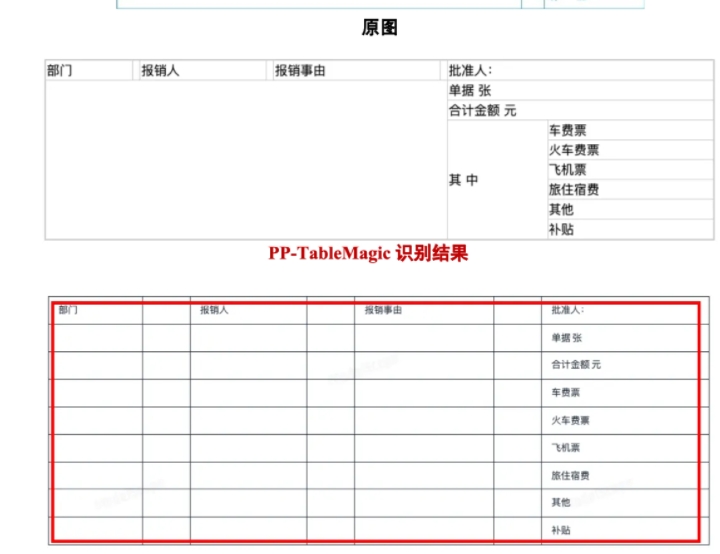
The core advantage of PP-TableMagic lies in its innovative architectural design. This solution adopts a dual-stream architecture, divides tables into two categories: wired tables and wireless tables, and then disassembles the end-to-end table recognition task into two sub-tasks: cell detection and table structure recognition. Finally, a complete HTML table prediction result is generated through the self-optimization result fusion algorithm. Among them, the lightweight table classification model PP-LCNet_x1_0_table_cls developed by the PaddlePaddle team can classify wired tables and wireless tables with high accuracy; the industry's first open source table cell detection model RT-DETR-L_table_cell_det realizes the precise positioning of table cells of various types; while the new representative grid structure recognition model SLANeXt performs excellent in table HTML structure analysis. Compared with the previous models SLANet and SLANet_plus, SLANeXt uses Vary-ViT-B with stronger feature representation capabilities as a visual encoder, further improving the accuracy of table structure recognition.
In practical applications, PP-TableMagic can not only directly process tables, but also meet the needs of different scenarios through customized model fine-tuning. Compared with the fine-tuning of traditional end-to-end table recognition models, PP-TableMagic's multi-model networking architecture allows users to fine-tune only key models, thus avoiding the performance problem of "one rises and the other falls" and reducing the workload of data annotation. In addition, for senior developers, PP-TableMagic's architecture also supports branch-level adjustments, which can be optimized for specific types of table data, further improving overall recognition capabilities.
To help users get started quickly, PP-TableMagic provides detailed installation guides and usage tutorials. Users can easily call models through the Python API provided by PaddleX, perform table recognition and result export. In addition, PP-TableMagic also supports high-performance inference, service-based deployment and end-side deployment, which can meet the needs of different users. Baidu PaddlePaddle Team also plans to hold an online course on March 13 to deeply analyze the technical details of PP-TableMagic and open an industrial scenario practical camp to lead the user to experience the complete development process from data preparation to model deployment.
Open source address: https://github.com/PaddlePaddle/PaddleX/blob/release/3.0-rc/docs/pipeline_usage/tutorials/ocr_pipelines/table_recognition_v2.md