
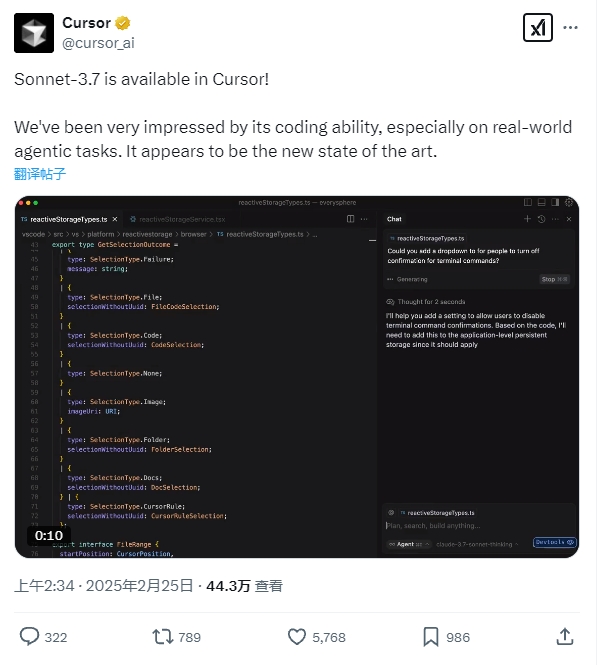
Recently, Cursor AI announced a major update that successfully integrated the Claude 3.7 Sonnet model and optimized the user interface to make it more concise and easy to use. This update not only improves the user experience, but also introduces a cross-chat conversation function, which can automatically summarize chat content and inherit it into a new chat window, greatly improving work efficiency.
Claude 3.7 Sonnet is the latest inference model launched by Anthropic, which quickly became the focus of the industry with its innovative design philosophy and excellent programming capabilities. The core innovation of the model lies in the combination of quick answers with deep thinking ability to simulate the way the human brain thinks and provide users with a smoother and more natural interactive experience.
In practical applications, Claude 3.7 Sonnet provides two modes for users to choose: standard mode and extended thinking mode. Standard modes provide answers quickly, while extended thinking modes allow the model to reflect on itself before answering, especially for complex tasks such as mathematics, physics, and programming. Through the API, users can also accurately control the model's thinking budget, up to 128K tokens, thus finding the best balance between speed, cost and answer quality. Unlike traditional competition-based models, Claude 3.7 Sonnet focuses more on practical commercial applications and is committed to providing users with practical solutions.
In the field of programming, the Claude 3.7 Sonnet is particularly outstanding. In one programming test, Sonnet led the way with a high score of 70.3% for other well-known models, such as OpenAI's o1, o3-mini and DeepSeek R1, which scored only around 49%. This result shows that Anthropic intends to position Sonnet as a powerful coding AI, focusing on improving programming capabilities to meet developers' needs in complex code base processing and full-stack updates.
Currently, Claude 3.7 Sonnet is fully launched, supporting free, professional, team and enterprise versions, and can be used on Anthropic API, Amazon Bedrock and Google Cloud's Vertex AI. However, free users cannot use the extended thinking mode for the time being. In terms of pricing, Sonnet 3.7 is consistent with the previous generation model: $3 per million input tokens and $15 per million output tokens, including thinking tokens.
In addition to the significant improvement in programming capabilities, the Claude 3.7 Sonnet also demonstrates outstanding performance in other fields. For example, in the TAU-bench test, Sonnet achieved an accuracy of 81.2% in the retail scenario and 58.4% in the aviation scenario, leading the other models in general. In addition, Sonnet has performed well in instruction understanding, reasoning ability, multimodal processing and code writing, especially after opening the extended thinking mode, its performance in mathematical and scientific problems has improved by leaps and bounds.
Overall, the release of Claude 3.7 Sonnet marks another major breakthrough in AI technology in the field of reasoning and programming. Whether it is a developer, a company or an ordinary user, you can benefit from it and experience more intelligent and efficient AI tools.