
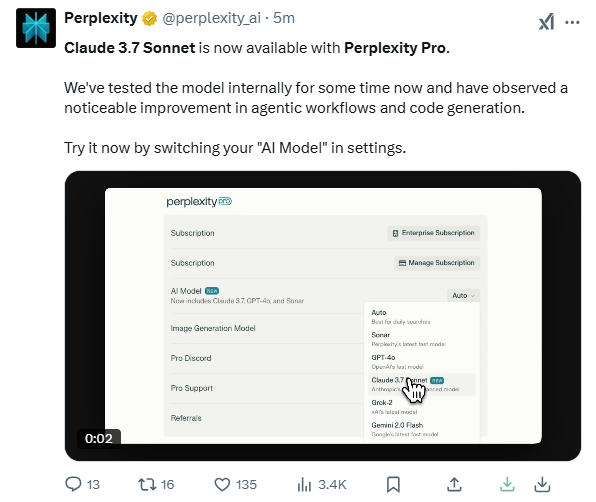
Artificial intelligence search platform Perplexity recently announced that its Pro version has successfully integrated the latest Claude 3.7 Sonnet model released by Anthropic. This news has attracted widespread attention in the technology community, especially in the fields of artificial intelligence and machine learning. The latest news released by Perplexity on the X platform shows that the company has conducted internal testing of the model for weeks, and the results show that it has made significant progress in its proxy workflow and code generation capabilities.
Perplexity details this new feature in a tweet: "Claude3.7Sonnet is now available with Perplexity Pro. We have tested the model internally for some time and have observed its significant improvements in proxy workflow and code generation. Now, users can experience this new feature with the 'AI Model' option in the settings." Users simply update to the latest version and select Claude3.7Sonnet in their app settings to get started with this powerful new tool.
User feedback on X platform further proves this news. User @aigclink posted earlier that day that Claude3.7Sonnet is Anthropic's first hybrid inference model, supporting instant response and detailed step-by-step thinking presentation, and significantly improving performance in tasks such as mathematics, physics, instruction understanding and programming. The flexibility of this model has also attracted attention, with users getting quick answers through standard modes or enabling extended thinking modes to handle more complex tasks.
As an AI-powered search and question-and-answer platform, Perplexity's rapid integration of Claude 3.7Sonnet shows its keen sense of the latest technologies and efficient execution of technological updates. Industry insiders pointed out that the addition of this model is expected to further enhance Perplexity Pro's competitiveness in complex query processing and code-related tasks. Pro users can now experience this upgrade through the official website or in-app settings to explore their potential in actual applications.