
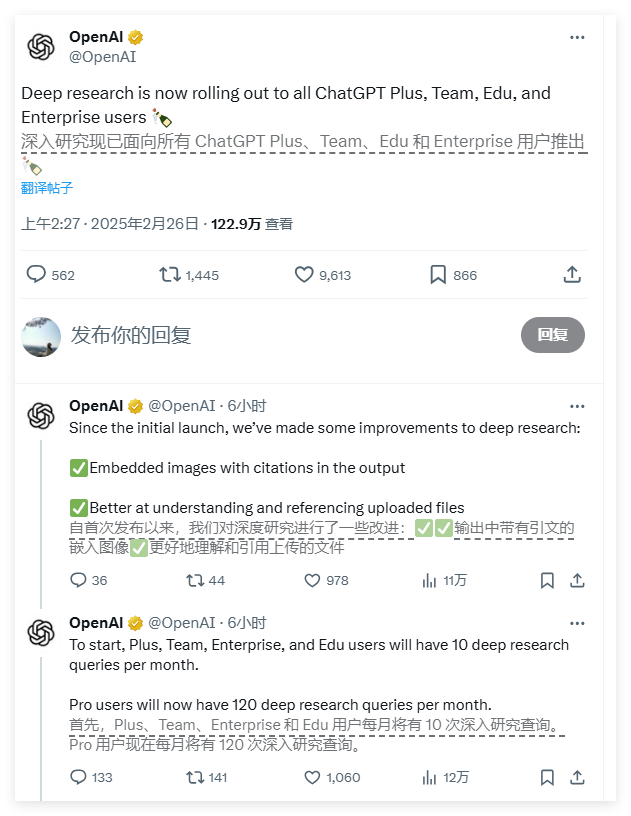
OpenAI recently announced a major update to fully open its Deep Research capabilities to ChatGPT Plus, Team, Education and Enterprise users. This feature is hailed by the industry as the most revolutionary AI assistant upgrade since the launch of ChatGPT. According to the official announcement, these users will receive 10 in-depth research query permissions per month, while Pro users enjoy the privilege of 120 inquiries per month, further enhancing their use value.
The core of the in-depth research function is that it adopts the upcoming o3 model of OpenAI, which significantly improves AI's performance in complex research tasks. Unlike traditional chatbots that only provide instant responses, in-depth research can independently search hundreds of online resources, analyze multiple data types including text, images, and PDF files, and generate detailed reports similar to those written by professional analysts. This capability makes AI more efficient and accurate in dealing with complex problems.
At the same time, the global competitive landscape in the AI field is also changing rapidly. China's DeepSeek has become a new competitor. They openly sourced the DeepSeek-R1 model through the MIT license, directly challenging OpenAI's subscription-based business model. Unlike OpenAI's payment strategy, DeepSeek adopts an open source approach, attracting more developers and enterprises to participate, further promoting the popularization and application of AI technology.
This kind of market competition is not only reflected in the technical level, but also reflects the collision of different technical concepts. In addition to OpenAI and DeepSeek, Anthropic's Claude3.7Sonnet also gained a foothold in the market through an inference process that emphasizes transparency. Perplexity has integrated DeepSeek-R1 into its research tools to provide services at more competitive prices, further verifying the market potential of open technology.
OpenAI founder Sam Altman mentioned when announcing the in-depth research feature that the technology “may be worth $1,000 per month for some users,” which fully reflects the diversity of its technological value. To protect the benefits of the high-end market, OpenAI has restricted free users, allowing only two queries per month, while Plus and Pro users enjoy different queries quotas to ensure the attractiveness of their high-end products.
In-depth research performed particularly well in the "Last Exam for Humanity" benchmark test, with an accuracy rate of 26.6%, far exceeding other competitors. This achievement not only demonstrates its advantages in improving efficiency, but also reveals its potential in collaborating with human experts. When integrating in-depth research technology, enterprises need to re-examine their information workflows and explore more efficient application methods to fully utilize their value.
Overall, OpenAI's in-depth research capabilities expansion has brought new changes to the field of AI assistants, while DeepSeek's open source model has injected new vitality into the industry. This competition between technology and business models not only promotes the advancement of AI technology, but also provides companies with more choices, prompting them to rethink how to optimize information processing processes to meet future challenges.