
Recently, Google officially launched its latest economical AI model, Gemini2.0Flash-Lite, and announced that the model has entered the production stage. As part of the Google Gemini series, Gemini2.0Flash-Lite has become the first choice for developers in AI solutions for its cost-effectiveness positioning. The model is currently available on the Google AI Studio and Vertex AI platforms, and is designed to power developers who need efficient and low-cost AI tools.
Gemini2.0Flash-Lite's design philosophy is centered on lightweight and is especially suitable for teams and startups on a budget. When dealing with large-scale text output tasks, the model performs well, meeting the needs of high-frequency tasks while maintaining low costs.
In terms of pricing, Gemini2.0Flash-Lite demonstrates its market competitiveness. The price of input tokens is $0.075 per million, and the price of output tokens is $0.30 per million. Compared with OpenAI's GPT-4o-mini (input $0.15/million and output $0.60/million), Gemini2.0Flash-Lite is cheaper, providing developers with a more attractive option.
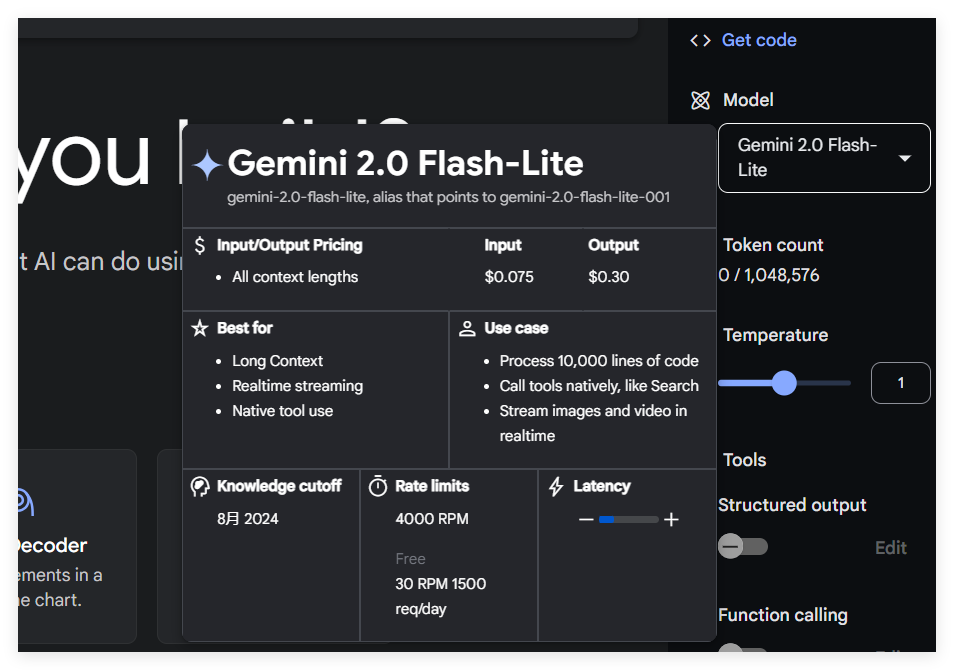
In terms of performance, Gemini2.0Flash-Lite inherits the excellent genes of the Gemini series, with a context window of up to 1 million tokens, which can process a large amount of data. In most benchmarks, the model outperforms Gemini1.5Flash while maintaining the same speed and cost, especially suitable for task scenarios that require high frequency processing.
Although Gemini2.0Flash-Lite supports multimodal input, it does not support image or audio output compared to 2.0Flash, nor does it have advanced features such as "Search as a Tool" or "Code Execution as a Tool". This makes the model more focused on text generation tasks and is suitable for application scenarios where fast and low-cost solutions are required. For example, the model can generate single-line titles for about 40,000 photos, costing less than $1, fully demonstrating its efficiency in practical applications.
Google's launch of Gemini2.0Flash-Lite is seen as an important step in its AI strategy, especially in fierce competition with competitors such as OpenAI and Anthropic. By providing cost-effective AI tools, Google further consolidates its influence in the AI field and provides developers with more options.