
Today, we will explore the latest developments in China's artificial intelligence (AI) field in the first quarter of 2025. If you still think that China's AI is struggling to catch up with the United States, then this report "Artificial Analysis: State of AI: China Q12025" will completely overturn your perception. China's AI has transformed from a "student" to a "competitor", and this transformation is eye-catching.
In 2023, China's AI is still working to narrow the gap with the United States, but by the end of 2024 to the beginning of 2025, this gap has narrowed significantly. Here are some shocking data: DeepSeek's R1 model intelligence index hits 89, almost the same as OpenAI's o1 model (94). In addition, seven AI laboratories in China have launched cutting-edge models with reasoning capabilities, and technology giants such as Alibaba, ByteDance, Baidu, Tencent, and Huawei have also launched their own AI model series. These data fully prove that the rise of China's AI is not empty talk, but a tangible achievement.
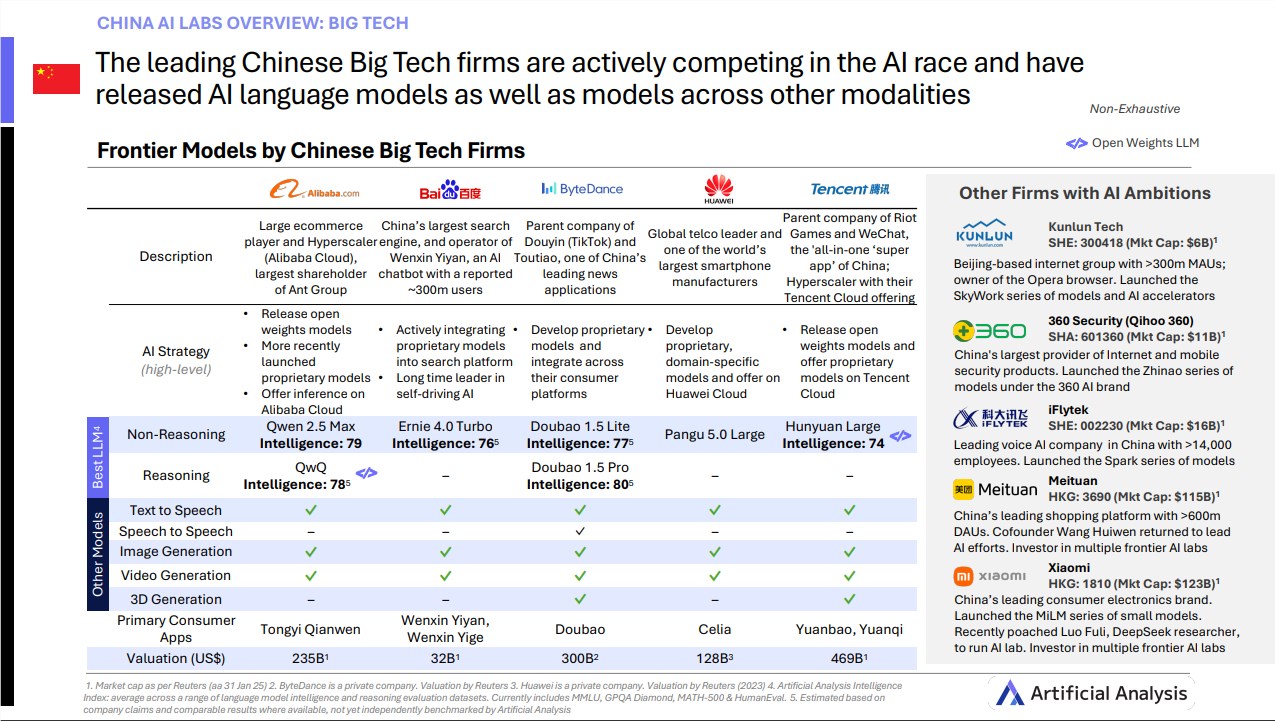
The rise of China's AI is inseparable from the promotion of many key players. Alibaba has launched the Qwen series models, with the Qwen2.5Max's intelligent index reaching 79 and the QwQ inference model reaching 78. Baidu has made significant progress in the deep integration of AI and search platforms through the Ernie 4.0 Turbo model (intelligent index 76). ByteDance's Doubao1.5Pro model intelligent index is as high as 80, demonstrating its technical strength in the field of short videos. Huawei focuses on domain-specific models and provides services on Huawei Cloud. Tencent launched the Hunyuan Large model (Smart Index 74) and is committed to creating an open source weight model.
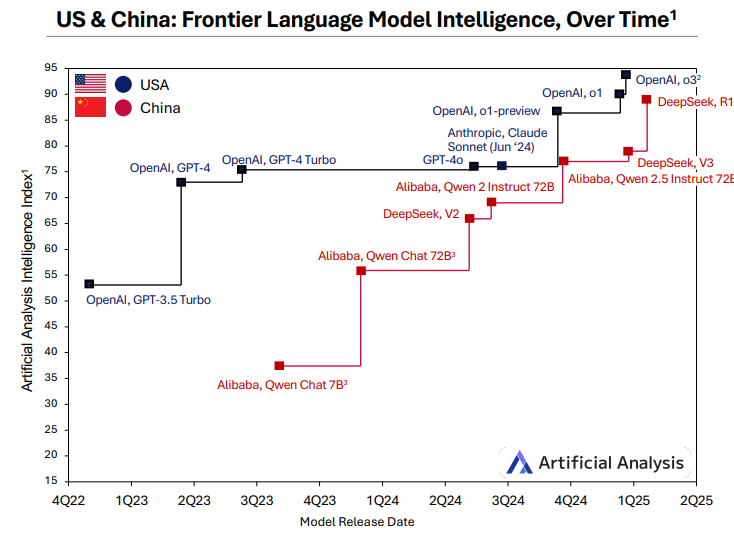
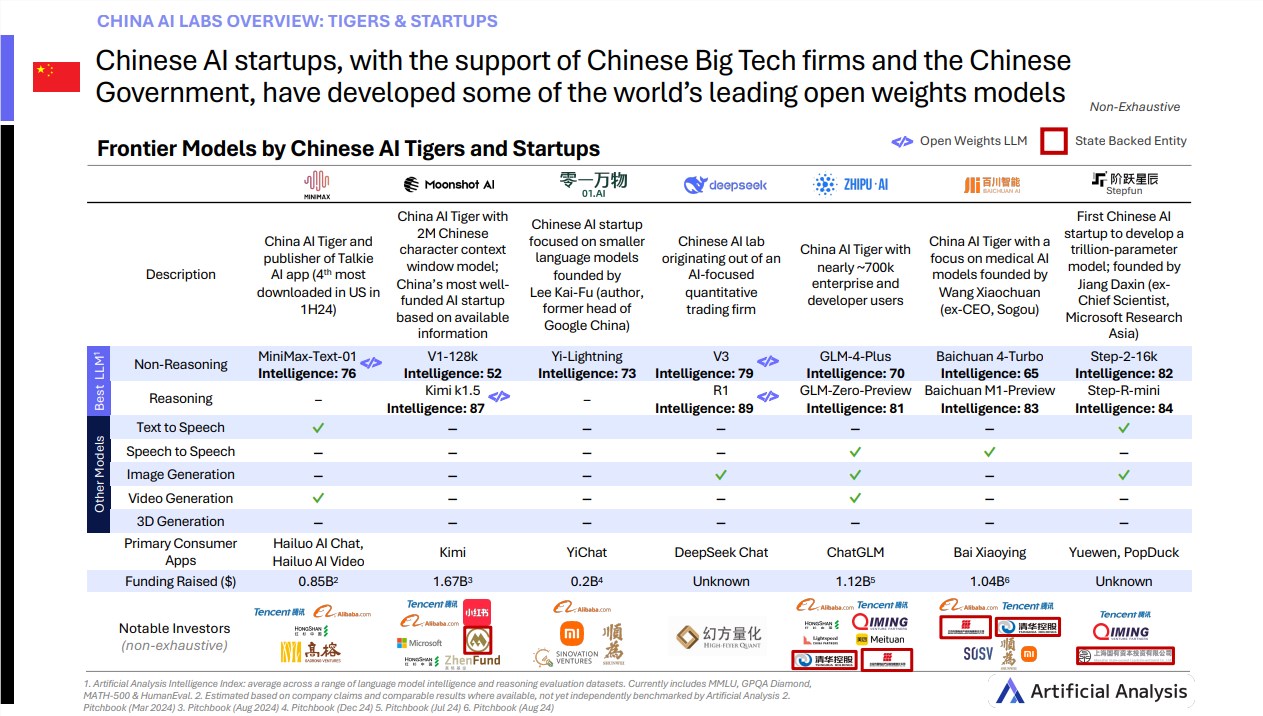
In addition to these technology giants, a number of AI upstart companies are also rising rapidly. DeepSeek's R1 model intelligence index reaches 89, surpassing many American models. MoonShot AI, as a super unicorn that raised $1.67 billion, has a Kimi k1.5 model intelligence index of 87. Zhipu's GLM-Zero-Preview model intelligence index is 81, with nearly 700,000 enterprise and developer users. Baichuan was founded by Wang Xiaochuan, former Sogou CEO, and its M1-Preview model intelligence index is 83. Stepfun is the first AI startup in China to develop a trillion-parameter model, with its Step-R-mini model intelligence index of 84.
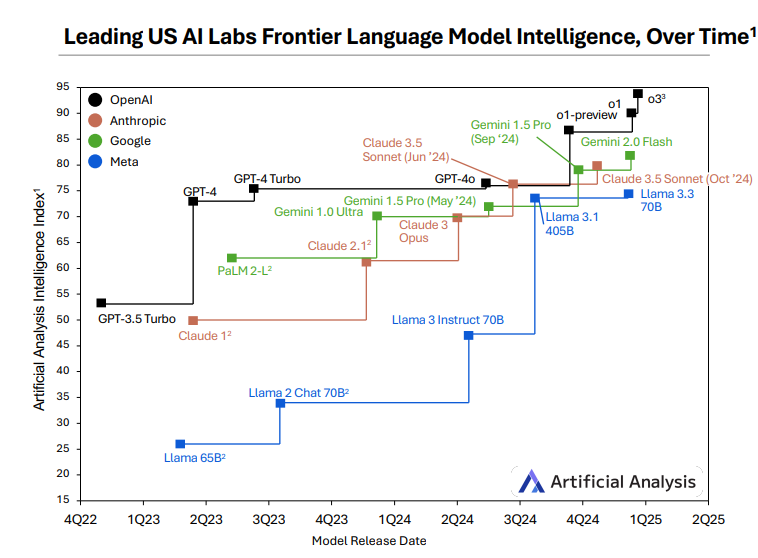
The development history of China's AI can be regarded as a history of "not giving up" struggle. From 2022 to 2023, when OpenAI launched GPT-4, China's AI was still in its infancy. However, by 2024, China's AI labs have begun to quickly narrow the gap with the top American labs. At the end of 2024, after OpenAI launched the o1 model, DeepSeek launched the R1 model with comparable performance within a few months. In early 2025, China's AI Laboratory intensively released cutting-edge inference models, and the speed and pace of release indicate that China is no longer a latecomer. It is particularly worth mentioning that China's AI Laboratory is at the forefront of open source weight model, and the open source models launched by companies such as DeepSeek and Alibaba are close to the level of intelligence at the O1 level.
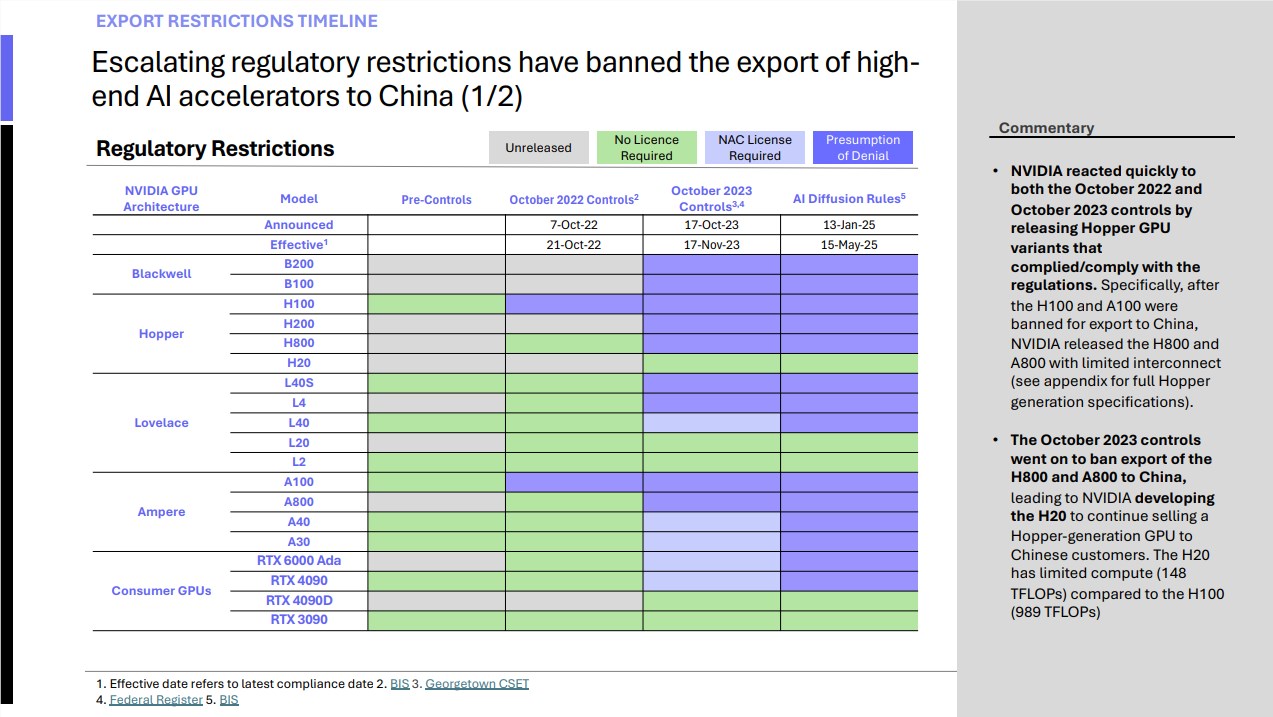
However, the development of AI in China has not been smooth sailing. The United States' export restrictions on high-end AI accelerators have brought considerable challenges to China's AI. In October 2022, the United States restricted cutting-edge GPU exports for the first time; in October 2023, the framework was revised to prevent evasion; in January 2025, the three-layer licensing framework was implemented, and an advanced AI chip ban was imposed on Tier3 countries, including China. NVIDIA chips such as H20 and L20 are still free to export to China because their performance indicators are below the limit threshold. However, the Trump administration has begun preliminary discussions on the possibility of putting H20 chips on the restricted list.
Looking ahead, although the United States remains ahead of the smart frontier overall, China is not far away. At the beginning of 2025, OpenAI's o3 model intelligence index was 94 points, ranking first; DeepSeek's R1 model followed closely with 89 points. The third to fifth place are OpenAI's o3-mini (90 points), o1-mini (89 points) and StepFun's Step-2-16k (84 points). It is worth noting that in the global AI field, except for the United States and China, only France (Mistral), Israel (AI21Labs) and Canada (Cohere) have a few companies that can demonstrate cutting-edge training capabilities.
It can be clearly seen from this report that China's AI has transformed from a follower to a competitor, and this trend will only be more obvious in 2025. Although export controls present challenges, China's AI labs have shown amazing adaptability and speed of innovation. In the future, with the release of more models and technological breakthroughs, China and the United States will enter a new stage of AI competition. This is not only a contest of technical strength, but also a comprehensive competition for innovation ecology, talent training and application implementation.
What do you think of the rise of China's AI? Welcome to leave a message in the comment area for discussion!
Paper address: https://artificialanalysis.ai/downloads/china-report/2025/Artificial-Analysis-State-of-AI-China-Q1-2025.pdf