
On March 5, Google officially released its highly anticipated "AI model", and the launch of this feature marks a new era for search engine technology. The AI model aims to help users solve complex problems more efficiently through artificial intelligence technology, thereby improving the intelligence and intuitiveness of the search experience.
In the official blog, Google specially invited users to participate in the testing of this feature, hoping to further improve this innovative feature through extensive user feedback. The launch of the AI model indicates that the field of information retrieval will usher in a profound change, and the way users obtain information will be more convenient and accurate in the future.
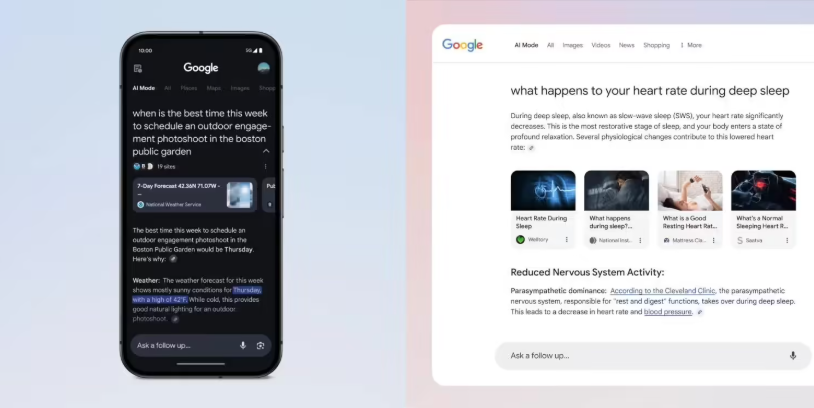
The core advantage of the AI model is that it allows users to ask more complex questions and can generate more detailed and intuitive answers based on search results. This design directly hits the pain points that users often encounter in traditional search, that is, the question that requires multiple queries to obtain satisfactory answers. Through the AI model, users can obtain more comprehensive information at one time, greatly improving search efficiency.
Using AI mode is very simple. Users just need to enter the query content in the search box and click the "AI mode" button to experience a brand new search method. In addition, the AI model also provides a "deep exploration" function, where users can directly skip regular search results and focus on AI-generated content, thereby finding the information they need faster.
To meet the needs of mobile users, the AI mode also supports image upload and voice input functions, although only text output is available at present. This function also integrates the user's historical search records, so that users can view previous query records at any time, further improving the convenience of use.
The power of the AI mode is thanks to the customized Gemini 2.0 engine behind it. This engine can access real-time data sources and knowledge graphs, and use "query extension" technology to extract information from multiple sub-topics and data sources and present them to users in a comprehensive manner. If the system fails to provide sufficient information, the user will be directed to the web search results to ensure the comprehensiveness and accuracy of the information.
In the early testing phase, the length of the user's query doubled compared to traditional searches, and subsequent questions were asked 25% of the time, indicating that users are very accepting of this new model. Google plans to gradually open this feature to all users, and the current testing phase is mainly aimed at advanced users.
Google's AI model is not only a technological innovation, but also an important milestone in the future search experience. Its launch indicates that the way users obtain information will undergo fundamental changes, and search will be smarter, more efficient and personalized in the future.