
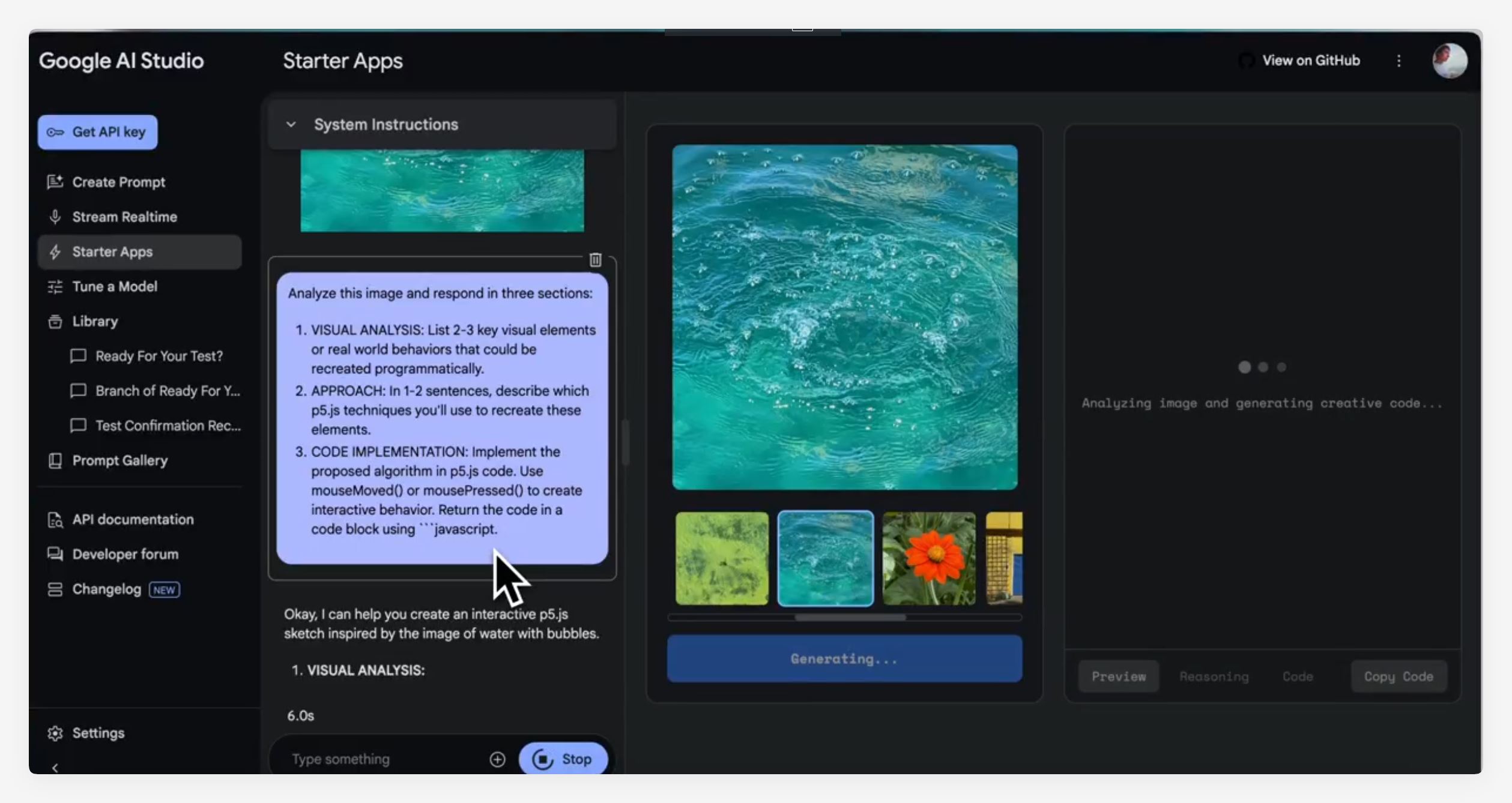
On March 6, 2025, the technology community ushered in an exciting news. According to X platform users, a hidden startup application called "Image to Code" quietly appeared in AI Studio. This application is powered by Gemini technology and can use images as input, generate corresponding program code through intelligent analysis and reasoning, thereby drawing programmatic images. This innovative technology has quickly attracted widespread attention from technology enthusiasts and developers, and has become the focus of recent hot discussion.
The core function of the "Image to Code" application lies in its intelligent conversion capabilities. Users only need to upload an image, and Gemini technology can conduct in-depth analysis of it, understand the content and structure in the image, and generate program code that can reproduce the image. This technology not only demonstrates the powerful capabilities of AI in the field of visual recognition, but also combines it with programming capabilities, providing creative developers and technology enthusiasts with brand new tools. Whether it is a designer, an educator or an artist, you can find a suitable application scenario from it.
Although the official has not released specific application details or use cases, the potential application scenarios of this feature are full of imagination. For example, designers can quickly generate interactive prototype code by uploading sketches, greatly shortening the development cycle; educators can use this tool to teach the combination of programming and image processing to stimulate students' interest in learning; while artists can use it to explore more possibilities of code art and create unique digital works.
Gemini technology is a popular technology in the field of AI and is well-known for its multimodal processing capabilities. It can not only process text, but also understand various types of data such as images and audio. The exposure of the "Image to Code" function further proves Gemini's potential in cross-domain integration. Compared with traditional image recognition technology, Gemini's uniqueness lies in its inference ability - it can not only "understand" images, but also convert them into logical code output, opening up new directions for the application of AI technology.
The news has sparked widespread discussion on the Internet. Some users believe that this app may become a "game changer" for AI-assisted development, significantly lowering the threshold from concept to implementation. However, some netizens expressed doubts about the maturity of the technology, pointing out that there is currently a lack of specific demonstration or open source code support, and the actual effect of the function remains to be verified. Combined with the recent technological trends on the X platform, the launch of this function seems to be consistent with the popularization of AI tools, showing that artificial intelligence is accelerating its penetration into daily work and creation.
It is worth noting that "Image to Code" is described as a "hidden" application in AI Studio. This may mean it is currently in beta, or is only open to some users. As a platform that integrates multiple AI tools, AI Studio has previously received widespread attention for its innovation. The exposure of "Image to Code" undoubtedly adds more attractive to AI Studio.
Although there is still limited information about "Image to Code", it reflects the huge potential of AI technology in automation and creative support. If the app is officially launched and open to use, it could bring a brand new experience to developers, designers and even ordinary users. Industry insiders expect Google to release more details in the coming weeks, and may even provide public demonstrations in response to the community's eager anticipation.
As of press time, Google has not made a formal response to this news. But in any case, the exposure of this technology is enough to ignite people's imagination of the future of AI. Let's wait and see how Gemini redefines the relationship between people and code through "Image to Code" and bring more surprises to the world of technology.