
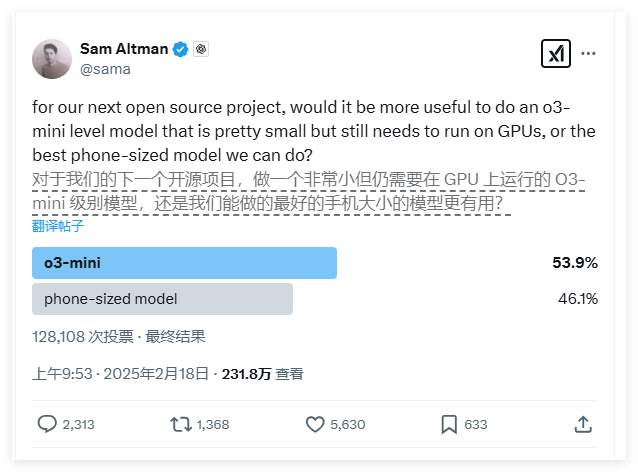
OpenAI CEO Sam Altman recently launched a survey on social media platform X to ask users about their next open source development direction. This move has attracted widespread attention, especially in the context of increasingly fierce competition in the field of artificial intelligence. Altman's question not only reflects OpenAI's emphasis on user needs, but also implies potential adjustments to the company's open source strategy.
The background of this investigation is that OpenAI is undergoing a major transformation, and the company is transforming its for-profit division into a public welfare company. Since getting Microsoft's investment, OpenAI's relationship with open source has changed significantly. Especially after the release of GPT-4, OpenAI gradually reduced its open source contribution and focused on smaller projects such as Whisper. Altman has mentioned the suspension of open source for security reasons, but he recently admitted that this strategy could be wrong, as competitors like Deepseek have released their V3 and R1 models.
In this survey, Altman asked: "Is it more useful for our next open source project to launch a smaller o3-mini model or to create the best model that can run on a phone?" As of now, the o3-mini model is leading the voting, and the survey has 12 hours to come. The raising of this question not only reflects OpenAI's attention to user needs, but also shows the company's flexibility in open source strategies.
Although ChatGPT and OpenAI's API services still take the lead in the industry, open source competitors have gradually emerged, with companies such as Meta, Deepseek, Alibaba and Mistral all launching open source models that can compete with OpenAI products. This competitive situation forces OpenAI to revisit its open source strategy to maintain market competitiveness.
xAI plans to release Grok2 as open source after launching Grok3. The launch of an open source o3-mini will provide users with a strong alternative without directly competing with OpenAI's high-end products, especially as GPT-4.5 is being tested and GPT-5 is about to be released. This strategy not only helps OpenAI regain user trust in the open source field, but also brings more market opportunities to the company.
This move does not mean that OpenAI will return to its original open source principles, but rather indicates that a completely closed strategy is no longer sustainable in a rapidly changing competitive environment. Jan Leike, who worked at OpenAI, recently expressed concerns about the company's restructuring, criticizing OpenAI for reducing its mission to "ensure AGI benefits all mankind" to smaller philanthropic initiatives in areas such as healthcare, education and science.
He believes that nonprofits should support a broader AI development initiative, including AI governance, security and adaptability research, and research on the impact of the labor market. Perhaps, the release of open source code could be a compromise that enables security researchers to better understand the operation of inference models. This open strategy not only helps promote the safe development of AI technology, but also wins more support for OpenAI in a highly competitive market.
Key points: OpenAI CEO Sam Altman solicited users' opinions on future open source projects on the X platform, implying that he might return to the open source field. With the rise of competitors, OpenAI realizes that a completely closed development strategy can no longer last. Open source projects may be able to promote security research and governance of AI and promote broader technological development.