
The competition among artificial intelligence in the field of image recognition is becoming increasingly fierce, and traditional classification tasks can no longer meet the needs. More complex identification tasks are now mainstream, such as identifying sports cars of a particular year and model, or distinguishing subtle differences in bird feathers. These tasks not only require high-precision recognition capabilities, but also need to explain the basis for recognition, which is the challenge facing current neural networks.
Although neural networks perform well in recognition tasks, they often appear unscrupulous when asked to explain their decision-making process. Although the traditional Class Activation Map (CAM) method can point out key areas of attention to the neural network, it cannot explain in detail the "why" these areas are being followed. Especially when facing extremely similar objects, neural networks often can only give vague answers and cannot accurately distinguish nuances.
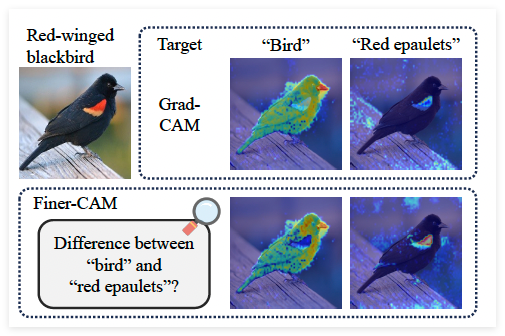
To address this challenge, the Ohio State University research team has developed a new technology called Finer-CAM. Finer-CAM can more accurately identify unique and distinctive features by comparing the feature differences between target categories and similar categories. This approach not only improves the accuracy of recognition, but also enhances the interpretability of neural networks.
The core idea of Finer-CAM is to enhance recognition ability through "contrast learning". Unlike traditional single-category identification, Finer-CAM compares target categories with similar categories to find out the differences between them. This method is similar to the "Everyone Come Find Fault" game. Through comparative analysis, Finer-CAM can more accurately locate those subtle but distinctive characteristics.
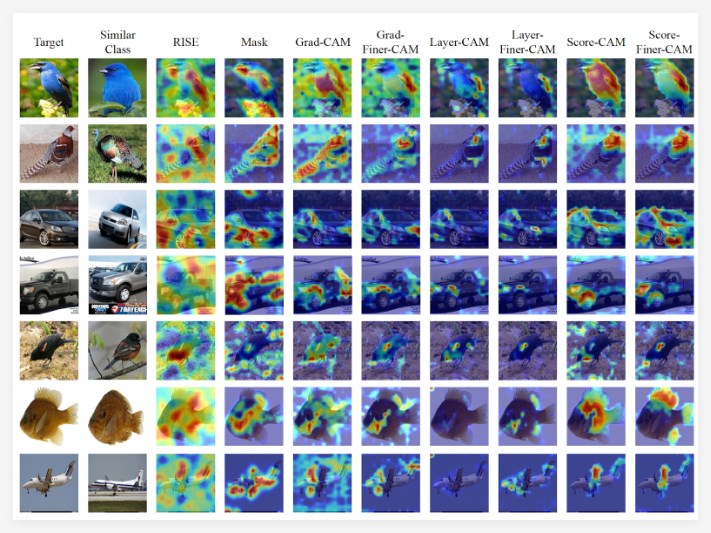
The advantages of Finer-CAM are not only reflected in recognition accuracy, but also in its ability to effectively remove background interference and focus on key features of the target. Traditional CAM methods are often affected by background noise, resulting in insufficient recognition results. Through comparative analysis, Finer-CAM can filter out irrelevant background information, making the identification results cleaner and more accurate.
In addition, Finer-CAM also performs well in multimodal learning. It can not only process image data, but also identify it in combination with text descriptions. This capability makes Finer-CAM more flexible when handling complex tasks, and can provide accurate identification results based on different input types.
The emergence of Finer-CAM marks a new step in image recognition technology. It not only improves the accuracy of recognition, but also enhances the interpretability of neural networks, allowing AI to give accurate answers more confidently when facing complex tasks.
Project: https://github.com/Imageomics/Finer-CAM
demo:https://colab.research.google.com/drive/1plLrL7vszVD5r71RGX3YOEXEBmITkT90