In 2025, China has made remarkable progress in the field of humanoid robots. On March 11, Zhiyuan Robot officially released its latest bipedal intelligent interactive humanoid robot - Lingxi X2. This robot can not only perform complex movements, such as scooters, riding a bicycle, but also perform fine operations, such as sewing stitches to grapes. This breakthrough technology demonstrates the wide application potential of humanoid robots in daily life and medical fields.
At the 2025 Embodied Intelligent Robot Development Conference, Wang Tianyou, Vice President of Tianjin University, delivered an important speech. He pointed out that the annual growth rate of the global humanoid robot market is expected to exceed 30% in the next five years, and by 2030, the size of China's humanoid robot market is expected to reach nearly one trillion yuan. This forecast not only reflects the huge potential of the market, but also indicates that humanoid robotics will be rapidly popularized in the next few years.
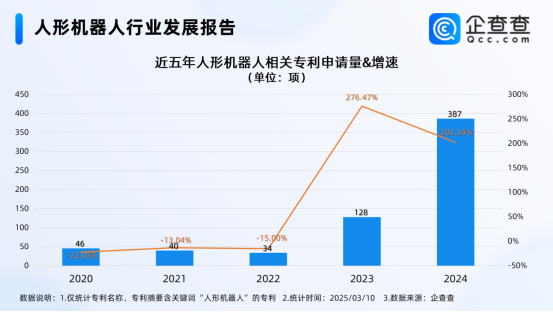
According to Qichacha data, China currently has 1,021 patents related to humanoid robots. Judging from the trend of patent applications, the number of applications has increased significantly in the past two years, with the number of applications in 2023 and 2024 increasing by 276.47% and 202.34% respectively, reaching 128 and 387. As of March 10, 25 related patents have been submitted this year, indicating that technological innovation in this field continues to be active.
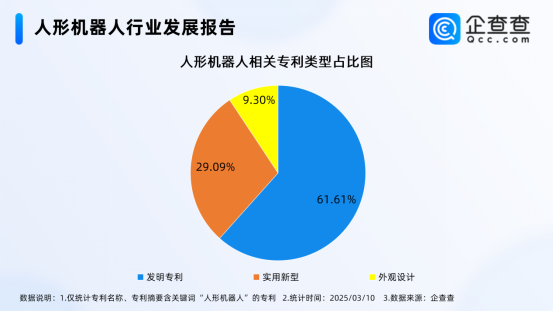
In terms of patent types, humanoid robot-related patents are mainly invention patents, accounting for as high as 61.61%. Utility model patents and design patents account for 29.09% and 9.30% respectively. This distribution shows that the research and development of humanoid robotics focuses on innovation and functionality rather than just appearance design.
The rapid development of humanoid robot technology has not only promoted technological progress, but also brought new opportunities to all walks of life. With the continuous maturity of technology, humanoid robots are expected to play an important role in many fields such as medical care, education, and service industries, bringing more convenience and innovation to human society.