
With the rapid development of artificial intelligence technology, the application of DeepSeek is redefining digital life. As a leading technology company in China, Baidu took the lead in deeply integrating the DeepSeek-R1 model into its core product Baidu Map, bringing users an unprecedented intelligent search experience. This deep integration not only reflects Baidu's strategic layout in the field of artificial intelligence, but also marks a major transformation of map services from traditional navigation tools to smart life assistants.
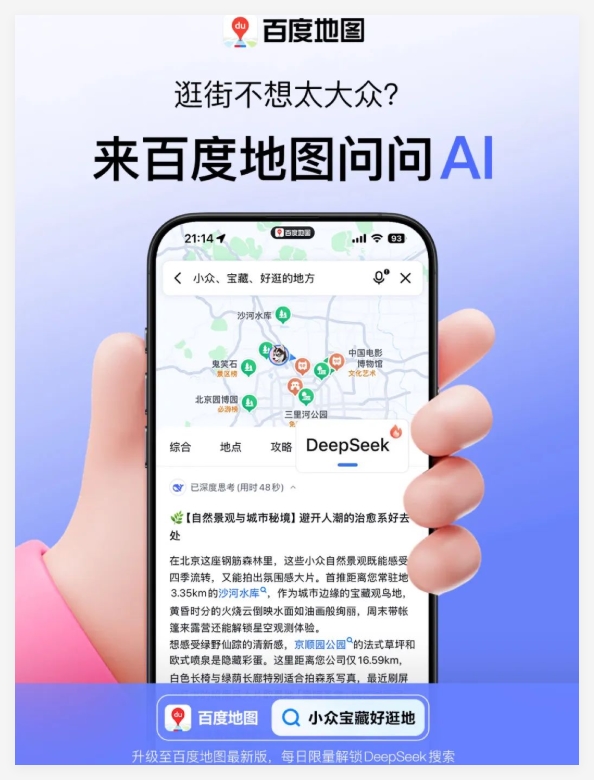
In practical applications, users only need to enter natural language questions in the Baidu map search bar, such as "What are fun in Zhengzhou?" After selecting the DeepSeek tag, the system will accurately understand and analyze user needs based on the deep learning algorithm. This innovative interactive method has completely changed the search mode in traditional map services that requires users to enter specific place names, making map services more intelligent and humanized.
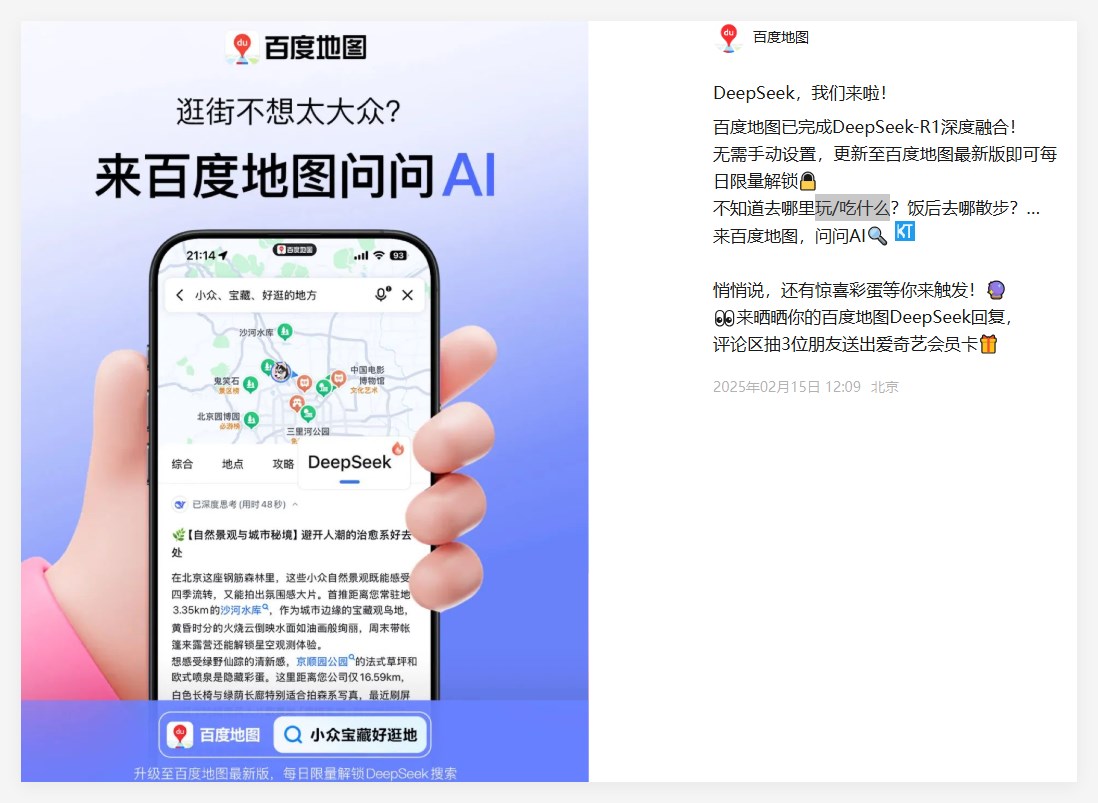
In terms of search results presentation, the DeepSeek-R1 model can not only provide detailed recommendations of attractions, but also intelligently display practical information such as the specific address and opening hours of each attraction. More importantly, users can directly click on the address in the search results to navigate, achieving a seamless connection from information acquisition to action execution. This integrated service experience significantly improves user efficiency and makes travel planning more convenient.
It is worth noting that Baidu has become the second technology giant after Tencent to deeply integrate DeepSeek technology. Previously, Tencent had conducted grayscale tests of the DeepSeek-R1 model on the WeChat platform, demonstrating its strategic layout in the field of AI search. This technological competition among giants not only promotes the rapid development of artificial intelligence technology, but also indicates that search services are undergoing a paradigm shift from "information retrieval" to "problem solving".
Traditional search engines face inherent difficulties such as excessive advertising and limitations in keyword matching, and it is difficult to meet users' increasingly complex search needs. The introduction of AI technologies such as DeepSeek is reshaping the boundaries of search services through advanced functions such as multi-round dialogue and cross-modal understanding. Looking ahead, search engines are likely to evolve to a "hybrid mode", combining AI-generated smart answers with traditional link lists to provide users with richer and more personalized choices.
In the long run, with the continuous advancement of AI technology, traditional search engines will inevitably undergo fundamental changes. Artificial intelligence technologies such as DeepSeek can not only provide more accurate search results, but also continuously optimize user experience through deep learning, promoting search services to a more intelligent and humanized direction. This technological innovation not only changes the way people obtain information, but will also profoundly affect the development direction of the entire Internet ecosystem.