
Driven by modern technology, lithium-ion batteries have become an indispensable part of our daily lives. From smartphones, laptops to electric bikes and electric cars, these batteries are popular for their high energy density. However, when lithium-ion batteries are overheated or damaged, they can cause a heat out of control reaction, resulting in a fire or explosion. In 2023, the New York City Fire Department reported 268 residential fires caused by electric bicycle batteries, killing 150 people. Faced with this increasingly serious fire risk, the National Institute of Standards and Technology (NIST) research team is developing a new technology to detect fires from lithium batteries using sound.
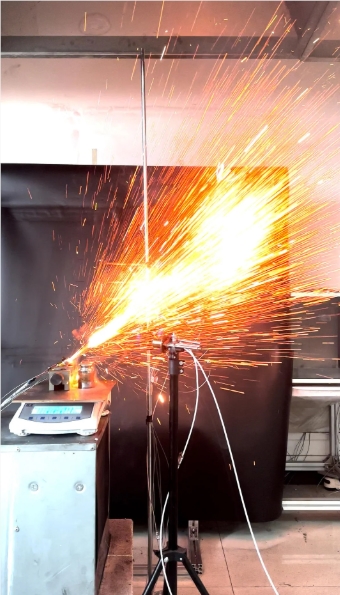
NIST researchers found that before the lithium-ion battery is about to catch fire, chemical reactions occur inside the battery, causing the air pressure to increase and the battery case begins to expand. Many lithium-ion batteries have safety valves that, when the internal pressure is too high, will rupture and release gas, making a "hiss" sound similar to opening a beverage bottle. The researchers noticed the sound while watching the video of the battery explosion and decided to further verify its feasibility.
To train machine learning algorithms to identify this particular sound, the researchers worked with the laboratory of Xi'an University of Science and Technology to record 38 audio samples before the battery exploded and adjusted it in speed and tone to generate more than 1,000 unique audios sample. After training, the algorithm's recognition rate is as high as 94%. The researchers successfully detected the sound of overheating the battery through a microphone installed on the camera. To verify the effectiveness of the algorithm, the researchers also used various noises to perform interference experiments, and the results showed that only a very small number of noises confuses the detector.
At present, the research team has presented their research results at the Asia-Pacific Fire Science and Technology Symposium and applied for a patent. In the future, they plan to test more types of batteries and microphones to confirm the warning time for the safety valve to rupture, usually about two minutes before the battery fails. Ultimately, this technology is expected to develop into a new fire alarm, installed in homes, offices, and even warehouses with large batteries and electric vehicle parking lots, providing people with early fire warnings.
Key points:
The NIST research team developed a sound-based lithium battery fire warning technology to identify the sound of a safety valve rupture through AI algorithms.
The trained algorithm has a recognition rate of up to 94%, and can still maintain efficient detection under multiple noise interferences.
In the future, new fire alarms are expected to provide about two minutes of early warning to help people escape in time.