
With the advent of the digital age, recommendation systems have become a key technology to improve user experience and enhance user retention. In many industries such as e-commerce, streaming media and social media, the recommendation system accurately recommends content that may be of interest to users by analyzing the complex relationship between users, products and their background factors. However, most existing recommendation systems rely on a large amount of historical data. In the "cold start" scenario, due to the lack of sufficient data, the system's recommendation effect is greatly reduced.
To solve this problem, researchers from Shanghai Jiaotong University and Huawei Noah’s Ark Laboratory developed the AutoGraph framework. The framework significantly improves the accuracy of recommendations by automatically building graphs and dynamically adjusting recommendation strategies. At the same time, AutoGraph uses large language models (LLMs) to enhance the understanding of the context, thereby better capturing user preferences and needs.
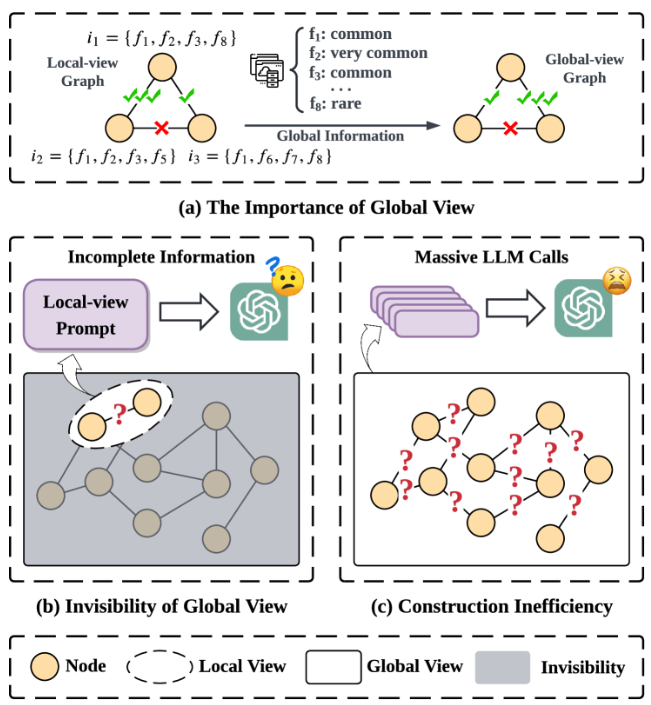
Existing graph-based recommendation systems usually require the user to manually set the features and their connections in the graph, which is not only time consuming and inefficient. In addition, pre-set rules limit the adaptability of these graphs and cannot fully utilize the rich semantic information contained in unstructured data. Therefore, the introduction of the AutoGraph framework provides a completely new way to solve the problem of data sparseness, which can promptly capture subtle relationships of user preferences.
The core functions of the AutoGraph framework include analyzing user input using pre-trained large language models (LLMs) to extract potential relationships from natural language; generating knowledge graphs through LLMs as structured representations of user preferences, and optimizing the graphs to remove them. irrelevant connections; finally, the built knowledge graph is combined with graph neural networks (GNNs), so that the recommendation system can use node features and graph structures to provide more accurate recommendations while remaining sensitive to personal preferences and user trends.
To verify the effectiveness of the AutoGraph framework, the researchers benchmarked the datasets of e-commerce and streaming services. The results show that the framework significantly improves the accuracy of recommendations, indicating its strong ability to provide relevant recommendations. Furthermore, AutoGraph shows better scalability when processing large data sets and is significantly lower in computing requirements than traditional graph construction methods. The combination of automated processes and advanced algorithms helps reduce resource consumption without affecting the quality of results.
The launch of the AutoGraph framework marks an important advancement in the field of recommendation systems. Its ability to automatically build graphs effectively deals with long-standing scalability, adaptability, and context-aware challenges. The success of this framework demonstrates the transformative potential of combining LLMs with graphics systems, setting new standards for future personalized recommendation research and application.
Paper entrance: https://arxiv.org/abs/2412.18241
Key points:
** Automatic graph construction based on LLMs**: The AutoGraph framework automatically analyzes user input, extracts relationships, and builds a knowledge graph through pre-trained large language models.
** Significantly improve recommendation accuracy**: In benchmarks, this framework significantly improves recommendation accuracy on e-commerce and streaming datasets.
** Reduce resource consumption**: Compared with traditional methods, AutoGraph performs excellent in computing requirements and demonstrates good scalability.