
At the recent CES show, Nvidia CEO Jensen Wong's statement attracted widespread attention. He claimed that the RTX5070 graphics card will achieve performance comparable to the $1,599 RTX4090 for $549. This bold statement quickly sparked heated discussions on social media, especially on platforms such as YouTube and TikTok, where numerous tech enthusiasts and gamers commented. However, the implementation of this promise does not rely solely on the improvement of the hardware itself, but mainly relies on Nvidia's latest DLSS4 technology.
In his speech, Huang Renxun emphasized the key role of artificial intelligence in achieving this goal. He pointed out that through multi-frame generation technology, DLSS4 technology can generate up to three additional images on the basis of each frame of traditional rendered frame. Although some PC gamers questioned this approach, believing it does not really reflect the actual performance of the graphics card, Nvidia insists that with DLSS4, the RTX5070 can achieve similar performance to the RTX4090 in games supporting the technology.
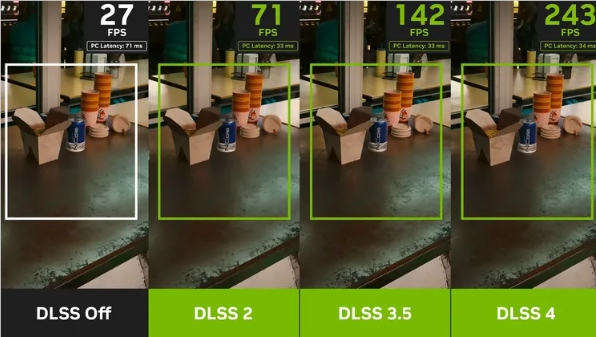
In the demonstration of DLSS4, Nvidia showed off significant performance gains in games like Cyberpunk 2077. When DLSS is not enabled, the frame rate of the RTX5070 is 27fps, while when DLSS4 is enabled, the frame rate soars to 243fps. Nvidia emphasizes that RTX5070 can achieve similar performance as RTX4090 under DLSS3.5 in games supported by DLSS4. However, this does not mean that the RTX5070 will surpass the RTX4090 in all settings and configurations, and performance improvements still depend on support for specific games and settings.
Nvidia further explained the technical details of DLSS4. The new transformer model increases frame generation speed by 40%, while the video memory usage is reduced by 30%. Although multi-frame generation technology significantly improves frame rates, the game's input delay and smoothness are still the focus of players' attention. Nvidia said they are working to optimize these aspects to ensure players can get a smooth gaming experience when using DLSS4.
With the continuous development of modern game technology, more and more developers have begun to use various optimization methods to improve picture quality. DLSS4 provides developers with more tools to enable better visual effects without sacrificing performance. As ray tracing technology gradually becomes mainstream, the future of PC games will increasingly rely on these AI-powered rendering technologies. Nvidia's DLSS4 is not only a technological breakthrough, but also a foreshadowing of future game development trends.
In summary, the RTX5070 promises similar performance to the RTX4090 for $549 through DLSS4 technology. Although this goal is achieved in games that support DLSS4, the game's input delay and smoothness are still issues that players need to pay attention to. With the continuous application of AI technology in the gaming field, future PC games will usher in more innovations and breakthroughs.