
Microsoft's latest rStar-Math technology marks a major breakthrough in artificial intelligence in the field of mathematical reasoning. This innovative technology is designed specifically for small language models (SLMs), and through unique inference methods, significantly enhances the capabilities of these models in solving complex mathematical problems. In multiple tests, rStar-Math technology not only greatly improves the performance of multiple open source models, but even surpasses OpenAI's o1-preview model in specific scenarios. This achievement has attracted widespread attention from the industry.
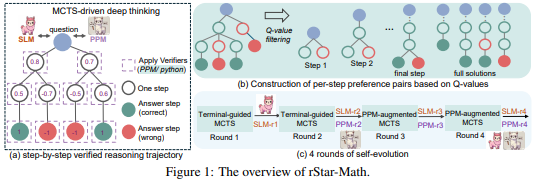
The core of rStar-Math technology lies in its innovative Monte Carlo Tree Search (MCTS) application. This method simulates the process of human deep thinking, helping small language models to achieve self-evolution by gradually refining and optimizing solutions to mathematical problems. The research team not only asked the model to output the final answer, but also asked it to provide detailed natural language inference steps and corresponding Python code. This dual output mechanism greatly promoted the model's learning efficiency and reasoning ability.
In specific tests, rStar-Math technology is applied to multiple well-known open source models, including Microsoft's Phi-3 mini model, Alibaba's Qwen-1.5B and Qwen-7B models. Test results show that all models participating in the test performed significantly in the MATH benchmark. It is particularly worth mentioning that after applying rStar-Math technology, the accuracy rate of the Qwen2.5-Math-7B model jumped from 58.8% to 90.0%. This achievement not only surpassed OpenAI's o1-preview model, but also showed small models. The huge potential of models in specific fields.
The research team plans to disclose relevant code and data on Github, and this decision has been widely welcomed by the AI community. Many experts believe that the combination of rStar-Math technology and Monte Carlo tree search, especially the application in fields such as geometric proof and symbolic reasoning, will promote the development of artificial intelligence in mathematics-related fields. This step-by-step reasoning method not only improves the accuracy of the model, but also provides new directions for future research.
The success of rStar-Math technology has also triggered reflection on the current development model of artificial intelligence. In recent years, innovation in the AI field has mainly relied on the continuous increase in model parameters. Although this "larger, the better" development model has brought about performance improvements, it is also accompanied by high costs and environmental burdens. Microsoft demonstrates the potential of small models with rStar-Math technology, providing new options for medium-sized organizations and academic researchers to gain cutting-edge AI capabilities without having to bear huge costs.
In specific application scenarios, rStar-Math technology has shown remarkable results. In the American Mathematics Invitational (AIME) test, a model using rStar-Math technology solved 53.3% of the problems, which is equivalent to the top 20% of high school contestants. This achievement not only proves the effectiveness of this technology in practical applications, but also provides possibilities for future applications in the field of education.
The paper, jointly completed by eight researchers from Microsoft, Peking University and Tsinghua University, has been published on arXiv.org, providing detailed technical details and experimental data to the academic and industry. With the upcoming disclosure of code and data, it is expected to attract more researchers to join this field, promoting the further development and improvement of rStar-Math technology.
The launch of rStar-Math technology not only demonstrates the huge potential of small language models in specific tasks, but also provides new ideas for the development of artificial intelligence. While pursuing larger models, how to improve the performance of small models through technological innovation will become one of the important directions in future AI research. The success of this technology may trigger a new round of technology competitions and promote the entire industry to develop in a more efficient and sustainable direction.