
Recently, a news that the xAI large language model Grok3 proved the Riemann conjecture was exploding on social media, arousing widespread attention and heated discussion. xAI engineer Hieu Pham released a message saying that Grok3 successfully proved this difficult problem that has plagued the math community for many years and therefore suspended model training. However, this was just a "broken" triggered by netizens' revelations, which was eventually revealed by the humorous response of xAI co-founder Greg Yang and others. Although it is just a joke, this incident has triggered people's in-depth thinking about AI's mathematical ability and makes us look forward to the future breakthrough of AI in the field of mathematics.
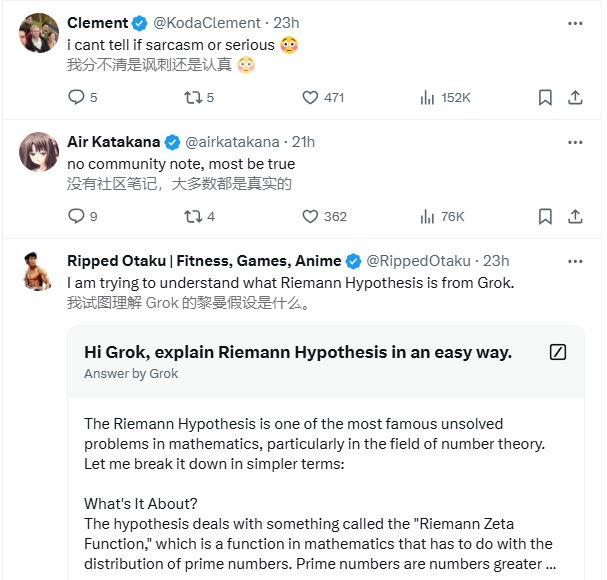
Recently, xAI engineer Hieu Pham posted an "explosive" message on social media, claiming that xAI's large language model Grok3 successfully proved the Riemann conjecture and suspended the training of the model. This news quickly sparked heated discussions in the AI circle, and netizens expressed their shock and it was difficult to tell whether it was true or false. After all, the Riemann Conjecture, as one of the seven major mathematical problems of the millennium, is known as the "crown of the conjecture world", and its difficulty can be imagined.
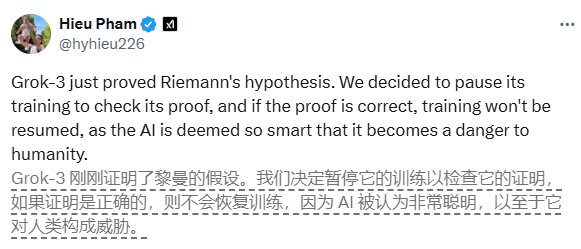
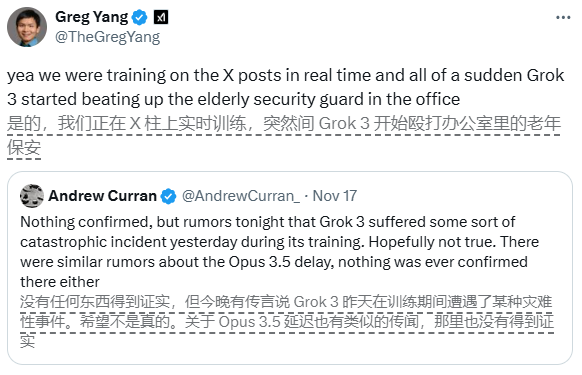
A few hours later, Pham revealed the answer in another post: It was just a joke. This "objection" originated from the revelations of netizen Andrew Curran, who claimed that Grok3 encountered a "disaster incident" during training.
Faced with the rumors that the more it spread, xAI Lianchuang Greg Yang couldn't help but post a sarcastic article and said sarcastically, "Yes, yes, Grok3 started attacking the security guards in the office." Another researcher, Heinrich Kuttler, also humorously He said, "The situation is very bad! We later replaced all the bad weights with nan (Not a Number, non-number) before we recovered." Seeing this, netizens also joined the ranks of memes.
Although this "farce" ended in a joke, it also triggered people's thinking about AI mathematical abilities.
So, how far is AI from overcoming millennial math problems like the Riemann conjecture?
We can see the performance of AlphaProof, an AI mathematical proof tool developed by Google's DeepMind team. AlphaProof successfully solved three questions in the 2024 International Mathematics Olympiad (IMO), among which the sixth question is known as the "ultimate boss" and is extremely difficult. AlphaProof demonstrated strong logical reasoning ability and creative thinking in the process of solving problems. For example, in the second question, it cleverly chose to consider the number ab+1 to construct proof, which is not consistent with human problem-solving ideas. And together.
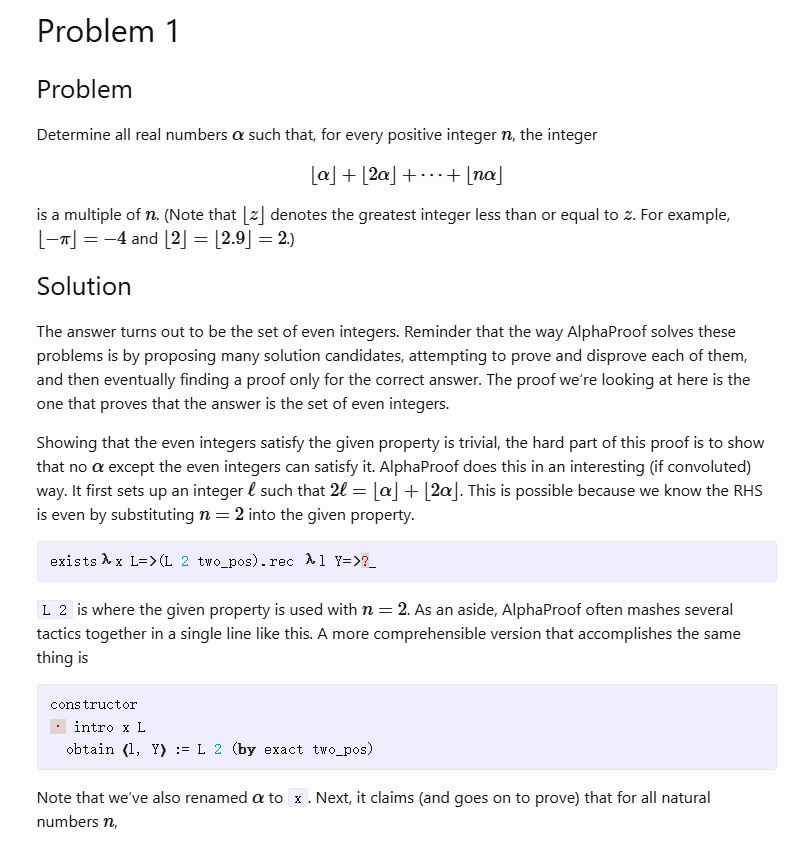
Although AlphaProof has achieved remarkable results, AI still has a long way to go to overcome top mathematical problems like the Riemann conjecture. The Riemann conjecture has a history of 165 years since it was proposed in 1859, and countless mathematicians have devoted their efforts to it, but they have never been completely proved.
To prove the Riemann conjecture, AI needs to have strong computing power and in-depth reasoning capabilities. Currently, AI can search all possible proofs by exhaustively searching for proven theorems, but this requires astronomical computing resources. In addition, AI also needs to have the ability to understand and apply existing mathematical tools in order to play a greater role in mathematical research.
Some AI experts predict that by the end of 2026, AI will become a "superman mathematician", which is enough to solve problems such as the Riemann conjecture. Musk also promised that the Grok3, which was trained with 200,000 H100, will be released at the end of the year and will bring amazing performance.
In the future, let us wait and see whether AI can make breakthrough progress in the field of mathematics.
Although this "farce" about whether AI can prove the Riemann conjecture, it ended in a joke, has also triggered our thinking on the future development direction of artificial intelligence. The progress of AI in the field of mathematics is obvious to all, but there is still a long way to go to overcome such top-notch problems as the Riemann conjecture. Let us look forward to more breakthroughs in AI in the field of mathematics in the future!