
Artificial intelligence is rapidly changing the business landscape. According to a study by IDC, the vast majority of enterprises have begun to use AI technology to improve efficiency and profitability. The Microsoft-commissioned study explores the business opportunities brought by artificial intelligence and reveals the explosive growth of generative AI and the huge returns on enterprise investments. This article will interpret the key findings of the study and analyze the challenges facing enterprises in AI applications and the efforts made by Microsoft to address these challenges.
According to an IDC study, 92% of businesses are actively leveraging artificial intelligence technology to increase productivity, customer engagement, revenue growth, cost management and product innovation. The research was commissioned by Microsoft and titled "Business Opportunities for Artificial Intelligence." The report shows that as businesses invest in artificial intelligence, the return on investment (ROI) has increased significantly.
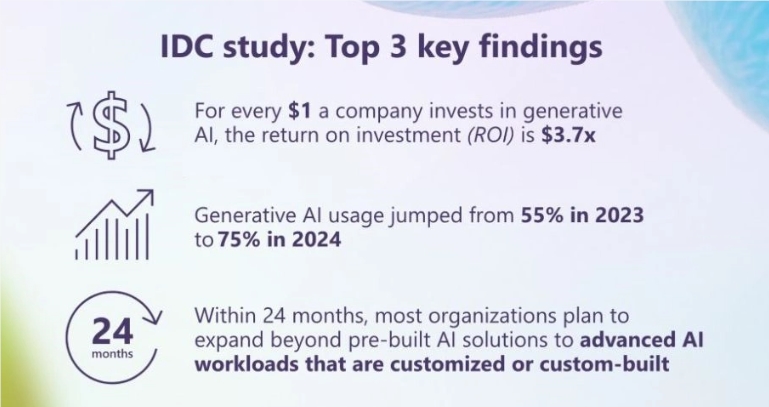
Research points out that the adoption of generative artificial intelligence is expanding rapidly, with an expected jump from 55% in 2023 to 75% in 2024. Currently, the average cycle of enterprises implementing artificial intelligence solutions is less than eight months, and the value brought by technology can be felt within about 13 months. Generative AI is becoming a key driver of industry transformation as more companies plan to develop customized AI solutions over the next two years.
According to IDC's survey, companies' investment in generative artificial intelligence can earn an average return of $3.7 for every $1 invested, and some companies' return on investment is as high as 10.3 times. The financial services, media and telecommunications industries have achieved the highest return on investment in the application of generative artificial intelligence.
However, the biggest challenge facing enterprises when applying artificial intelligence technology is the lack of professional skills, with about 30% of enterprises saying that they lack specialized AI technology talents within. To address this problem, Microsoft has helped more than 14 million people receive digital skills training and certification in more than 200 countries and regions over the past year.
"We are committed to working with governments, educational institutions, industries and social groups to help more people learn to use AI," said Alissa Taylor, chief marketing officer of Microsoft Business Cloud and Artificial Intelligence in his blog. She also mentioned that Generative artificial intelligence has become an important driving force for business achievements in all industries in 2024, and many companies and industries are still exploring the potential of this new technology.
Points:
92% of enterprises use artificial intelligence to increase productivity and revenue growth.
The average return on investment of enterprises in generative artificial intelligence is 3.7 times, and some enterprises are as high as 10.3 times.
30% of enterprises face the challenge of lacking professional AI talents, and Microsoft is committed to skills training and certification.
In short, artificial intelligence has become a key driver of enterprise growth, but talent gaps remain the main obstacle to its widespread use. The active investment of technology giants such as Microsoft has provided important guarantees for bridging this gap and promoting the inclusive development of artificial intelligence. In the future, artificial intelligence will show its huge potential in more fields.