
NASA and Microsoft have launched a revolutionary AI chatbot, Earth Copilot. This tool aims to break the barriers to scientific data acquisition and enable the public to understand and use NASA's vast geospatial information more easily. Through natural language interaction, the "Earth Assistant" can quickly analyze NASA databases and answer users' various questions about earth science in an easy-to-understand way, and obtain clear answers from hurricanes to environmental changes. This innovation will greatly improve the efficiency of the public's access to scientific knowledge and promote the popularization of scientific knowledge.
Recently, NASA teamed up with Microsoft to launch an AI chatbot called Earth Copilot, which aims to make it easier for the public to obtain and understand scientific data about the planet. This tool will integrate NASA's vast geospatial information into easy-to-understand answers to satisfy people's curiosity about geoscience issues.
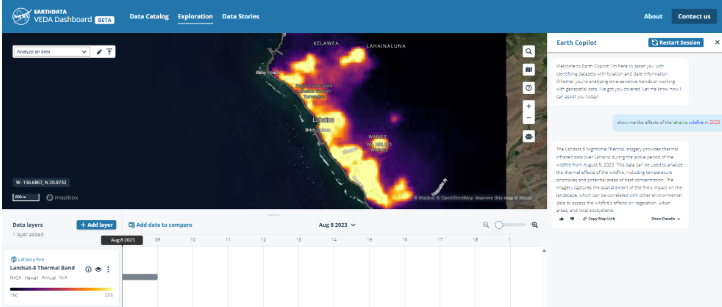
The launch of Earth Assistant is an important attempt by NASA to integrate artificial intelligence (AI) technology with its data repository. With this new tool, users can easily ask various questions about the planet, such as "What is the impact of Hurricane Ian on Sanibel Island?" or "How does the COVID-19 pandemic affect the air quality in the United States?" With AI, Earth Assistant Ability to quickly extract relevant information from NASA's database and provide answers.
NASA hopes to "democratize" scientific data through Earth Assistant. Currently, ordinary users often need professional skills to obtain and understand the information in NASA database. This includes familiarity with the technical interface, understanding of data formats, and mastery of geospatial analysis. These skills are usually only available to a few non-technical users. Tyler Bryson, Microsoft's vice president of public sector, said at the press conference that AI can simplify the process and allow people to gain insights into the Earth's data in seconds.
Currently, Earth Assistant is limited to NASA scientists and researchers, who will evaluate the performance of the tool and explore integrating it into NASA's Visualization, Exploration and Data Analysis Platform (VEDA). This platform has provided users with part of NASA's data and will further expand its functions in the future.
The development of Earth Assistant not only represents the advancement of technology in the field of science, but also provides new ways for ordinary users to obtain complex scientific information, allowing them to understand the changes in the Earth and its environment more easily.
Points:
NASA and Microsoft launched the AI chatbot "Earth Assistant" to simplify scientific data acquisition.
Earth Assistant is able to answer a variety of questions about the Earth and provides easy-to-understand scientific data interpretations.
Currently, Earth Assistant is only for use by NASA scientists and researchers and will be integrated into existing data platforms in the future.
The emergence of the "Earth Assistant" marks a change in the way scientific data is obtained. In the future, it will be further improved, benefiting a wider group and bringing new possibilities to geoscience research and public education. Looking forward to the day when it is officially released to the public.