
The "2024 Young People's AI Usage Trend Report" shows that AI has penetrated into all aspects of young people's lives, from work to entertainment, and even emotional companionship, AI has appeared. The report provides an in-depth analysis of different groups’ use of AI tools, preferences, and views on the future of AI. It shows the impact of AI technology on the lifestyle and thinking patterns of the younger generation, as well as their predictions on the development trend of AI technology. The report data has a wide coverage, covering multiple dimensions such as different age groups, occupations and genders, providing a valuable reference for us to understand the current application status and future development direction of AI.
According to the "2024 Young People's AI Usage Trend Report", the application of AI is no longer limited to specific fields, but penetrates into all levels, from work review to personal side business, to creative video production, and even as a cyber friend or lover. Role.
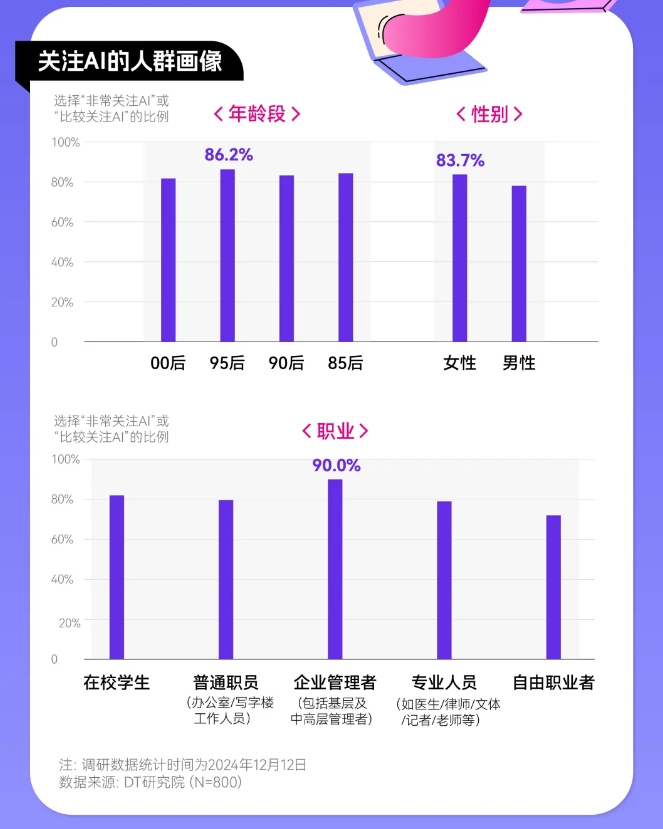
The report points out that compared with 2023, those born after 1995, women and business managers pay the highest attention to AI. Overall, more than 80% of the respondents expressed high concern for tools such as AI text, painting, audio and video. In addition, nearly half of the respondents said they use AI tools every day, showing that AI has become an indispensable part of daily work and life.
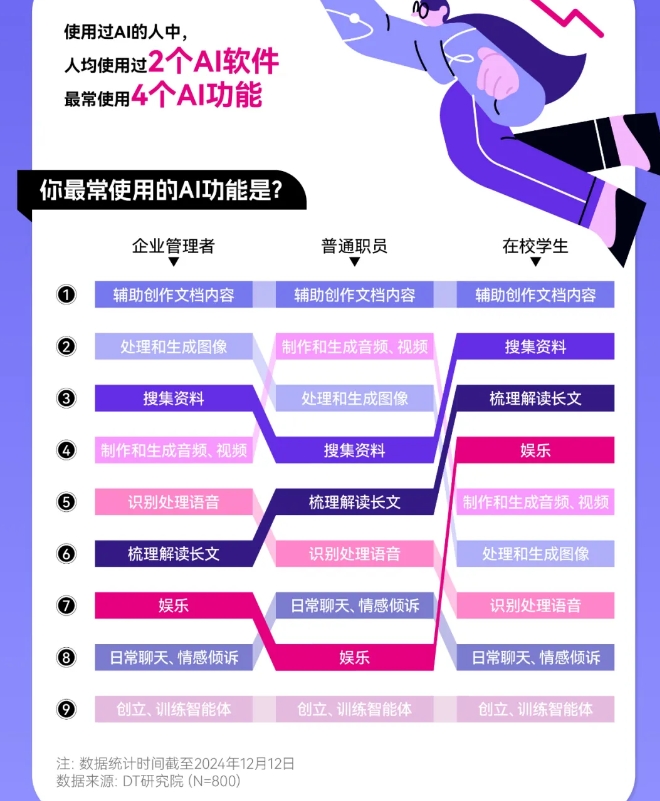
Among people who use AI, the average person has used 2 AI software, and the 4 most commonly used AI functions. People with rich workplace experience are more likely to use generative AI functions, such as assisting in creating document content, processing and generating images, producing and generating audio/video, recognizing and processing speech, etc. School students most often use AI to assist in creating document content, collecting information, and sorting out and interpreting long texts to meet their academic needs.
The survey also found that people’s evaluations of AI-generated content are generally positive, with “interesting” being the most common evaluation. College students are more inclined to use AI to "open their minds" and try to realize creative ideas, while white-collar workers regard AI as an "expert replacement" and seek AI advice on law, health, fitness, travel, etc.
More than 70% of the respondents are trying to learn how to use AI in depth, especially skills such as learning AI prompt words and how to polish instructions. Among school students, 8% have paid to learn AI, showing their foresight about the demand for AI skills in the future workplace.
In addition to practicality, AI is also used for entertainment and creative expression. For example, AI is used in metaphysical activities such as cyber tarot calculations and horoscope reading, as well as in the creation of emoticons and videos. The ease of use and fun of AI tools have made them a new favorite among young people.
AI has also shown its advantages in travel planning and translation, especially during short and long holidays, when the popularity of AI reaches its peak. With the recovery of outbound travel, the popularity of AI translation tools has also increased significantly.
Finally, although people's expectations for AI-generated content are higher than last year, the "wait-and-see", "cautious" and "vigilant" attitudes towards AI have also increased, especially in terms of data privacy protection. Most people are willing to recommend AI tools, but only if they are highly secure and do not leak personal or important information.
AI has become an important tool to enhance personal competitiveness, and people are exploring how to use AI more effectively while remaining alert to the potential risks behind the technology. As AI technology continues to advance, its applications will be more extensive and in-depth in the future.
All in all, the report clearly demonstrates the deep integration and widespread application of AI in young people's lives, and reminds us that while enjoying the convenience of AI, we need to pay attention to its potential risks, look at it rationally, and actively respond to the challenges and opportunities of the AI era.