
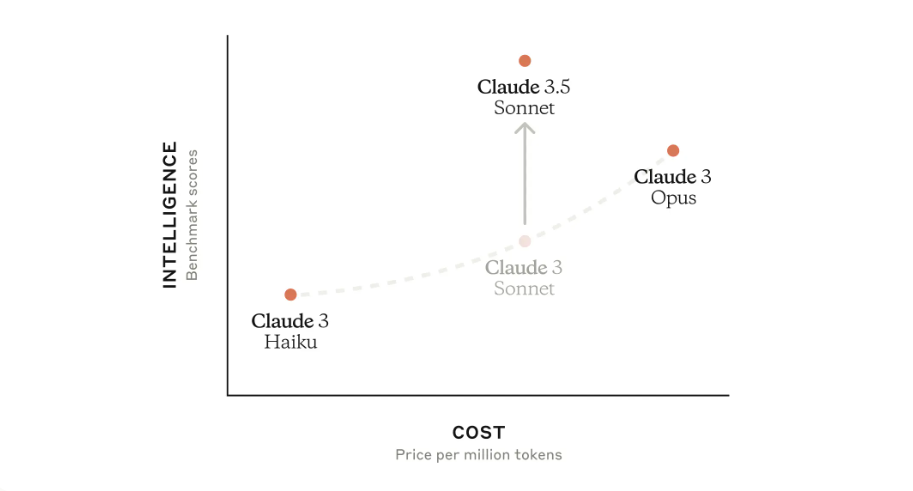
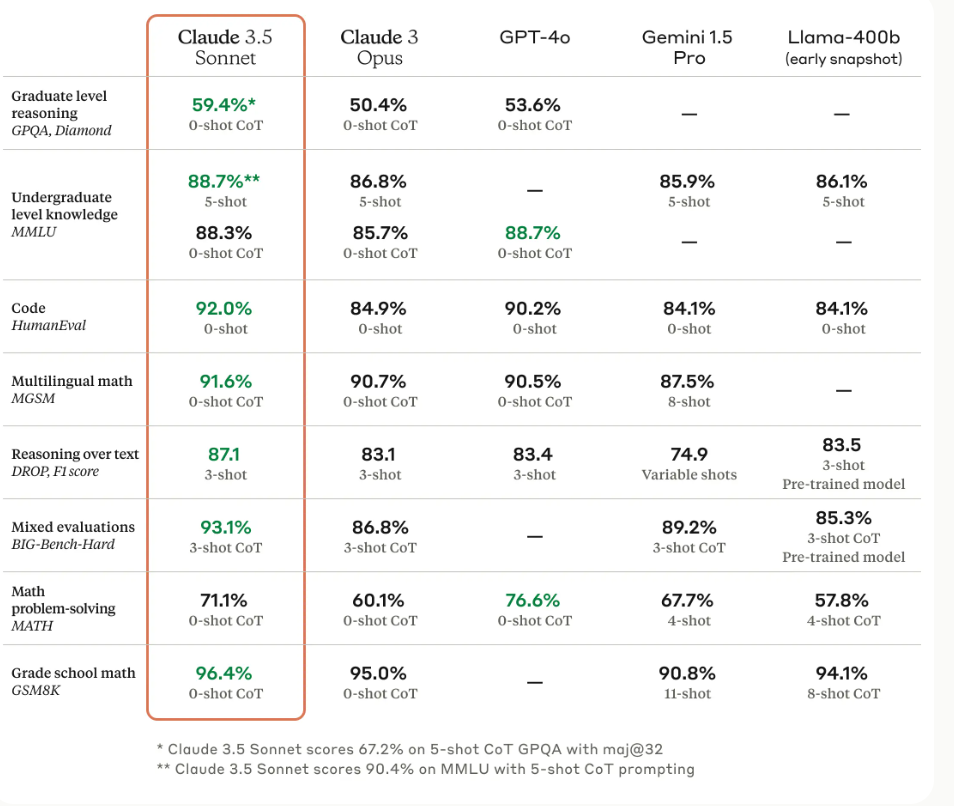
Anthropic is proud to introduce the Claude 3.5 Sonnet, the first product in the Claude 3.5 series, which outperforms competitors and its predecessor, the Claude 3 Opus, in multiple evaluations. It significantly improves performance, including graduate-level reasoning, undergraduate-level knowledge, and coding capabilities, while maintaining comparable speed and cost to midrange models. Claude 3.5 Sonnet is now available on multiple platforms, providing users with more convenient and efficient AI services.
Anthropic today announced the launch of the Claude 3.5 Sonnet, the first product in the Claude 3.5 series. The model outperformed competitors and its predecessor, the Claude 3 Opus, in multiple evaluations while maintaining speeds and costs comparable to mid-range models, setting a new industry standard.
Claude 3.5 Sonnet is now available to the public on Claude.ai and the Claude iOS app, as well as commercial services via the Anthropic API, Amazon Bedrock, and Google Cloud’s Vertex AI. This model charges $3 per million input tokens and $15 per million output tokens, with a context window of 200K tokens.
Greatly improved performance
Claude 3.5 Sonnet sets new industry benchmarks in graduate-level reasoning, undergraduate-level knowledge and coding abilities. It makes significant progress in understanding nuance, humor, and complex instructions, and creates high-quality content in a natural and approachable tone.
It's worth noting that the Claude 3.5 Sonnet runs twice as fast as the Claude 3 Opus. In the internal proxy coding evaluation, Claude 3.5 Sonnet solved 64% of the problems, far exceeding Claude 3 Opus's 38%. This makes it particularly suitable for handling complex tasks such as context-sensitive customer support and multi-step workflow coordination.
Visual abilities significantly enhanced
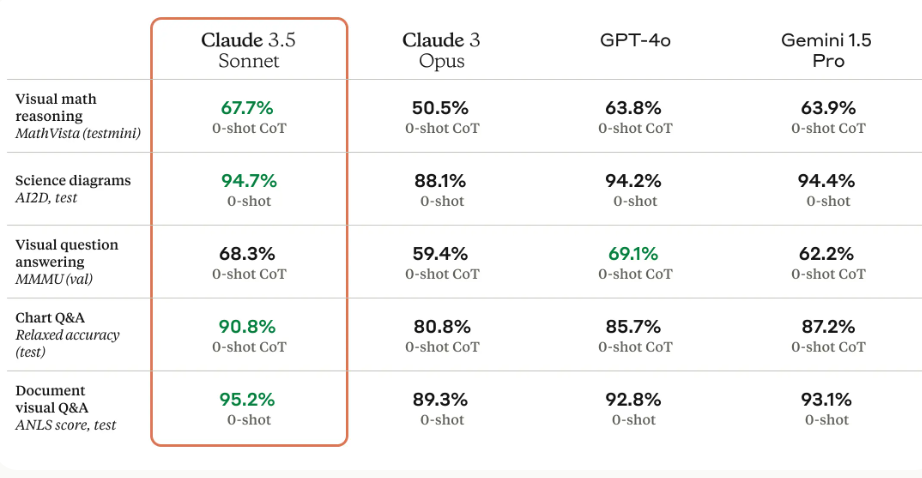
The Claude 3.5 Sonnet also achieved major breakthroughs in visual processing, surpassing the Claude 3 Opus in standard visual benchmarks. It performs especially well at tasks that require visual reasoning, such as interpreting charts and graphs, and can accurately transcribe text from imperfect images, which has important implications for industries such as retail, logistics and financial services.
New feature: Artifacts
Anthropic also launched the Artifacts function on Claude.ai, expanding the way users interact with Claude. Users can ask Claude to generate content such as code snippets, text documents, or website designs, which will be displayed along with the conversation in a dedicated window, creating a dynamic workspace.
Security and Privacy Commitment
Despite the leap in intelligence of the Claude 3.5 Sonnet, Anthropic says it remains at ASL-2 safety levels. The company worked with external experts, including the UK Artificial Intelligence Safety Institute (UK AISI), to put the model through rigorous security testing. Anthropic emphasizes that it does not use user-submitted data to train its generative models unless the user explicitly allows it.
future outlook
Anthropic plans to complete the Claude 3.5 series with the release of Claude 3.5 Haiku and Claude 3.5 Opus later this year. The company is also developing new modes and features to support more enterprise use cases, including integration with enterprise applications and personalized memory capabilities.
Anthropic invites users to submit feedback directly within the product to help improve Claude 3.5 Sonnet and guide future development paths.
The launch of Claude 3.5 Sonnet marks another important advancement in AI technology. Its powerful performance and rich functions will bring users a more convenient and efficient AI experience. Anthropic’s continued innovation and emphasis on user feedback are also worth looking forward to.