
OpenAI has released CriticGPT, an AI model for identifying and correcting errors in code generated by ChatGPT. CriticGPT is based on the powerful GPT-4 model, focuses on code review, and is improved through reinforcement learning and human feedback, aiming to improve code quality and review efficiency. It does an excellent job of reducing useless “nitpicking” and false positives, and in some cases successfully uncovers previously unnoticed errors. This article will introduce in detail the main features, development process, experimental results, potential applications and limitations of CriticGPT.
OpenAI researchers on Thursday announced the launch of CriticGPT, an innovative AI model designed to identify and correct errors in code generated by ChatGPT. This breakthrough marks an important step forward in self-improvement and quality control of artificial intelligence technology.

Key features of CriticGPT
1. Based on the GPT-4 series: CriticGPT is built on the powerful GPT-4 language model.
2. Focus on code review: mainly used to analyze the programming code generated by ChatGPT and point out potential errors.
3. Human-machine collaboration: Acts as an AI assistant to human trainers to improve the efficiency and accuracy of code review.
4. Reinforcement learning: Improve the "alignment" of the AI system by learning from human feedback (RLHF).
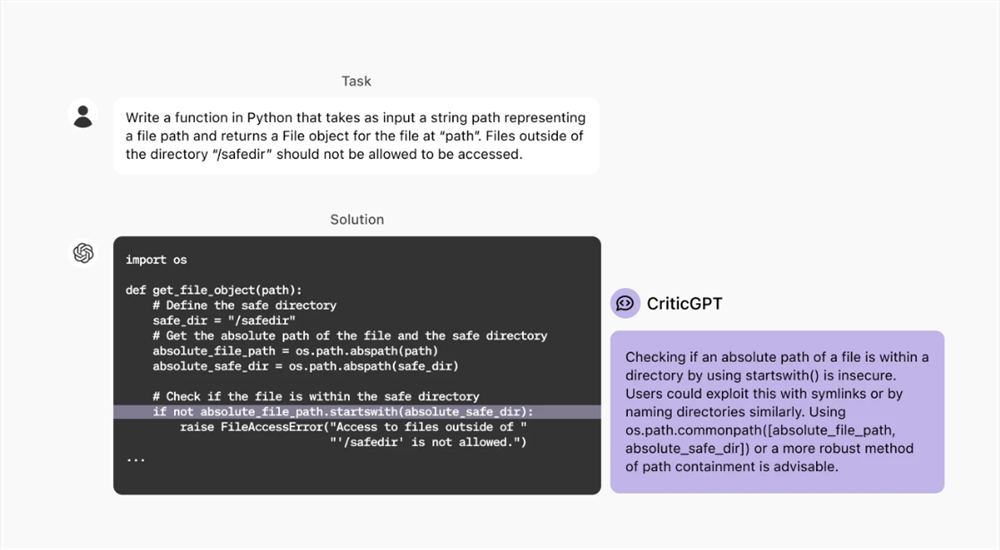
Development process and results
Researchers used innovative training methods to develop CriticGPT:
1. Data set preparation: Use code samples with intentionally inserted errors for training.
2. Human participation: Human trainers are required to modify the code written by ChatGPT, introduce errors and provide feedback.
3. New technology application: Introducing "Forced Sampling Beam Search" (FSBS) technology to balance the generation of detailed comments and fictitious questions.
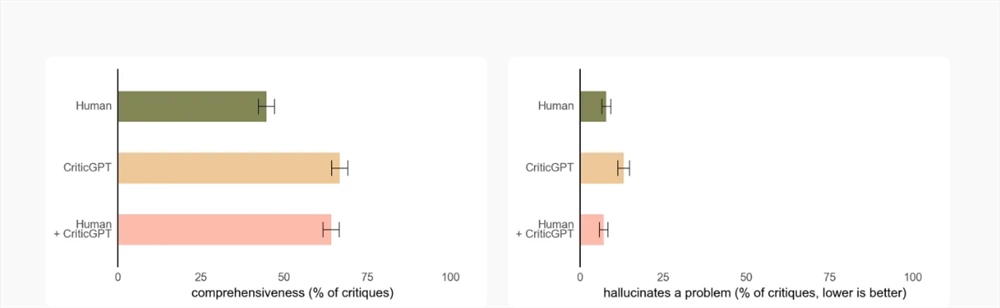
The experimental results show:
- In 63% of naturally occurring error cases, humans preferred CriticGPT.
- CriticGPT reduces useless "nitpicking" and false positive/hallucination issues.
- CriticGPT successfully found and confirmed bugs in 24% of cases that were previously considered perfect.
Potential applications and limitations
Although CriticGPT is primarily targeted at code reviews, research shows that it has the potential to generalize to non-coding tasks. However, this model also faces some limitations:
1. Mainly trained on shorter ChatGPT answers and may not be suitable for more complex tasks.
2. Although fictitious behavior has been reduced, it has not been completely eliminated.
3. There is still room for improvement in identifying errors distributed across multiple parts.
future outlook
OpenAI plans to integrate CriticGPT-like models into its RLHF tagging pipeline to provide AI assistance to trainers. This represents an important advance in the development of tools for evaluating large language model (LLM) output. However, the researchers also emphasized that even with AI assistance, extremely complex tasks remain challenging for human evaluators.
As AI technology continues to develop, innovations like CriticGPT will play a key role in improving the accuracy and reliability of AI systems, driving further alignment of AI with human needs.
Address: https://openai.com/index/finding-gpt4s-mistakes-with-gpt-4/
The emergence of CriticGPT heralds significant progress in self-correction and quality control of AI models, providing a new direction for the future development of AI technology. Although CriticGPT still has some limitations, its potential application value is huge and deserves continued attention and research.