
OpenAI's latest CriticGPT, a code review model based on GPT-4, has brought revolutionary changes to the field of artificial intelligence code review. CriticGPT can identify and point out a variety of errors in code, including syntax errors, logic errors, and security vulnerabilities, with an accuracy that even exceeds that of human evaluators. This model assists human experts in more accurately evaluating code by generating natural language comments, significantly improving the efficiency and accuracy of error detection and effectively reducing misjudgments caused by bias. This article will provide an in-depth analysis of the functions, technical methods and experimental results of CriticGPT, showing its potential in improving code quality and promoting technological progress.
In the field of artificial intelligence, code generation and review have always been important battlefields for technological progress. OpenAI recently launched a model based on GPT-4, CriticGPT, which is specially designed to review the code generated by ChatGPT and find errors in it. The addition of this innovative tool marks an important step towards self-supervision and error detection in artificial intelligence.
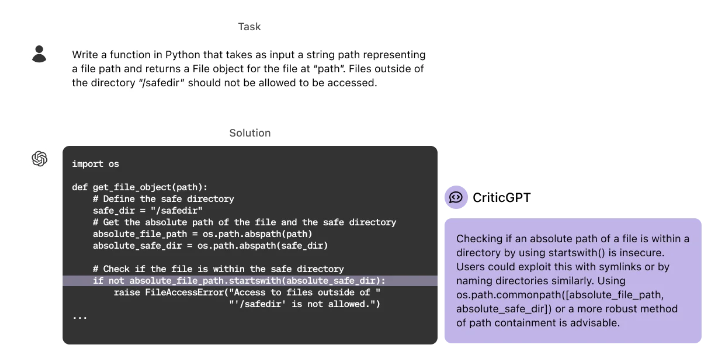
Although large language models (LLMs) like ChatGPT have achieved remarkable results in generating code, there are still uncertainties in the quality and correctness of their output. CriticGPT was born to make up for this shortcoming. It significantly improves the capability and efficiency of error detection by generating natural language comments to assist human experts in evaluating code more accurately.
Excellent performance in error detection
CriticGPT does an excellent job of identifying errors in code, whether they are syntax errors, logic errors, or security vulnerabilities. It can identify and point them out one by one. Research shows that CriticGPT detects even more errors than human evaluators, a finding that is revolutionary in the field of code review.
Reduce bias and improve collaboration efficiency
CriticGPT also makes a significant contribution in reducing hallucination errors. By collaborating with human experts, CriticGPT is able to significantly reduce bias in error detection while maintaining efficient error identification capabilities. This "human-machine cooperation team" working model provides a new perspective for error detection.
CriticGPT’s main features
Error Detection: CriticGPT comprehensively analyzes the code to identify and report various errors while avoiding phantom errors.
Critical review generation: Provide detailed error analysis and improvement suggestions to help the team deeply understand and solve the problem.
Enhance training results: Work with human trainers to improve the quality and reach of reviews.
Reduce false errors: Use forced sampling beam search strategy to reduce unnecessary false annotations.
Model training and optimization: Continuously optimize the performance of CriticGPT through RLHF training.
Accurate search and evaluation: Balance problem finding with false positives to provide accurate error reporting.
Enhanced collaboration between humans and AI: used as an auxiliary tool to improve assessment efficiency and accuracy.
Technical methods and experimental results
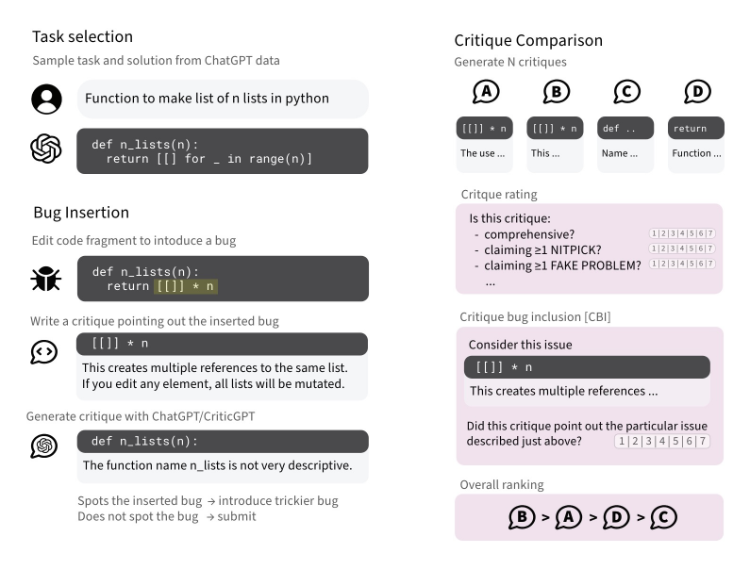
CriticGPT is trained from human feedback via reinforcement learning, focusing on handling input that contains errors. The researchers trained CriticGPT by manually inserting errors into the code and providing feedback. Experimental results show that CriticGPT is more favored by trainers when providing criticism. Its criticisms are of higher quality and more helpful in discovering and solving problems.
The introduction of this technology not only improves the accuracy of code review, but also provides new possibilities for self-supervision and continuous learning of artificial intelligence. With the continuous optimization and application of CriticGPT, we have reason to believe that it will play an important role in improving code quality and promoting technological progress.
Paper: https://cdn.openai.com/llm-critics-help-catch-llm-bugs-paper.pdf
All in all, the emergence of CriticGPT marks a major breakthrough for AI in the field of code review. It not only improves code quality, but also provides a new direction for AI self-supervision and continuous learning. In the future, the application of CriticGPT will further promote the efficiency and safety of software development.