
GuijiAI announced that it has open sourced its artificial intelligence-based digital human interaction platform DUIX (Dialogue User Interface System), providing developers with a convenient tool to build personalized digital human applications. DUIX supports access to multi-party large models, speech recognition and speech synthesis capabilities, and can be deployed to Android and iOS platforms with one click. This open source initiative lowers the threshold for digital human development and provides the possibility for application expansion in various industries.
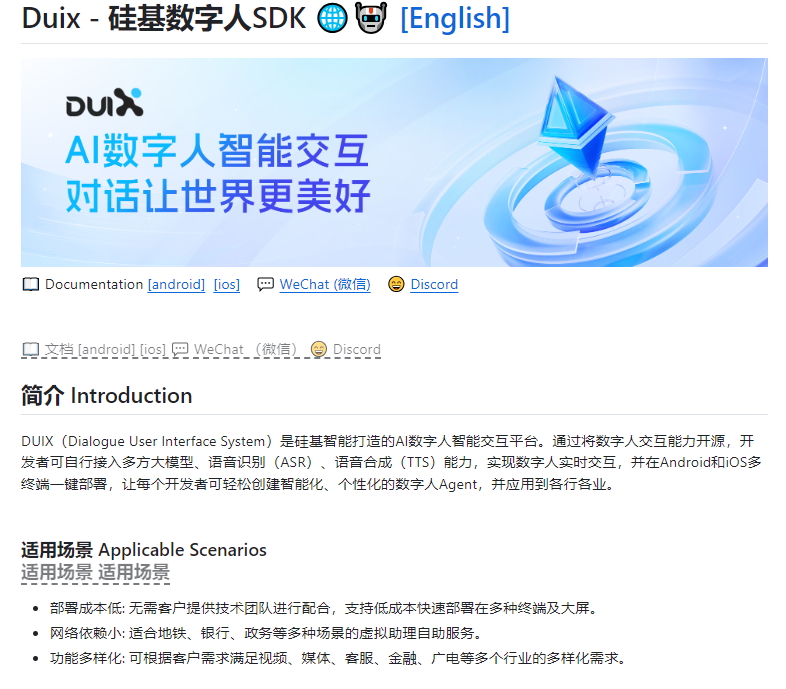
Open source entrance: https://github.com/GuijiAI/duix.ai
After being open sourced, developers can access multi-party large models, speech recognition (ASR), and speech synthesis (TTS) capabilities on their own to realize real-time interaction between digital people and deploy it on multiple Android and iOS terminals with one click.
This allows every developer to easily create intelligent and personalized digital human agents and apply them to various industries. DUIX has the advantages of low-cost deployment, small network dependence and diversified functions. It is suitable for various scenarios such as subways, banks, government affairs, video, media, customer service, finance, radio and television, etc.
Core functions
Low deployment cost: There is no need for customers to provide technical teams for cooperation, and it supports low-cost and rapid deployment on a variety of terminals and large screens. Low network dependence: Suitable for virtual assistant self-service in various scenarios such as subways, banks, government affairs, etc. Diversified functions: It can meet the diverse needs of video, media, customer service, finance, radio and television and other industries according to customer needs.The open source of the DUIX platform marks the move towards a more convenient and popular stage for the application of digital human technology, providing developers and enterprises with more innovation and application possibilities. Its low cost, easy deployment and diversified functions indicate that digital human technology will play a role in more fields, improve user experience and create new value.