
Qualcomm recently released an innovative software called "AI Commander" that aims to integrate artificial intelligence technology into daily life. This software is not a simple AI assistant, but plays the role of an intelligent bridge connecting personal data, applications and AI models, and is committed to providing highly personalized and efficient intelligent services. The editor of Downcodes will give you an in-depth understanding of the uniqueness of this software and its impact on future smart life.
Chip giant Qualcomm recently launched an innovative software called AI Commander, which aims to integrate artificial intelligence technology more closely with users' daily lives. The core goal of this software is to coordinate AI models and applications directly on user devices, becoming an intelligent bridge connecting personal data, applications and AI models.
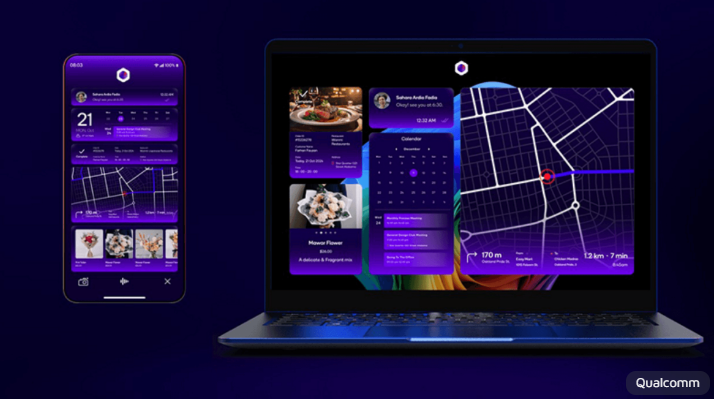
AI Commander is designed to combine the user's personal preferences, daily activities and social circle information with a generative AI assistant to provide highly personalized responses and action recommendations. It supports a variety of input methods, including text, images, and voice, and leverages the capabilities of apps installed on your device. Qualcomm emphasized that local processing on the device can not only significantly improve response speed, but also better protect user privacy.
The core technology of this software is to process user input through components such as RAG (Retrieval Augmentation Generation) and agent-based AI to generate personalized responses suitable for different scenarios. Qualcomm gave a vivid application scenario: when arranging dinner, the AI commander can automatically coordinate the schedule, book restaurants, adjust the calendar, and flexibly respond to unexpected changes.
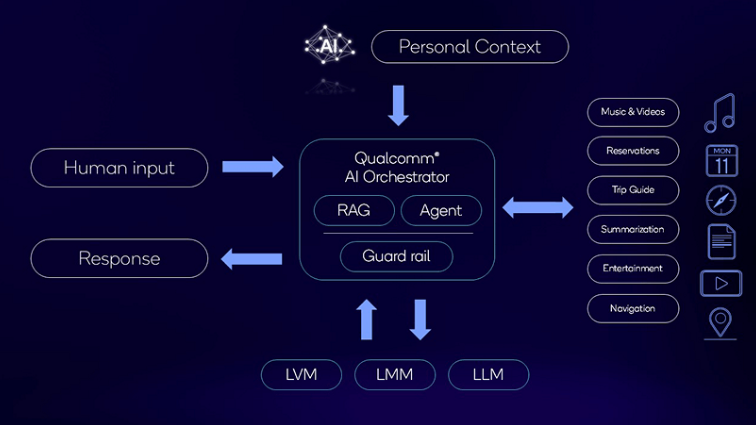
AI Commander will be deeply integrated with Qualcomm’s AI technology stack and become a mediator between applications and AI frameworks and runtimes. Qualcomm plans to further expand its capabilities, especially in enabling seamless connectivity between devices and between devices and cars. More details will be revealed at Qualcomm’s annual Snapdragon Summit starting on October 21.
However, industry experts point out that there is currently no fully reliable agent AI system on the market. Mustafa Suleiman, head of Microsoft AI, believes that advanced AI agents that can support such complex tasks may require two generations of technology development to mature. At the same time, OpenAI plans to launch a market-ready AI agent system next year, and Google DeepMind CEO Demis Hassabis expects this technology to be implemented within one to two years.
Nonetheless, Qualcomm’s move to launch AI Commander undoubtedly demonstrates the company’s vision for the future of AI. It not only reflects the technology industry's pursuit of personalized intelligent services, but also outlines an exciting blueprint for intelligent life for users. Although it will take time to realize a truly mature AI agent system, the emergence of AI commanders has undoubtedly injected new vitality into the development of smart devices.
All in all, Qualcomm’s AI Commander represents a new direction in the application of artificial intelligence technology. Although it still faces technical challenges, its innovation and development potential cannot be ignored. In the future, as technology continues to mature, AI commanders may become an indispensable part of our daily lives, bringing us a more convenient and intelligent life experience. The editor of Downcodes will continue to pay attention to the subsequent development of this product, so stay tuned.