
OpenAI announced that its latest AI models o1-preview and o1-mini are available to ChatGPT Enterprise and ChatGPT Edu users. These two powerful models are designed to handle complex reasoning tasks and are expected to revolutionize the way organizations and academic institutions solve problems, showing great potential in fields such as advanced programming and scientific research. The editor of Downcodes will explain in detail the characteristics of these two models and how they will affect various industries.
OpenAI has made its latest AI models o1-preview and o1-mini available to all ChatGPT Enterprise and ChatGPT Edu customers. Designed to handle complex reasoning tasks, these models have the potential to transform the way organizations and academic institutions solve difficult problems, ranging from advanced programming to scientific research.
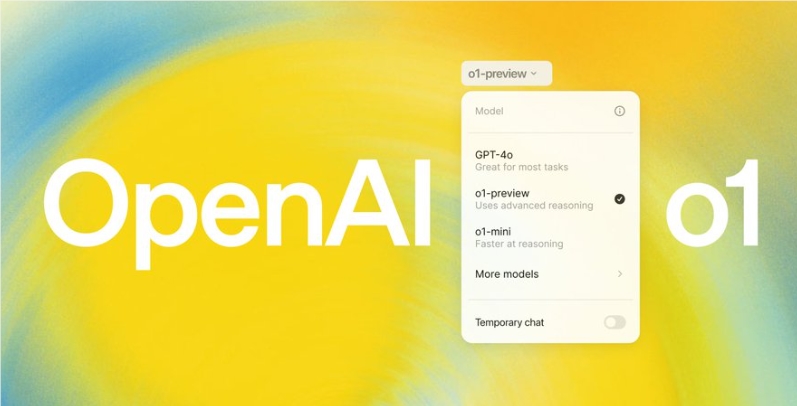
The o1 model debuted earlier this month and represents a major attempt by OpenAI to create AI capable of deep multi-step reasoning. By simulating human thinking processes, these models can solve complex problems that previously were difficult for AI models to deal with, bringing new possibilities to industries that rely on advanced problem solving.
Compared to their predecessors, the o1-preview and o1-mini models are more rigorous in their thinking and can spend more time processing information before responding. Early testing shows that o1-preview solved 83% of the problems in the International Mathematical Olympiad qualifying exam, while the previous GPT-4o only solved 13%.
The o1-mini model is designed specifically for programming tasks, providing a more cost-effective option for businesses that require advanced problem-solving capabilities but do not require extensive world knowledge. This makes o1-mini particularly useful for tasks such as generating and debugging complex code, especially for small businesses and developers.
For enterprise customers, these new models represent a huge leap forward. More and more enterprises regard AI not only as an automation tool, but also as a partner in solving complex and high-risk problems. The o1 model is able to reason, refine strategies and identify errors, making it suitable for companies dealing with complex data sets and workflows.
In the field of education, the o1 model also has great potential. Many universities and research institutions face resource and time constraints when conducting complex data analysis or research. OpenAI makes these models available to educational users, enabling students and researchers to leverage cutting-edge AI tools to solve difficult problems in their fields.
In addition, the o1 model is equipped with enhanced security features, and OpenAI promises not to use customer data for training to ensure the security of commercial secrets. The company has also established partnerships with AI safety agencies in the United States and the United Kingdom to ensure that the development of the technology complies with ethical standards and regulatory frameworks.
The launch of o1-preview and o1-mini models demonstrates OpenAI's continuous innovation strength in the field of AI technology, and also brings more powerful AI auxiliary tools to enterprises and educational institutions. The future application prospects are worth looking forward to. The editor of Downcodes will continue to pay attention to the development of AI technology and bring more exciting reports.