
In recent years, the field of art conservation has increasingly relied on non-destructive imaging technologies. Macroscopic X-ray fluorescence (MA-XRF) analysis technology is a powerful tool that provides researchers with an effective means of analyzing painting pigments and techniques, but the massive data it generates also brings new challenges. The editor of Downcodes will introduce to you a study that uses deep learning technology to break through the bottleneck of traditional MA-XRF data analysis.
In recent years, non-destructive imaging technology has achieved rapid development in the field of painting research and protection. Macroscopic X-ray fluorescence (MA-XRF) analysis technology, as one of the leaders, can help experts identify pigments, analyze painting techniques, and provide a better understanding of artists' creations. process provides valuable information. However, MA-XRF technology generates large and complex data sets, posing challenges to traditional data analysis methods.
Recently, Italian researchers applied deep learning algorithms to spectral analysis of MA-XRF data sets and developed a new set of analysis methods. This method uses more than 500,000 synthetic spectra generated by Monte Carlo simulation to train a deep learning algorithm and can quickly and accurately analyze XRF spectra in the MA-XRF data set, overcoming the limitations of traditional deconvolution methods.
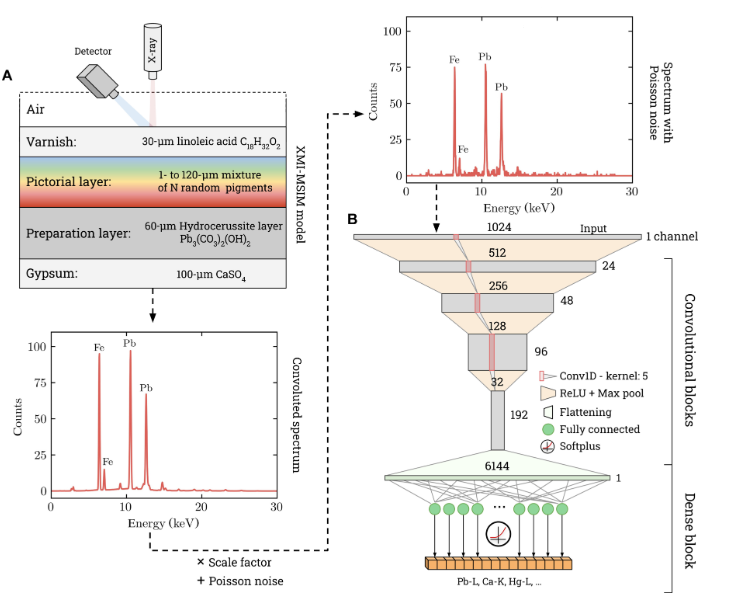
To verify the accuracy and applicability of the new method, the researchers applied it to two Raphael paintings - "God the Father" and "Virgin Mary" - on display at the Capodimonte Museum in Italy. The results show that the deep learning model can not only quantify fluorescence line intensity more accurately, but also effectively eliminate artifacts produced by traditional analysis methods and generate a clearer element distribution map.
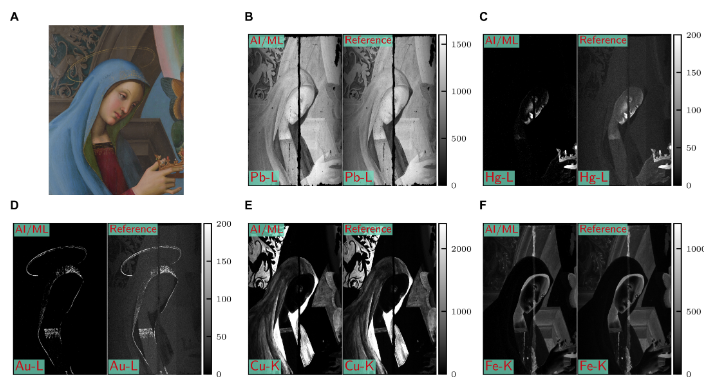
Through comparative analysis with the traditional deconvolution algorithm, the researchers found that the new method performed better when processing element lines with low counts and low signal-to-noise ratio, and could more accurately separate overlapping fluorescence lines in the XRF spectrum, thereby making it more precise. Accurately identify pigments. For example, the new method can accurately distinguish iron (Fe) and manganese (Mn) elements with similar energies, as well as lead (Pb) and sulfur (S) elements, avoiding misjudgments easily caused by traditional methods.
This research result marks a major advancement in artificial intelligence technology in the field of artwork analysis, and provides new ideas for more accurate and efficient analysis of XRF spectra, especially for processing large data sets generated by MA-XRF imaging technology. In the future, the researchers plan to further expand the scope of applications of this method, such as inferring the tomographic structure of paintings or comparing spectral data obtained by different instruments.
Paper address: https://www.science.org/doi/10.1126/sciadv.adp6234
This research fully demonstrates the great potential of deep learning in the field of artwork analysis, and provides new technical means for art protection and research. The editor of Downcodes looks forward to more artificial intelligence technology being used in the art field in the future to promote the further development of art research. .