
The editor of Downcodes will introduce you to MMed-RAG, a new multi-modal retrieval enhanced generation system, which aims to solve the long-standing problem of fact illusion in medical large-scale visual language models (Med-LVLMs), thereby significantly improving medical diagnosis. accuracy and reliability. The core of MMed-RAG lies in its unique domain-aware retrieval mechanism and adaptive calibration method, which can intelligently select the most appropriate retrieval model and contextual information based on different medical image types, thereby achieving more efficient and accurate medical image analysis. This not only improves diagnostic efficiency, but also reduces the risk of misdiagnosis, providing a new direction for the future development of smart medical care.
In recent years, the impact of artificial intelligence (AI) on the medical industry has become increasingly significant, especially in disease diagnosis and treatment planning. The development of medical large-scale visual language models (Med-LVLMs) provides new possibilities for realizing smarter medical diagnostic tools. However, in practical applications, these models often face a problem that cannot be ignored, that is, fact illusion. This phenomenon may not only lead to incorrect diagnostic results, but may also have serious consequences for the patient's health.
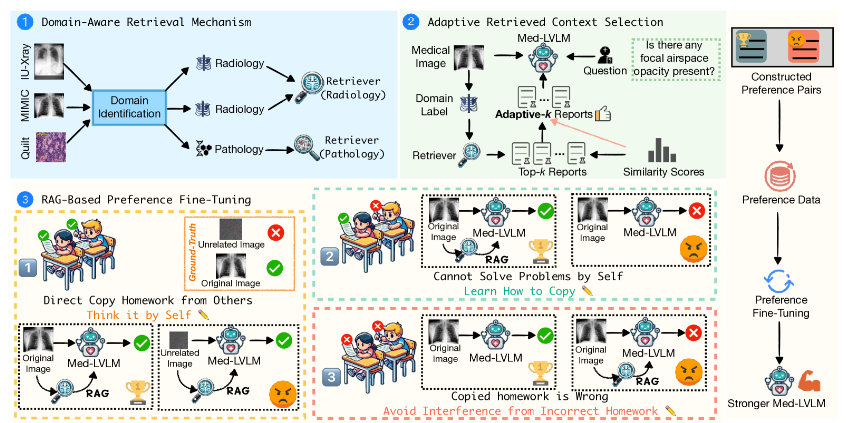
In order to solve this problem that plagues medical AI, researchers have developed a new multi-modal retrieval enhancement generation system, named MMed-RAG. The design goal of this system is to improve the factual accuracy of Med-LVLMs, thus enhancing the reliability of medical diagnosis. The biggest highlight of MMed-RAG is that it has a domain-aware retrieval mechanism, which allows it to perform more efficiently and accurately when processing different types of medical images.
Specifically, MMed-RAG uses a domain recognition module, which is used to automatically select the most appropriate retrieval model based on the input medical images. This adaptive selection method not only improves the accuracy of retrieval, but also ensures that the system can quickly respond to the needs of various medical images. For example, when a doctor uploads a radiology image, the system can instantly identify which field the image is from and select the corresponding model for analysis.
In addition to this, MMed-RAG also introduces an adaptive calibration method for intelligently selecting the amount of retrieved context. In the past, many systems retrieved a large amount of information at once during retrieval, but this information was not necessarily helpful for the final diagnosis. Through adaptive calibration, MMed-RAG can select the most appropriate contextual information in different scenarios, thereby improving the efficiency of information utilization.
On the basis of this system, MMed-RAG also incorporates a RAG-based preference fine-tuning strategy. The purpose of this strategy is to improve the cross-modal and overall alignment of the model when generating answers.
Specifically, the system designed some preference pairs to encourage the model to make full use of medical images when generating answers, even if some answers are correct without images, try to avoid them. In this way, it not only improves the accuracy of diagnosis, but also helps the model better understand the retrieved contextual information when facing uncertainty and avoid interference from irrelevant data.
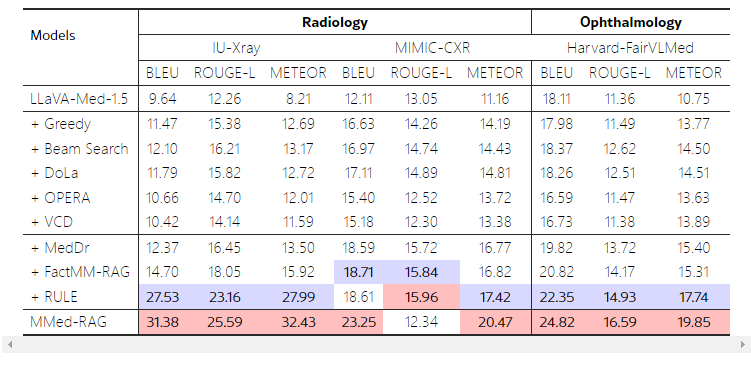
Through testing on multiple medical datasets, MMed-RAG performed extremely well. The researchers found that the system improved factual accuracy by an average of 43.8% , greatly enhancing the reliability of medical AI. This achievement not only injects new impetus into the intelligentization process in the medical field, but also provides reference ideas for the development of future medical diagnostic tools.
With the advent of MMed-RAG, we can expect that future medical AI will be able to serve doctors and patients more accurately and truly realize the vision of smart healthcare.
Paper: https://arxiv.org/html/2410.13085v1
Project entrance: https://github.com/richard-peng-xia/MMed-RAG
Highlight:
The MMed-RAG system improves the processing capabilities of different medical images through a domain-aware retrieval mechanism.
The adaptive calibration method ensures that the selection of retrieval context is more accurate and information utilization is more efficient.
Experimental results show that MMed-RAG's factual accuracy on multiple medical datasets is improved by 43.8%.
The emergence of MMed-RAG marks a major breakthrough in the accuracy and reliability of medical AI, pointing out the direction for the future development of intelligent medical care. We look forward to more similar research results that will benefit more doctors and patients!