
On November 12, at the Baidu World 2024 Conference, Baidu founder Robin Li made his latest statement on large models and AI applications. In his speech, Robin Li said that the biggest change that has occurred in the AI industry in the past two years is that large models have basically eliminated illusions, allowing AI to become usable and trustworthy from "serious nonsense". Based on the rapid iteration of technology, Robin Li judged that AI applications are about to usher in an explosive period.

As a technology company that has been deeply involved in the field of AI for 10 years and invested more than 170 billion, Baidu has continued to regard AI applications as an important strategic direction since it released the first generative AI in China. Today, the impact of Baidu's strategy is gradually emerging: more and more companies and individuals are developing their own AI applications and agents through Wenxin large models, using large models to create incremental value. Baidu's latest data shows that Baidu Intelligent Cloud already has the largest scale of large-scale model industry implementation in China, and has helped various enterprise users develop a total of 770,000 enterprise-level applications.
In just one year, the average daily calls of Baidu Wenxin’s large model increased by about 30 times.
On November 12, Robin Li revealed at a press conference that as of the beginning of November, the average daily calls of Baidu Wenxin's large model exceeded 1.5 billion, an increase of 7.5 times compared with the 200 million disclosed in May, and compared with the first time a year ago. The 50 million disclosed times increased by about 30 times.

This set of data that exceeded Robin Li's expectations reflects the real demand for AI in thousands of industries. The steep growth curve also represents the explosion of large-scale model applications in China in the past two years.
Over the past year, domestic large models have experienced rapid development. With the gradual accumulation of technology, how to truly apply AI to thousands of industries and maximize its incremental value has become an important area for large model manufacturers to compete for layout. In this track with strong commercial potential, Baidu has regarded it as one of its important strategies from the beginning, and through the ecological construction of AI applications, it has greatly expanded the actual implementation of the Wenxin model in various industry scenarios.
According to Shen Dou, president of Baidu Intelligent Cloud Business Group, AI applications are taking the lead in breaking out on the B-side (enterprise side). In the energy and power industry, State Grid is focusing on the Wenxin Big Model and Qianfan Platform, combined with high-quality data in the power industry, and working with Baidu to create the basic base of the power industry big model, and in-depth exploration in six major professional fields such as dispatching, equipment, and marketing. At present, the application has been successfully implemented in core scenarios of the power industry such as power equipment operation inspection and power supply services.
Precisely because of its early deployment, the current practical application cases of Baidu Wenxin's large model have spread across various fields such as finance, energy, education, recruitment, public services, etc., helping various enterprises to significantly reduce operating and production costs and improve output efficiency. At the same time, it also provided assistance for Baidu to quickly open up the B-side market.
According to Robin Li, currently on Baidu Smart Cloud's Qianfan large model platform, Baidu has helped users fine-tune 33,000 large models and developed 770,000 enterprise-level applications. Baidu Smart Cloud already has the largest large model in China. Regarding the scale of industrial implementation, more than 60% of state-owned enterprises and many private enterprises are working with Baidu Intelligent Cloud to carry out AI innovation.
When it comes to AI applications, in addition to the rapid development of the enterprise side, the application of C-side individual users in various scenarios is also growing rapidly. In particular, Baidu continued its comprehensive AI reconstruction of its Baidu Library, Baidu Search, Baidu Maps and other products last year.
Taking Baidu Wenku as an example, this product has evolved from a document sharing platform to a "one-stop AI content acquisition and creation platform", expanding its application scenarios to multiple fields such as learning and office, family education, entertainment consumption, etc. It has also launched functions such as smart PPT, smart writing, mind mapping, research reports, pictures and essays, smart picture books, and smart comics, becoming an "AI treasure chest" for content creation.
At present, Baidu Wenku AI’s monthly active users have reached the first echelon in China. Baidu Wenku's AI function has achieved the third consecutive number of monthly active users of all domestic AI applications in the second quarter of 2024 (AI product list), and its smart PPT market share has reached 80%. As of October 2024, the number of Baidu Wenku AI users has exceeded 230 million, and the cumulative number of AI functions used has exceeded 2.8 billion.
In fact, it is the continuous accumulation of technology in the field of AI that has continuously improved the availability of Baidu's AI products, and this has also helped Baidu achieve a new growth curve.
Looking back on its past history, Baidu began to lay out AI technology in 2010, and then established the Deep Learning Research Institute in 2013. In 2014, it got involved in autonomous driving and established the Baidu Research Institute. In 2016, Baidu released Baidu Brain and transformed into an AI company. At the same time, it open sourced the deep learning framework Feipiao. Since then, Baidu has continued to make breakthroughs in the field of AI, including the release of the cloud AI chip "Kunlun", which has led the number of patent applications for many years. Baidu Brain has also continued to upgrade and open up a large number of AI capabilities. By 2023, Baidu will launch large-scale models such as Wen Xinyiyan, further improving the usability of AI technology. In the past ten years, Baidu has invested more than 170 billion in AI, demonstrating its deep accumulation and continuous innovation in the field of AI.
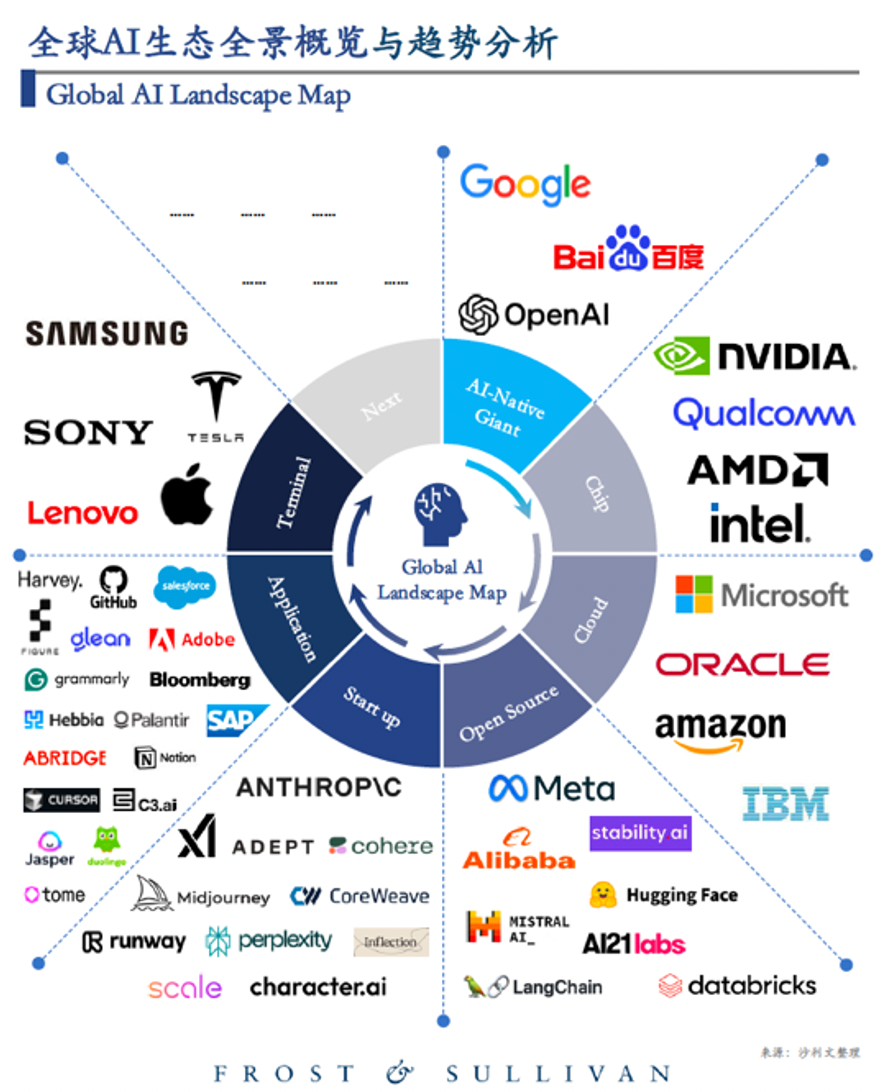
Recently, the well-known organization Sullivan published the "2024 Global AI Ecosystem Panoramic Overview" report, revealing the latest pattern of the global AI field. In this report, Baidu, Google, and OpenAI are located in the same quadrant of AI-Native Giant, demonstrating its core position in the global AI ecosystem.
On November 12, Robin Li once again announced the latest iteration of Baidu AI technology at Baidu World 2024. Among them, iRAG, the enhanced retrieval technology for Vincentian images, combines the hundreds of millions of image resources searched by Baidu with powerful basic model capabilities to generate a variety of ultra-realistic images. “The overall effect far exceeds the original Vincentian system, without the need for machines. taste". iRAG technology has greatly improved the usability of AI-generated images, with commercial value such as no illusion, ultra-realism, no cost, and immediate availability.
In addition, in Robin Li's view, among the two general directions of AI applications, in addition to industrial applications, the other is intelligent agents. In the past, the most important threshold for developing intelligent agents was writing programs, which was also broken by Baidu's latest tool "Miaida".
The birth of this tool also means a profound change in the way intelligent agents are developed. As a codeless development tool, it is a software that can realize any idea without writing code. It covers features such as codeless programming, multi-agent collaboration, and multi-tool invocation. You can build various applications just by talking. These characteristics give Miaida huge potential in promoting the popularization and application innovation of AI. It can help more people and more companies create millions of "super useful" applications.
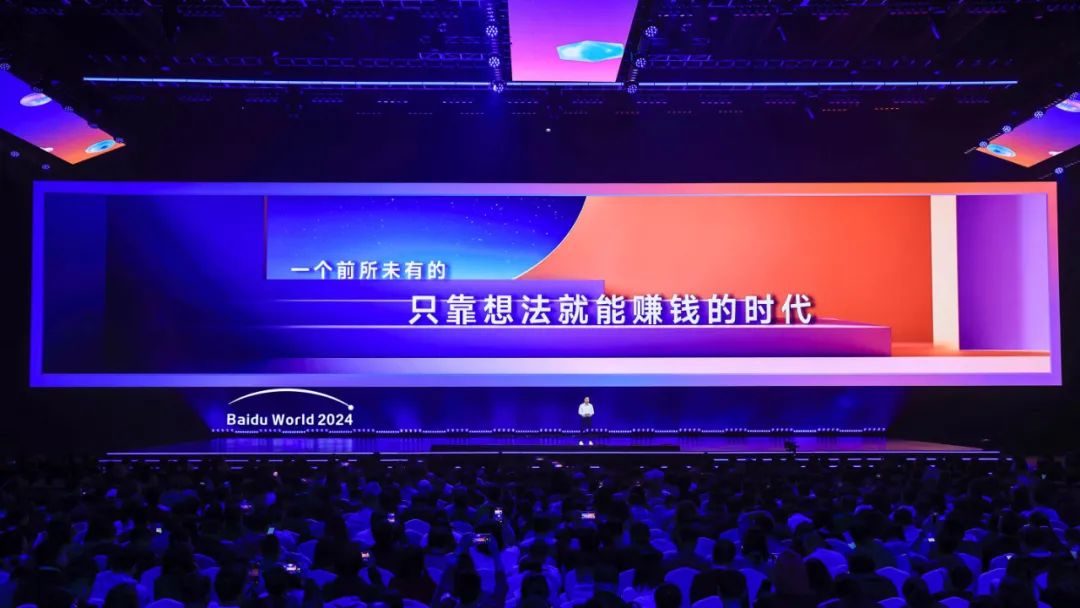
This also means that the threshold for developing AI agents has been significantly lowered. There is no need to recruit project managers, designers, developers, testers, etc., and you can command multiple agents to complete tasks collaboratively. This is why Robin Li said, "We will usher in an unprecedented era where we can make money just by relying on ideas."
After solving the technical threshold, the difficulty of intelligent agent development is greatly reduced, which also means that the application scenarios contain huge potential.
From Baidu's perspective, building an agent is very similar to building a website in the PC era, or building a self-media account in the mobile era. The difference is that the agent is more human-like, more intelligent, and more like your sales, customer service, and assistant. On that day, Robin Li demonstrated four different types of agents at the scene, namely company agents, role agents, tool agents and industry agents. He said that intelligent agents may become a new carrier of content, information and services in the AI native era.
Robin Li gave the example of corporate intelligence. Under the traditional PC official website model, companies can only statically display company introductions and product parameters, but lack active recommendation, timely response and one-to-one service capabilities; while corporate intelligence can be customized according to customer needs. Recommend corresponding products according to the needs. In terms of services, it can also respond to needs more directly and quickly, which can greatly improve the efficiency of interactive marketing. After BYD's official smart phone went online, the sales conversion rate increased by 119%, and the September interaction rate of Lenovo's AIPC smart phone increased by 89%.
In addition, Robin Li demonstrated the special functions and usage scenarios of multiple types of agents such as roles, tools, and industries. For example, Baidu Wenku and Baidu Netdisk jointly created the tool intelligent "Free Canvas", which allows users to freely drag documents, audio and video and other rich media materials on a "canvas"-like interface to quickly generate multi-modal content. For another example, the legal intelligence "Faxingbao" has answered 16.6 million legal questions from users. Not only can it give answers like a professional lawyer, it can also calculate the amount of legal compensation, write legal documents, and recommend suitable lawyers.
Based on the rich application scenarios of intelligent agents, how to reach users has become a big problem. It is worth mentioning that, based on Baidu’s own powerful search channels, Baidu search has become the largest entrance to agent distribution.
Baidu said its average daily distribution volume has exceeded the 10 million mark. This data indicates that Baidu's search ecosystem can effectively help enterprises and developers promote their agents and achieve profitability, and promote the growth of customer sales conversion and improvement of advertising efficiency. As more and more companies choose to access the company's intelligence, the future development space of Baidu's search business is bound to be significantly expanded.
Robin Li revealed in his speech that currently, the Wenxin Intelligent Platform has attracted the participation of 150,000 companies and more than 800,000 developers, covering a wide range of application scenarios. At the same time, he also released 100 major industrial applications based on large models on site, covering many industries such as manufacturing, energy, transportation, government affairs, finance, automobiles, education, and the Internet.
Robin Li said, "The release of these 100 major industrial applications actually represents our cognition and attitude. Baidu is not trying to launch a 'super application', but to continue to help more people and more companies create millions of applications." 'Super useful' app."