ACLM
1.0.0

การใช้งาน ACLM: วิธีการเพิ่มข้อมูลการกำเนิดแบบเลือกใช้แบบเลือก
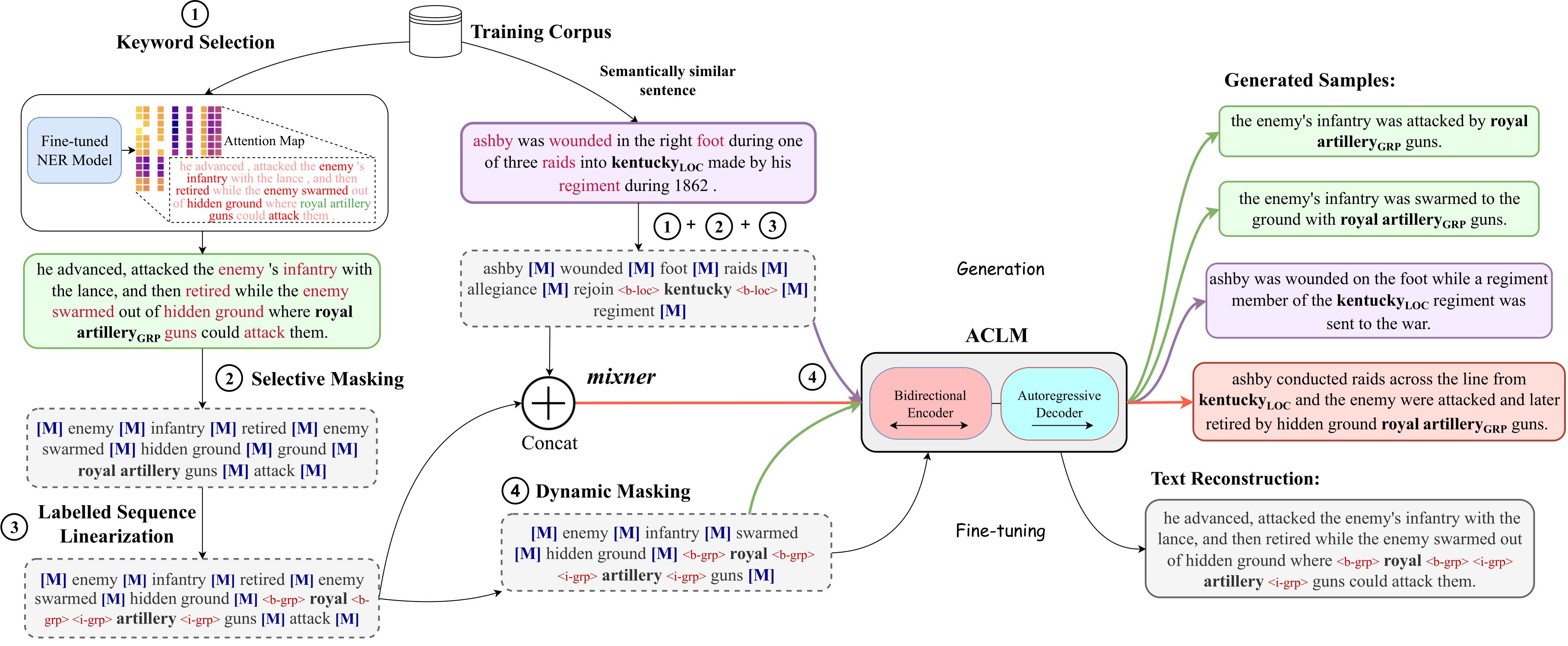
ขั้นตอน:
ติดตั้งการพึ่งพาโดยใช้:
pip install -r requirements.txt
ไปที่โฟลเดอร์รูท
cd ./src
เรียกใช้ไฟล์ sh ที่ต้องการ
sh train_dynamic_multilingual.sh <language> <language label> <size of dataset> <flair batch size> <seed> <masking rate> <number of generations>
สำหรับ Mixner :
sh train_dynamic_multilingual_mixner.sh <language> <language label> <size of dataset> <flair batch size> <seed> <masking rate> <number of generations>
ตัวอย่าง:
sh train_dynamic_multilingual.sh zh zh_CN 100 8 42 0.3 5
sh train_dynamic_multilingual_mixner.sh zh zh_CN 100 8 42 0.3 5
กรุณาอ้างอิงงานของเรา:
 @inproceedings{ghosh-etal-2023-aclm,
    title = "{ACLM}: A Selective-Denoising based Generative Data Augmentation Approach for Low-Resource Complex {NER}",
    author = "Ghosh, Sreyan  and
      Tyagi, Utkarsh  and
      Suri, Manan  and
      Kumar, Sonal  and
      S, Ramaneswaran  and
      Manocha, Dinesh",
    booktitle = "Proceedings of the 61st Annual Meeting of the Association for Computational Linguistics (Volume 1: Long Papers)",
    month = jul,
    year = "2023",
    address = "Toronto, Canada",
    publisher = "Association for Computational Linguistics",
    url = "https://aclanthology.org/2023.acl-long.8",
    pages = "104--125",
    abstract = "Complex Named Entity Recognition (NER) is the task of detecting linguistically complex named entities in low-context text. In this paper, we present ACLM Attention-map aware keyword selection for Conditional Language Model fine-tuning), a novel data augmentation approach based on conditional generation, to address the data scarcity problem in low-resource complex NER. ACLM alleviates the context-entity mismatch issue, a problem existing NER data augmentation techniques suffer from and often generates incoherent augmentations by placing complex named entities in the wrong context. ACLM builds on BART and is optimized on a novel text reconstruction or denoising task - we use selective masking (aided by attention maps) to retain the named entities and certain keywords in the input sentence that provide contextually relevant additional knowledge or hints about the named entities. Compared with other data augmentation strategies, ACLM can generate more diverse and coherent augmentations preserving the true word sense of complex entities in the sentence. We demonstrate the effectiveness of ACLM both qualitatively and quantitatively on monolingual, cross-lingual, and multilingual complex NER across various low-resource settings. ACLM outperforms all our neural baselines by a significant margin (1{%}-36{%}). In addition, we demonstrate the application of ACLM to other domains that suffer from data scarcity (e.g., biomedical). In practice, ACLM generates more effective and factual augmentations for these domains than prior methods.",
}





