Sensorboxes Bat Cave
1.0.0

BatCave is a sattelite (low-power sensor) of the Nature 4.0 project. It is designed to monitor the temperature inside of tree holes in low frequencies (> 1min) over a long period of time without changing the Battery.
The chosen components are listed here, each with it's important features named.
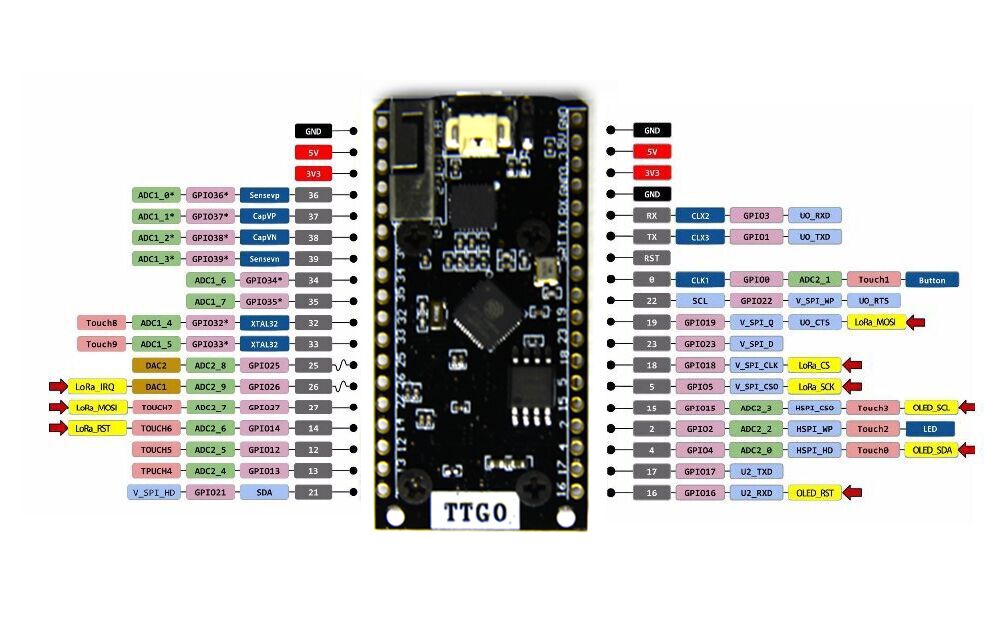
#define ONE_WIRE_BUS 15

#define SD_CS 23
#define SD_SCK 17
#define SD_MOSI 12
#define SD_MISO 13

#define SDA 21
#define SCL 22
The TTGO LoRa provides 3x GND, 2x 5V and 2x 3.3V. Most SD card breakouts, the RTC and the temperature sensors can run on 5V and can therefore be chosen freely. However I'd recommend to use 5V for the temperature sensors, especially when using longer (> 1m) cables.
The normal operation consists of:
If one step fails, this error needs to be logged, and the rest of the operation shall continue, for example:
The TTGO LoRa is kind of picky when using together with an SD breakout, the actual solution is to use multiple SPI busses, the rerouted Hardware-SPI for the SD and a Software-SPI for the SX1278. Details are explained here: http://github.com/jonashoechst/ttgo-lora-sd.
The deep sleep function of the ESP boards is very low power, which can lead to a shutdown of powerbanks (a function useful, when a charging smartphones is filled).
The TTGO LoRa v1 has trouble with power consumption. As discussed in this forum, the CP2102 usb-serial chip is in an active state when turned on and only going to suspend after beeing disconnected from a USB host. Possible fixes are suggested here.
The board will draw ~3 mAh with disabled CP2102 in contrast to ~10 mAh with a suspended CP2102.
     ms, shunt_mV,    bus_V, current_mA,  power_mW,     state
  80305,   -0.290, 3.336000,  -3.100000, 10.000000, suspended
 121786,   -1.020, 3.328000, -10.200000, 36.000000,    active
Also, the SX1276 LoRa modem has a low power mode which ineffective when the TTGO is in deep sleep (resulting from a high pin in deep sleep).
Possible alternatives:







