WARS Birdhouse
V1 - Working prototype

Looking for a different way to tweet? This project explores the potential of using low-cost/low-bandwidth LoRa radios to build simple mesh networks that can pass text messages around town. Networks of this type could be useful for emergency communications or other applications that can take advantage of the fully-autonomous (carbon-neutral) nature of the birdhouse repeater stations. This project is being undertaken by members of the Wellesley Amateur Radio Society, W1TKZ. The design is made available for amateur (non-commercial) purposes in the spirit of experimentation and knowledge sharing amongst the ham community. At the very least, we're creating homes for some lucky birds in our area.
Please contact Bruce MacKinnon (KC1FSZ) if you have technical questions. I am interested in home-brew radio projects, many of which can be found on my QRZ page.
The project WIKI is located here.
Will this bird fly? Let's find out!
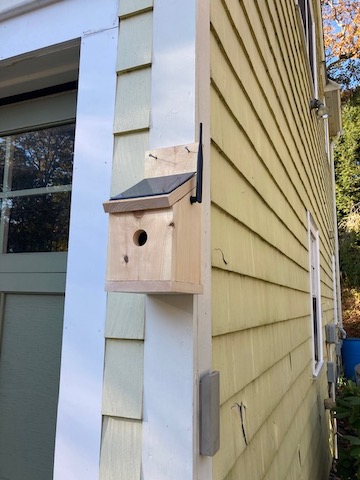
Nodes on the network are autonomous, solar-powered birdhouses that each contain a +20dBm/100mW radio (Semtech SX1276). These birdhouses will run 24x7 assuming reasonable weather conditions. USB-connected desktop nodes are used to access the network from a computer via serial connection. An internet gateway node is also under development.
LoRa range experiments have been widely documented. Your milage will vary considerably depending on terrain, station hight, etc. Testing shows that 1 km link ranges are reasonable in suburban areas.
Birdhouse packaging was chosen in order to blend into the surroundings more easily. We want this project to be environmentally friendly.
Low-power, solar design allows the birdhouses to be 100% autonomous. This makes it relatively easy to install a repeater station in any location that has good sun exposure and good visibility to other stations.
The desktop station model is powered by the USB connection, does not have the battery/solar components, but is identical to the birdhouse repeaters from an RF/firmware perspective.
The birdhouse is run by an ESP32 microcontroller at the moment, although this decision is under consideration. A more power-efficient STM32 prototype is being worked on.
Commodity components are being used to keep birdhouse costs to a minimum. Our goal is to keep the node cost under $50 USD.
The software supports a simple message routing protocol that allows packets to "hop" between houses to reach their final destination. Other control packets are used to extract engineering data and to control message routing.
The 33cm ham band (902-928 MHz) is used given that this is an experimental technology and is not FCC Part 15 certified at the moment. All nodes must be installed/operated by FCC licensed amateur/ham radio operators under Part 97 rules.
A proof-of-concept network of 5 stations has been constructed in Wellesley, MA. Messages have been successfully routed back and forth across the entire mesh, including hops between birdhouses that were separated by approximately 1 kilometer. Antenna height is important, as always. The houses have been subjected to bad New England weather conditions including snow, ice, extended periods of cloudy weather and sub-zero temperatures. It is an open question as to how the system will perform when our trees have leaves on them again!
A 15 node beta network is currently in the planning stages. This includes upgrades of the hardware and firmware.
If you are interested in high-speed mesh networks built using commercial hardware this project might not be your thing. Please take a look at AREDN (https://www.arednmesh.org) instead. The AREDN team is doing great work.
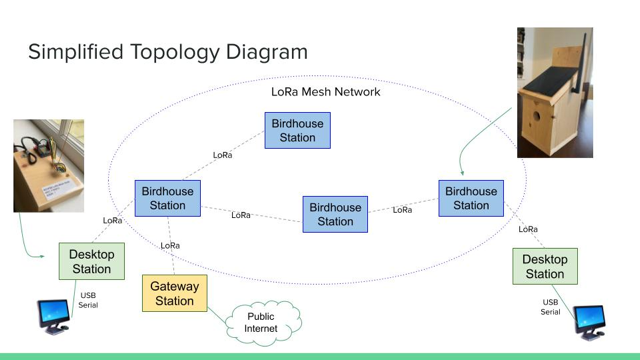
Users access the network using desktop stations that are fitted with a USB serial port. The desktop station runs exactly the same firmware as the birdhouse repeater. A serial command protocol is used to send and receive messages on the network. The desktop stations have all of the required RF components and are full-fledged nodes on the network (with their own addresses). Desktop nodes don't use the solar/battery installation since they can be powered from the USB port.
Currently users interact with the network using a conventional serial terminal running on a PC (ie. PUTTY or something similar). No special software is required. A Python desktop user interface is planned to improve ergonomics. The serial commands are described in a later section.
The expectation is that users will install a birdhouse station at some advantageous location on their property in order to join the network and increase the network coverage area. This means that the required line-of-sight for the desktop station is much less important - it's a "short hop" onto the network.
The other option is to connect the desktop station to a quality antenna using a longer feed-line and avoid the need for two stations. Either configuration is fine.
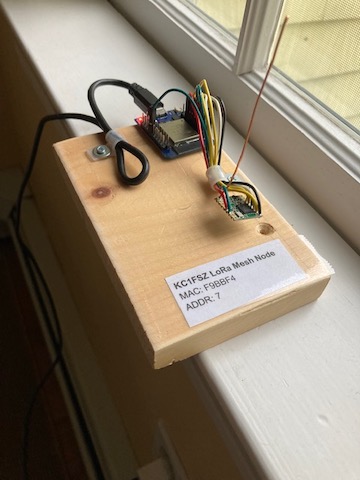
The packaging for the desktop station has not yet been finalized. At the moment the parts are mounted on a block of wood, as pictured below. A resonant vertical antenna and USB cable are included with the package.
Hardware/firmware is still being refined as part of a club project. All firmware, KiCAD files, and woodworking dimensions are available on this site for anyone who wants to build a birdhouse for themselves.
After our next hardware iteration (V2) is tested we will be making the components available in kit form.
If you live in a strategic location at high elevation and you would like a fully-assembled, tested station we will be happy to provide one free of charge. :-)
Please contact the network administrator to be assigned a node address on the network.
Yes. The radio module we are using is not Part 15 certified so it must be run using Part 97 (amateur) rules. We are currently doing research on a non-ham ISM Part 15 version of the network to make it easy for non-licensed users to join the fun. If anyone has expertise in this area please add a comment to the discussion this topic in GitHub.
Per FCC rules, Part 15 and Part 97 networks will not talk to each other.
The network runs on the 33cm (902-928 MHz) amateur band. We are running on 906.5 MHz, which lies in the digital portion of the ARRL band plan for 33cm. According to the New England Spectrum Management Council (NESMC, https://www.nesmc.org/) 902 MHz band plan, this frequency is in the "mixed use" section of the band. Our frequency has been registered in the NESMC database to ensure proper coordination with other uses of this band.
The LoRa message payload is documented here in compliance with FCC regulations. There is no encryption used anywhere in the design. The information contained here is all that a listener would need to interpret the messages.
The standard LoRa physical packet format is used. Particulars on LoRa parameters:
Here is a summary of the physical layer packet format from the Semtech documentation:
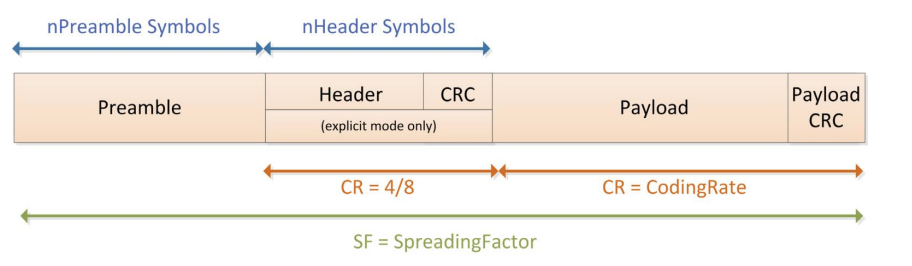
A much more detailed explanation of the LoRa encoding can be found here.
The payload above contains a 36-byte header followed by a variable length packet format. Particulars:

Each station is assigned a 16-bit address. Some addresses have special significance:
Packet types are interpreted as follows:
Most packet types are acknowledged on each hop. Packet type 1 is used for this purpose. Note that this doesn't mean that the acknowledgement reaches the original sender, it just means that each station will get an ACK to indicate that a packet has been handed off to the next station in the route path.
Acknowledgement packets (type 1) and Station ID packets (type 2) are not acknowledged.
Stations will maintain a counter for each node that is receives packet from. Duplicate packets will be discarded based on the Packet ID counter. A window will be used to avoid confusion when the counter wraps.
This packet returns technical data that is used to monitor the state of a station. Format is a follows:
2 byte and 4 byte integers are in little-endian format.
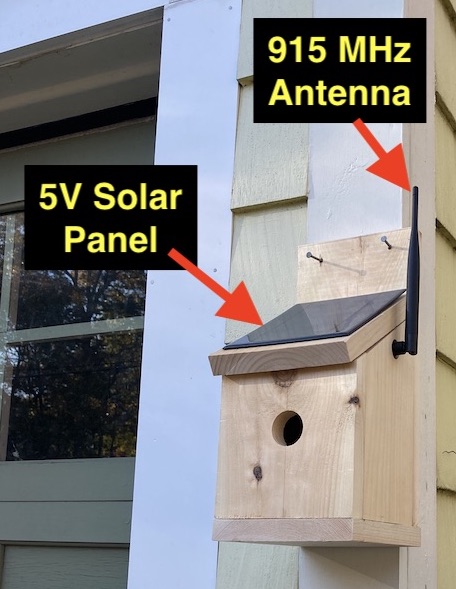
The birdhouse repeater prototype (external view):
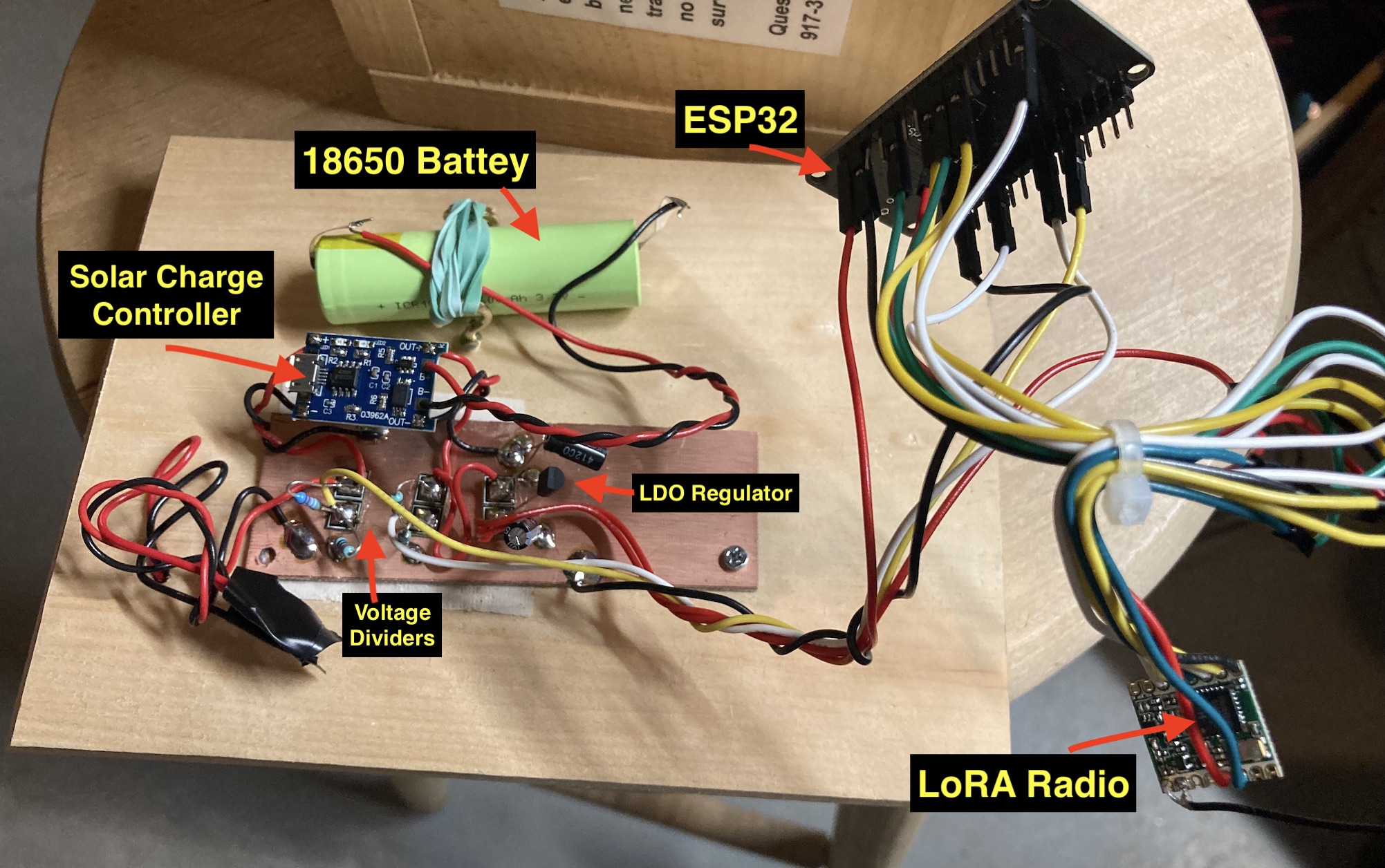
The birdhouse repeater prototype (internal electronics view):
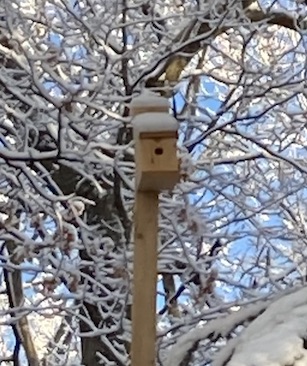
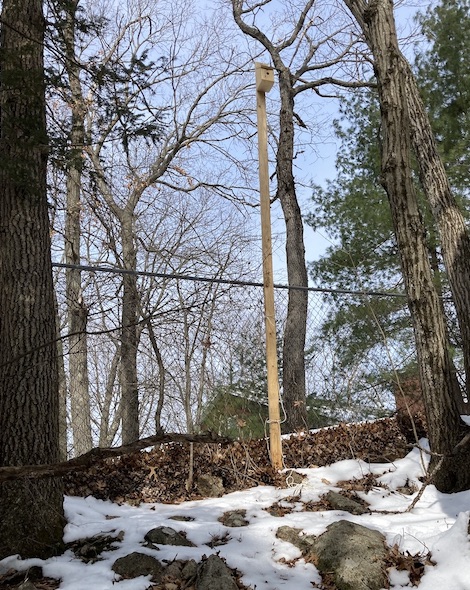
A tower-mounted birdhouse repeater prototype at the QTH of KC1FSZ:
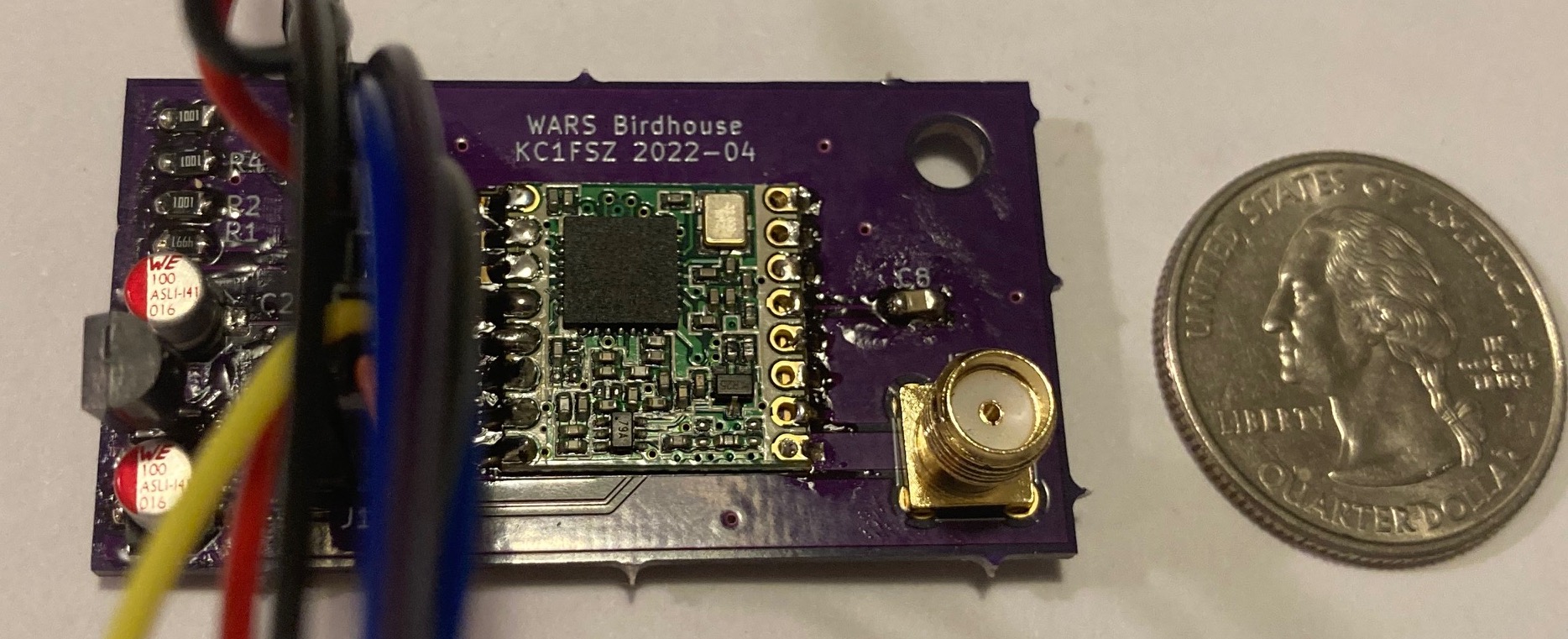
A custom PCB (V2) has been developed to improve integration and to make things easier for kit builders without SMD soldering capability. This board also provides an SMA connector to make antenna experimentation easier.
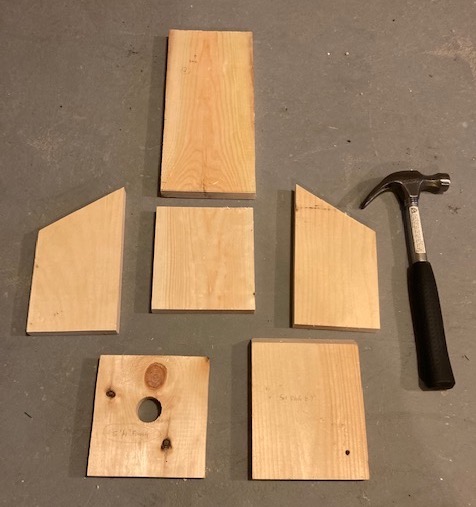
Repeater nodes are packaged in a standardized birdhouse enclosure that was designed for easy assembly.
Six pieces of wood are required. Components are attached using wood screws. The birdhouse is fully
functional for small bird species.
The roof is sloped at a 32 degree angle according to the recommended optimal configuration for solar generation at 42 degrees North latitude where the initial network was deployed. The design may need to be adjusted for other locations.
The wood parts for the birdhouse repeater prototype:
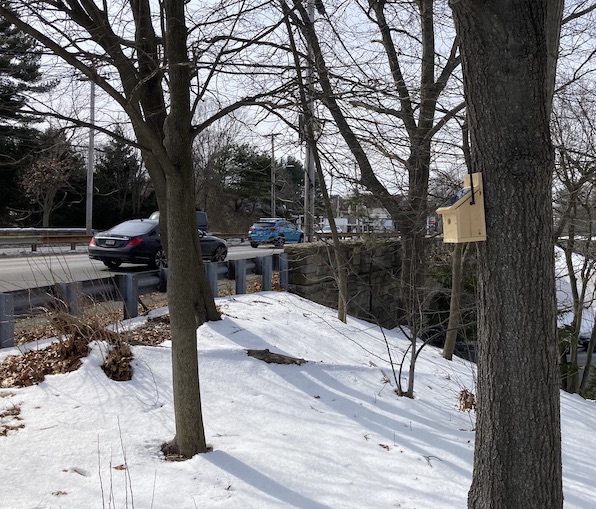
A tree-mounted repeater prototype installed in a tree inside of a cloverleaf on-/off-ramp:
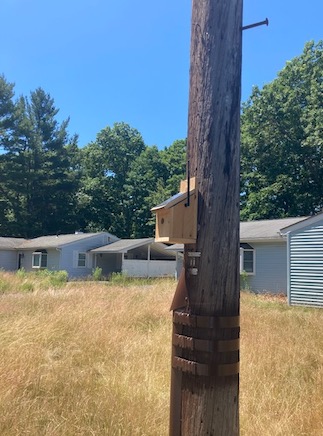
A repeater station mounted on the top of North Hill in Needham, MA.
Lumber Cut List:
PLEASE USE CAUTION WHEN WORKING WITH POWER TOOLS!
The LoRa software is completely homebrew - no off-the-shelf drivers are being used. This means much more work, and much more learning.
All nodes support a serial interface for interacting with the network, but this is only connected for desktop nodes.
The serial command processor is implemented using this very good project by Phil Jensen.
A static routing mechanism is being used at the moment. The routing table for each node can be changed remotely. Dynamic routing will be developed in a future phase.
Please see the project WIKI for information on development, IDE setup, etc.
(To follow)
Column 1
Row 0 - GND Row 1 - Supply GND Row 2 - IO33 (Battery Voltage Sense) Row 3 - IO34 (Panel Voltage Sense) Row 4 - Supply +VCC Row 5 - Pannel Row 6 - Pannel Row 7 - +3.3V
Column 2
Row 0 Row 1 Row 2 - IO19 (SPI MISO) Row 3 - IO23 (SPI MOSI) Row 4 - IO18 (SPI SCK) Row 5 - IO5 (SPI NSS) Row 6 - IO26 (Radio RST) Row 7 - IO4 (Radio DIO0)
Copyright (C) 2023 - Bruce MacKinnon KC1FSZ
This work is covered under the terms of the GNU Public License (V3). Please consult the LICENSE file for more information.
This work is being made available for non-commercial use by the amateur radio community. Redistribution, commercial use or sale of any part is prohibited.







