Enhanced-Fonts-style-transfer
Improved Chinese character font style migration based on EMD
Networks:
Limition:
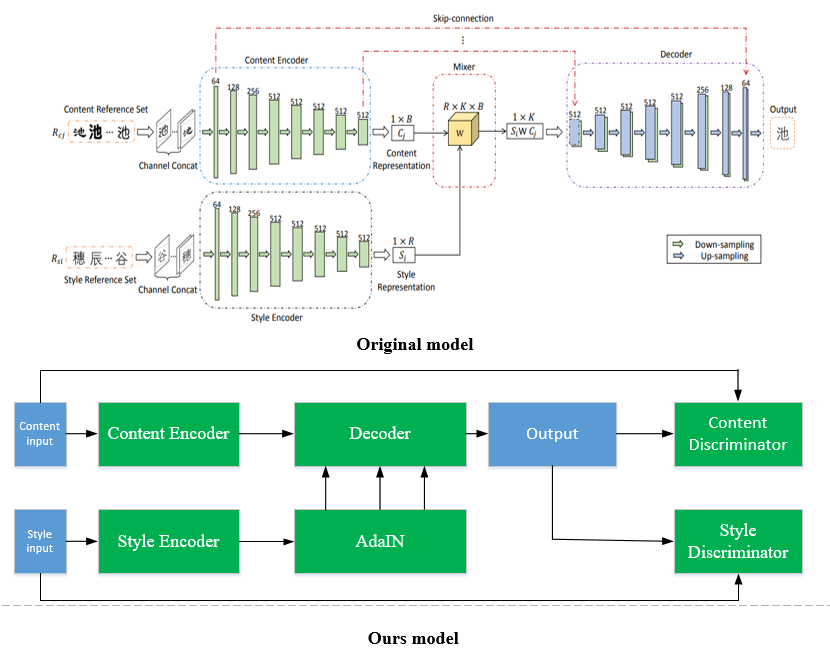
- The EMD model converts the original font into a vector representation through a Style Encoder. In essence, it is to train a conditional font style migration network. The style input is only generated as a condition. In this way, the trained model will have a very poor result when it encounters style fonts that do not appear in the training set.
- On the other hand, EMD uses fixed triple font images for training, which solves the style transfer of arbitrary font images to a certain extent. Due to the limitations of triple images, each font needs the same font, and because the images of a certain font have fewer bad results.
Improvement:
- Use Style Encoder as a real style encoder to continuously input the resulting style into the Decoder network module, alleviating the font style migration of unknown styles to a certain extent. In special cases, for example, the fonts of the same images in the training set are very rare, which can greatly improve the results of the original model.
- Add GAN loss and train two discriminators respectively. One discriminator is used to determine whether the generated font is the same as the input font, and the other discriminator is used to determine whether the generated font is the same as the input style font. At the same time, due to the existing style constant characteristics, the original style information is input and judged as a counterexample.
- The model can be extended to unsupervised font style migration, looping the generated fonts into the generator again, and doing the opposite transformation to constrain.
Examples:
References:
- Separating Style and Content for Generalized Style Transfer. Yexun Zhang, Ya Zhang, Wenbin Cai.
- Arbitrary Style Transfer in Real-time with Adaptive Instance Normalization. Xun Huang, Serge Belongie.
- A Style-Based Generator Architecture for Generative Adversarial Networks. Tero Karras, Samuli Laine, Timo Aila.