Nyushu
2023年6月10日 多文种混合字体试作

???? ?????
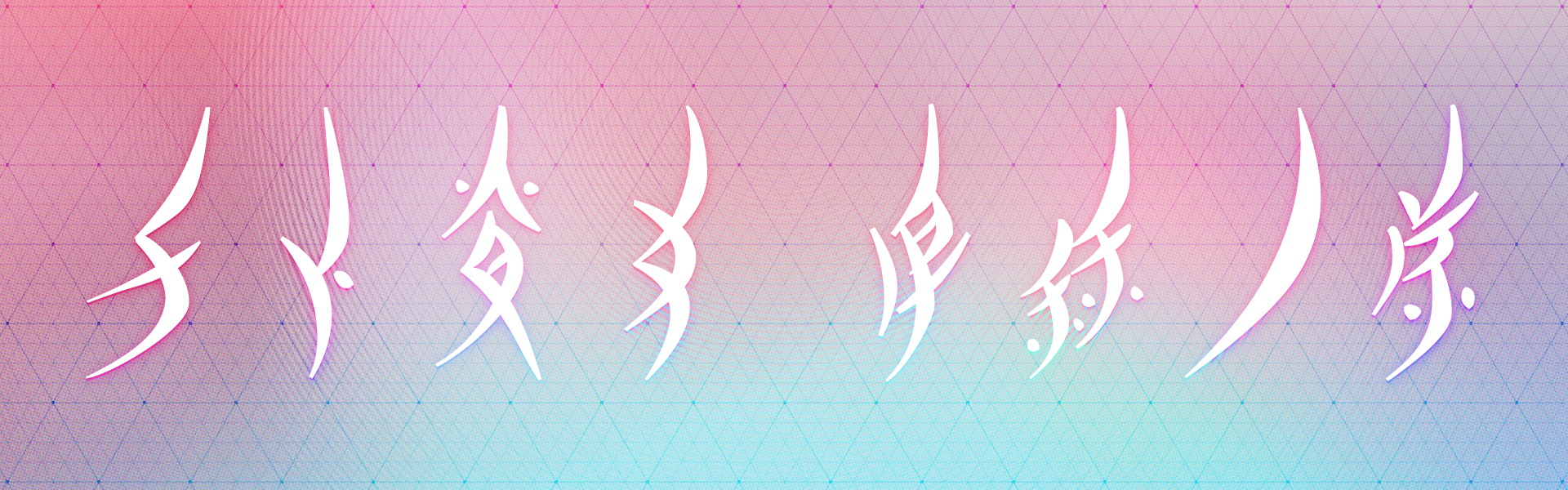
This is a set of calligraphy fonts of "willow leaf (serif)" in the women's book, aiming to support various known variants (variant forms) of women's book through OpenType characteristics, allowing the same women's character to change various writing styles.
If there are more variations, please provide them, even in foreign newspapers. I can send issues, discussions or send private messages to other places (if there is no reply, it may be that I have not received it. Please see if I am online and send it again)
Of course, if you can edit the font, you can directly open the source file to modify and publish it, and also open the source and notify me, that would be even better. As long as the font meets the design specifications, it will be merged into this font and added to the font information to thank you.
Regarding the file format of the glyph, you can give me .otf or .svg of the unmerged curves. You can use open source Inkscape to create and edit .svg vector graphics, and I use Inkscape to draw this font.
But it should be noted that the Women's Book Proposal 09-03-18 1 From 53 pages, the "Female Chinese Dictionary 2 " that contains 3400 female "characters" has a problem with the fake:
…all the characters in Nuhan Dictionary is written by the author himself, some of which is faked and created by him. They have never photocopied one character from the original works. …
As a kind of script system which is used by rural women, it is impossible for them to have a huge and complicated script system such as three or four thousand characters included. …
Even the cover word "Han" and "Dict" has no source (from page 57 of the above proposal, it should be written as "?"" and " 3 "). Therefore, although "Female Han" has certain reference value, the listed variants will not be adopted if there is no other source.
According to relevant research results, please refer to Zhao Liming's "Collection of Chinese Women's Books 4 " and "Reading Books of Women's Books 5 " (but I don't have it in my hand, so I refer to "Comparison of Use of Words in Women's Books 5 ")
I also have Zhou Shuoyi's "Dictionary of the Women's Books 6 " at hand. I found that this book not only had the problem of "The Women's Han", but also more: comparing and interpreting the text before regular script such as the Women's Books and oracle bone inscriptions and other regular scripts has nothing to do with the Women's Books, but copied the "Current Han"... Therefore, the variants listed are not adopted .
There is an introduction website: Legendary Girl Book - Tsinghua University Chinese Ancient Character Art Research Center. It seems that it has stopped updating before it is completed. There are still a lot of mistakes that have not been changed. Among them, the Girl Book Appreciation Page may be used as a reference for art character design.
GSUB features: calt, salt, ss01, ss02, ss03, ss04, ss09, ss10
calt context substitution , adjust the glyph without changing the meaning of the word according to the context. This feature is generally not required to be enabled by default by browsers.
The following features require software support and enable settings. Currently, major browsers should support it, just add the corresponding code to the web page CSS.
ss** style set is the first , replace the default glyph to the first variant, up to 20. This font is only used a few, of which 3 specify specific uses:
ss01 Original calligraphy : Restore the default characters to Hu Xin 7 style, even if it is different from the unified code table.ss10 different calligraphy : As a subset of ss01 , it only contains different parts from the unified code list.ss04 typo correction : This font intends to retain the previously existing erroneous glyphs for academic research. Turning on this will replace the wrong font with the one I corrected is not necessarily the default, but the shape is closest.Typos need to be entered manually. To avoid errors, a style set that is replaced with a typo is not deliberately set.
ss02 are consistent, and only the calligraphy, frames and so on are adjusted.ss03 is currently a variant with different strokes.ss05~08 reserved, after all, there are more than 3 variants.ss09 is currently a completely inconsistent variant, such as "?" written by Yang Huanyi (Comparison 5 " p14)ss11~20 or reserved for those who help improve the shape of the font. salt style replacement , unlike other fonts, this font specifies a specific purpose of "negative negative and positive": returns any non-default glyph (such as replaced by style set ) to the default unified code specified glyph of this font. If it is enabled at the same time as the style set ... it depends on who has higher priority or execution is later.
Needless to say, ss** calt is in nature and will interfere with each other.
To avoid misunderstanding, by the way: the font characteristics will only change the shape of the font, and of course the font code will not change. However, if the software used does not support the above OT features, you can only manually change the font code. See the NyushuSrc.csv chapter for details.
???????| First edition , March 8, 2023
calt characteristic detects the context of "Women in the World" or "Sisters' Family" will change the relevant characters to the style on the Taiping Heavenly Kingdom's carved mother money.????|March 10, 2023 Edition 1.001
: the aesthetic problem of the characters.斗时柳娘拜气心到派配等别刻鸳清淡shapes.ss10March 12, 2023 Edition 1.002
2023 June 10th , Edition 1.003
Next edition (in progress...)
ss01 ss02ss01 and about 14 characters lack the shape salt of the characters shown in the unified code.I'm considering
0 be changed from small size "?" to circle? Because "?" not only corresponds to zero.The weight of the word is variable, the serif is variable to the sans serif, and the art style is variable... In fact, I am already ready for the variable font while drawing the curve.
This font instruction manual is a plain text form.
〃 same as "ss1", and the square brackets are one-shaped to multiple characters (that is, the characters in the brackets [ ] share the characters in the front of the brackets. This is inevitable that there is a mistake. After all, Gong Zhebing and Tang Gong? The corresponding Chinese characters selected by "Neo Shu Standard Character Dictionary 8 " and "Neo Shu Code 7 " may be completely different)≈ Chinese characters in the standard are noted with the unified code 15.0.0 NamesList.txt, where "玉" has an errata, which should be "grave", and after the errata note is up! Unlike "Copyright 7 ", it is marked with the number !。 It indicates its radical, that is, itself, The corresponding Jiang Yongtu syllables in the book of Women, 21 initials, 38 finals, and 5 tones ("Comparison 5 " p162, the tone should be said to be 5 degrees, more than 5), so the number is upper limit ("Comparison" p194: more than 300), and words cannot be added infinitely, but there may be different forms.
The Huang Xuezhen system and the Chen Qiguang system can be seen. There are some differences between the two, but they are both correct. The Huang Xuezhen system is used in general philology examinations of the female book.
It is known that some local syllables are not Chinese at the bottom, so the character "female" cannot correspond to Chinese characters one by one. Although this font maps the various variants of the Women's Book to the same shape with the selected Chinese characters (the term "double-encoding" is the same technology used in the font "Dict Stone End" with only a few hundred characters), but this is convenient for some outdated software to use (such as those that only support basic planes (BMP), and inputs to the Women's Book located in SMP will explode), which does not mean that the mapping I chose is unique and accurate, and academic research cannot be lazy with this cheap design.
For example, an example I found, (ie²¹, the pronunciation is exactly the same as “?”), "Women's Book Reading 5 " p42 corresponds to “⼞子/子”, but “子” corresponds to “?” and “子” corresponds to “?”, and no Chinese characters are available. "Compare" p37 shows that it is the sound of "ie²¹" (and there are multiple sounds of "ie⁴⁴⁴⁴⁵, ie³³), but it is ie⁴². The previous page p36 "?" corresponds to "ie¹³" but "easy" corresponds to "? (ie¹³)". In the "Compare" p86, it can be seen that "?" also has the pronunciation "tchy²¹" corresponding to "go", but "go" corresponds to "? (tchy²¹)". To p201 "Basic Characters and Character Sources of Women's Books: 6 strokes" gives the word "original/piece", and the pronunciation is only ie²¹. Needless to say, "original" corresponds to "original" "original" "original" "original" "original" "original" "original" "original" "original" "original" "original" "original" "original" "original" "original" "original" "original" "original" "original" "original" "original" "original" "original" "original" "original" "original" "original" "original" "original" "original" "original" "original" "original" "original" "original" "original" "original" "original" "original" "original" "original" "original" "original" "original" "original" "original" "original" "original" "original" "original" "original" "original" "original" "original" "original" "original" "original" "original" "original" "original" "original" "original" "original" "origin As for why the pronunciations of the same book "Comparison" are inconsistent before and after. I can't say anything. "Neo Shu Dictionary 6 " page 638 is pronounced iə⁴⁴, which is translated as "inyinmarriage", and is noted as "suspectedly "yin"" ⋯?
Therefore, the "?" in this font does not correspond to any Chinese characters. Considering that the software is outdated or cannot render it, it is temporarily mapped to the private area uE1E2 "". If you have any better suggestions, please send them to me.
The "Basic Characters of Women's Book" attached to the "Comparison" is the second draft of October 2006. The Women's Book Proposal 09-03-18 1 contains the new version of "Basic Characters of Women's Book". The corresponding Chinese characters can be seen in comparison with p78. The corresponding Chinese characters are supplemented with "Study"
The origin of the book of Women is untestable. When experts wrote recommended books, they all said that women created it, but these experts are not all specializing in the book of Women, nor have they studied the book of Women. Most of the materials for women's calligraphy have not been explored in depth, and only know that they must be later than the regularization of Chinese characters. Only "Female Han 2 " reasoned that women's calligraphy may have been invented by men educated in Chinese characters. I think we should not make too many guesses before we discover new reliable cultural relics.
All the female calligraphy I have seen at present are all strokes and strokes without continuous cursive scripts. By the way, the unified code is sorted by the number of strokes, but the "?" should be corrected to 9 strokes, and it cannot be changed?
| Number of words | scope | View all |
|---|---|---|
| 1 | 1B170 | ? |
| 2 | 1B171~1B177 | ?????????? |
| 3 | 1B178~1B18A | ????????????????????????????? |
| 4 | 1B18B~1B1A7 | ???????????????????????????????????????????????? |
| 5 | 1B1A8~1B1DD | ?????????????????????????????????????????????????????????????????????????????????????????????????????????????????????????????????????????????????????????????????????????????????????????????????????????????????????????????????????????????????????????????? |
| 6 | 1B1DE~1B215 | ?????????????????????????????????????????????????????????????????????????????????????????????????????????????????????????????????????????????????????????????????????????????????????????????????????????????????????????????????????????????????????????????? |
| 7 | 1B216~1B243 | ?????????????????????????????????????????????????????????????????????????????????????????????????????????????????????????????? |
| 8 | 1B244~1B283 | ?????????????????????????????????????????????????????????????????????????????????????????????????????????????????????????????????????????????????????????????????????????????????????????????????????????????????????????????????????????????????????????????? |
| 9 | 1B284~1B2AF | ?????????????????????????????????????????????????????????????????????????????????????????????????????????????? |
| 10 | 1B2B0~1B2CD | ????????????????????????????????????????????????? |
| 11 | 1B2CE~1B2E0 | ????????????????????????????? |
| 12 | 1B2E1~1B2ED | ???????????????????? |
| 13 | 1B2EE~1B2F3 | ???????? |
| 14 | 1B2F4~1B2F6 | ??? |
| 15 | 1B2F7~1B2F9 | ??? |
| 16 | 1B2FA~1B2FB | ?? |
It is said that the preliminary argument of unified code has rejected the stroke section of the Women's Book (or Xixia, Khitan), so the following table is for my convenience in font production. The order of description is temporarily based on the p1 description in "Female Chinese Dictionary 2 ". "Compose the talisman" borrows Chinese characters' strokes and brackets.
| # | Stroke strokes | Thumb down | Composition | Example | Comments |
|---|---|---|---|---|---|
| 1 | Left diagonal | P | ㇒ | ?? | U+31D2 CJK Stroke P , skip |
| 2 | Right diagonal | N | ㇏ | ?? | U+31CF CJK Stroke N , |
| 3 | Left arc | R | ) | ?? | Close bracket ( Right par.), opening to the left |
| 4 | Right arc | L | ( | ?? | Le eft parenthesis |
| 5 | Dots | D | ㇔ | ?? | U+31D4 CJK Stroke D , dot |
| 6 | Arc | U | ︶ | ? | The opening faces upwards ( U pper), shaped like closed brackets, but there is no example of the example given by "The Female Han"? |
| 7 | Next arc | A | ︵ | ? | Arch ( Arch ), shaped like a bracket, but I never encountered the example characters given by "The Female Man" when I was font-made |
| 8 | Short vertical | S | ㇑ | ?? | U+31D1 CJK Stroke S , vertical |
| 9 | Short horizontal | H | ㇐ | ? | U+31D0 CJK Stroke H , horz. |
According to "Female Han 2 " and "Women's Book Proposal 09-03-18 1 p52, the "small circle" of "Women's Book is actually synthesized by left and right arcs (LR), but when I actually made the font, I abbreviated it to "O" (composition: ㇣)
It is said that the early argumentation of unified code has rejected the radical section of the girl's book, so I wrote some of them in NyushuSrc.csv for the convenience of font production, and the list is very long, as follows.
| Composition | Number of words | position | Comments |
|---|---|---|---|
| ) | 1 transaction | ????? left | = Small?, one of the derived symbols 10 |
| x | 2 transactions | ?????? left | = Small? |
| o | 2 transactions | ???? left;? right;? left and right | Derivative use, Female Man 2 → corresponds to "mouth" 10 :?-such as?-blow?-cry |
| V | 2 transactions | ????? Top | I guess some corresponding "典"? ?-Six?-Of |
| )V | 3 transactions | ????? upper left;? Half-encircled | Female Han 2 →corresponding to "官网":?-word?-home?-determined |
| Λ | 2 transactions | ?? Below;? Top | |
| Δ | 3 transactions | ? Top; ? Inside | |
| | | 1 transaction | ? Insert; ???? Below | ?Subtract? |
| Ȝ | 2 transactions | ?? Right | Female Man 2 →"Ɛ Ȝ" corresponds to "?", but? |
| Ɛ | 2 transactions | ?????? left;? middle | Female Man 2 →corresponding to "如":?-red?-le?-sha |
| Ɛ | 〃 | ??? left;? bottom left | Female Man 2 → also corresponds to "其":?- 11 ? -11 ?-11 ? -11 |
| . | 1 transaction | ?? left and right sides;? left and right upper and lower sides | |
| : | 2 transactions | ??????? left;?? right | Female Man 2 →corresponding to "其" 12 :?-Liu 11 ?-To?-Don't |
| ︙ | 3 transactions | ??? left;?? right | Female Man 2 → corresponds to "电", but many counterexamples 12 |
| … | 3 transactions | ??????? Lower right | Female Man 2 →corresponding to "灬":?-point 11 ?-fish?-jiao |
| ⁘ | 4 transactions | ?? Below;? Up and down | |
| ※ | 6 transactions | ??? Upper right | ⿵⿶?.. |
| ㄑ | 2 transactions | ?? left;? top | ≈ Ȝ |
| ⺈ | 2 transactions | ????? Below | Like a shaped one, lying flat one? |
| 博 | 3 transactions | ??? upper right;? lower right | |
| Hope | 3 transactions | ?? Lower left | Similar to the shape, the female Han 2 → corresponds to "典":?-小13 ?-小小小小小小小小小小小小小小小小小小小小小小小小小小小小小小小小小小小小小小小小小小小小小小小小小小小小小小小小小小小小小小小小小小小小小小小小小小 |
| ⼢ | 3 transactions | ?? Middle;? Left;? Right | Similar to the shape, but stand out, female man 2 →?-子11 |
| 安全 | 4 transactions | ??? Top | Similar to the shape but not “read” |
| No | 4 transactions | ?? Below;?? Lower left | ⿱??, one of the derived symbols 10 , Female Han 2 → corresponds to the wood character |
| 可 | 4 transactions | ??? Top;? Right | ⿵⿷?.., similar in shape but not "wood" |
| mouth | 4 transactions | ??? Top | Female Man 2 → Corresponding to "Oral" 2:?-Part?-Number 11 |
| Conjuring | 4 transactions | ??????? | Similar to the shape, suspected to be the first word "?" |
| 㓁 | 5 transactions | ? Right; ??? Top | Similar to shape, but not crossed inside |
| Half | 5 transactions | ? Right; ? Middle | ?-Company |
| district | 5 transactions | ? Lower left | The unified code was mistakenly made 4 strokes? |
| ⻊ | 5 transactions | ? Lower left | The shape is similar to ⿿♂︎, compare 5 p236→ corresponding to "foot":?-jump |
| Asia | 6 transactions | ? Top right | Female Man 2 →corresponding to "Asia 11 " |
| ⾑ | 6 transactions | ? Top right | Similar but not "sex" |
| ⾉ | 7 transactions | ??????? Right | |
| 南 | 8 transactions | ?? Right | Female Man 2 →Originally from "Dao" omitted |
| Chang | 10 transactions | ??? Right | ⿱?? |
| ㆬ | 4 transactions | ?????? Below | Like ᲅ |
| Ш | 4 transactions | ?? Top right | |
| ↓The following is something that can't be told | |||
| ① | 5 transactions | ??? Upper right | ⿼⿶?.., shaped like a "half" without feet |
| ② | 6 transactions | ? Right; ?? Below | ⿵⿰ㄑȜ:, Female Man 2 → Originated from "Ni" |
| ③ | 4 transactions | ??? Right;?? Lower right | ⿻丨⿻??⸺I can't fight, it seems like "going" the second half together |
| ④ | 7 transactions | ??? Upper right | Similar to the shape, but not out of the way |
| ⑤ | 5 transactions | ??? Top | ⿱?⿰.. |
Zhihu has pictures but lacks textual evidence.
Originally, there was no punctuation or space, which was considered syllable text to some extent, but most female characters were polyphonic characters (one to many. And there were homophones, many to one), so it was not. In fact, the Women's Book will use the word "Female " to express the same thing in the same article to avoid the rigidity of the article. The "Female " mentioned above is said to have more than 40 variants, but the source is not given one by one.
The heavy number of the female book (repeated characters) is necessary (there are more than 6 variants shown in "The Female Han 2 ", if it is true), and is not a brief description of the words that can be easily written. Even "everyone" must be written "??" 3 .
The "line breaking characters" in the women's book are visible, and there are 2, which can be called line-end fill-in-the-blank characters. The vertical rows are ↓ and o, which fill the remaining space in the rows and columns. There is no horizontal row form. The unified code has not been included as of version 15.1. I need to consider how to do the font. Currently, ↓ and ㇣ are used temporarily.
Here are the people who help draw or modify the glyph.
For font designers, if they want to create derivative fonts, they must start with Nyu . If the font has Chinese characters or female book titles, it must start with女or ? Since the same name cannot be repeatedly installed and used simultaneously, the purpose of avoiding future font name collisions is only for the purpose of avoiding the collision of future font names, the Reserved ???? Name is limited to Nyushu ????女书柳叶女書柳葉and these style suffixes (including abbreviations and combinations). But if naming is necessary, you can negotiate with me, which is looser than OFL, such as "Wu Shu Liu Leaf Body" is allowed because "body" is not a style suffix.
For font users, it is free for personal non-commercial use. If it is used on a good work, I might as well take a look. If the work has a staff table or a profile on the publishing page, just mark it there. But if the use does not meet the above conditions, please ask me first.
In particular, you don’t have to donate me before using fonts for commercial projects or books. If you use my fonts in academic publishing, you don’t have to donate me, but you are welcome to send me electronic archives such as web versions or pdfs of the work. (If you do use any of my fonts for a commercial project or in a commercial book, please do consider making a donation that reflects their commercial worth to you. If you use my fonts in an academic publication then I do not expect a financial donation, but you are welcome to send me a copy of the publication if you think it may be of interest to me.)
(The "I" appear on this page are all Mianyun Yili . Please click this if you give me a reward or make an appointment~)
???? | Women's Book Bold | Nüshu Sans
In sans-serif style, it is being shelved due to crash. However, the shape of the glyph is completely different from Noto, for example, my bold body is a diamond dot.
Women's Book Proposal 09-03-18: unicode.org/wg2/docs/n3598.pdf, page 69 attached to Zhao Liming's fourth draft of "Basic Characters and Character Origins of Women's Book" in February 2008, with 398 characters in total (text can be searched, non-scan) ↩ ↩ 2 ↩ 3 ↩ 4
Chinese Dictionary, published on 2006-8, ISBN: 9787810569866 ↩ ↩ 2 ↩ 3 ↩ 4 ↩ 5 ↩ 6 ↩ 7 ↩ 8 ↩ 9 ↩ 10 ↩ 11 ↩ 12 ↩ 13 ↩ 14 ↩ 15 ↩ 16 ↩ 17 ↩ 18 ↩ 19 ↩ 20 ↩ 21 ↩ 22
Examples can be seen in Volume 4 of "Chinese Women's Book Collection" (Page 09-03-18 1 64) He Yanxin "Suddenly SARS patients all feel so sad and united to unite and resolutely defeat SARS " ↩ ↩ 2
Collection of Chinese Women's Books, published on 2005-1, ISBN: 9787101044058 ↩
ISBN-10: 7-80198-261-4, Douban data is incorrect. However, the author also has a reading book of the Women's Book, published on 2008-6, ISBN: 9787543852822, Chapter 5: Comparison of the use of characters in the Women's Book, the photo is seen in the Tsinghua University Rescue SRT Group↩ ↩ 2 ↩ 3 ↩ 4 ↩ 5 ↩ 6 ↩ 7
Dictionary of Women's Books, published on 2002-1-1, ISBN: 9787806652343 ↩ ↩ 2
A calligraphy copybook for standardized characters for women's books, published on 2017-5 (1 month before the publication of the 10th edition of the unified code), ISBN: 9787302467052, the calligrapher is Hu Xin. ↩ ↩ 2 ↩ 3 ↩ 4
Online Women's Book Dictionary > Tools, I consulted relevant people and said it was unreliable. ↩
It refers to the recommendation letter of experts who applied for the UNESCO "World Memory Heritage List" before the Comparison: 5 people, Ji Xianlin, Zhou Youguang, Li Xueqin, Tan Lin and Dong Kun. Except for Li Xueqin who was cautious and did not mention it, the rest were all identified as being created by women. ↩
"The Female Man" pages 9 to 10 said that symbols such as small circles have derivative characters "circle break" in the Female Book to distinguish pronunciation, which does not necessarily correspond to "mouth" ↩ ↩ 2 ↩ 3
That’s right, “ISO/UCS Women’s Book Coding Proposal” n3340 and “Female Han” emphasize that the corresponding words are simplified. However, "worm" has not been found outside "The Female Man". By the way, the n3340p25 and 26 photos were released in reverse. ↩ ↩ 2 ↩ 3 ↩ 4 ↩ 5 ↩ 6 ↩ 7 ↩ 8
But corresponding to "Qing Dynasty", it is "coming" and "Wang", which is my doubts about reading "Female Han". ↩ ↩ 2
But reading mau³³, “fear” corresponds to? (pw¹³), which is also a question I have when I read "The Female Man". ↩
Examples can be seen in the 32-page "Female Han" thank you letter, and the four sentences use "female text", "female book", "female character" and "female article" to express the female book. ↩