vsop2013
v2.1

This repository started as a Delphi port of planet ephemerides database VSOP2013. With time it grew to include:
Completed drawings of western tradition constellations, mostly characters from Greek mythology. To go with the drawings (this is not in the software) I used AI chat bots ( MS Bing and Google Bard ) to create stories about the myths involving constellations, and how Zeus - mostly - designed the skies.
Check the constellation myths ( 8 stories ): https://github.com/omarreis/vsop2013/tree/master/constellations
apr/23: PlanetFun app v1.9 released for iOS and Android.
Added the Almanac module, which allows calculating ephemeris for various celestial objects. Added VSOP87 planet database. H150 and Navigator star catalogs.
COnstellation drawings ( added two new sky backgrounds, with constellation mythical greek figures )
See https://github.com/omarreis/vsop2013/tree/master/planetfun
VSOP 2013 (Variations Séculaires des Orbites Planétaires) is a high precision
planetary position model by G. FRANCOU & J.-L. SIMON - may 2013.
This repo contains a Delphi Pascal port of original Fortran code.
VSOP2013 calculation machinery uses Chebyshev polynomials to find position and speed of the 9 planets at a time (inside a 9000 years range).
Tested with D11.2 for Win32, iOS and Android. Tests are for Firemonkey but should work with VCL and console app as well.
VSOP 2013 original paper with Fortran code and data files can be found at:
https://ftp.imcce.fr/pub/ephem/planets/vsop2013/ephemerides/
VSOP2013 README:
https://ftp.imcce.fr/pub/ephem/planets/vsop2013/solution/README.pdf
Data files are large (400 MB) ASCII text containing Chebyshev polynomial of 1st kind coefficients. It is organized in 6 files, covering a 9,000 year period in all, as follows:
 range                file
 -4500 to -3000       VSOP2013.m4000
 -3000 to -1500       VSOP2013.m2000
 -1500 to 0           VSOP2013.m1000
 0     to +1500       VSOP2013.p1000
 +1500 to +3000       VSOP2013.p2000
 +3000 to +4500       VSOP2013.p4000
Each file is divided in 17122, 32 day intervals. Each interval has 978 coefficients, arranged in groups of 6 per line.
File header contains a table of indexes into coefficients for 9 planets: Mercury, Venus, Earth+Moon baricenter, Mars, Jupiter, Saturn, Uranus, Neptune and Pluto.
Each planet has a number of Chebyshev polynomial terms (between 7 to 14 terms per planet).
Results are two 3D vectors: position and speed.
Results are in AU ( AU/day for speeds ) heliocentric ecliptic coordinates ( x,y,z ).
The FTP repository contains Fortran code:
In this Delphi port, the whole file is pre-loaded into memory tables for fast access.
Object T_VSOP2013_File encapsulates VSOP 2013 machinery:
Most algorithms used for dealing with dates and astronomy are from the book "Astronomical Algorithms" by Jean Meeus ( AA 1st and 2nd editions )
Some formulas are from the "Almanac For Computers" publication by USNO ( marked AfC ).
Moon position calculations use theory ELP2000 ( AA chapter 47 ). ELP (Éphéméride Lunaire Parisienne) is a lunar theory developed by Jean Chapront, Michelle Chapront-Touzé, on the Bureau des Longitudes.
The implementation in Ah.Moon.pas was extracted from TMoon component by Andreas Hörstemeier.
see http://www.hoerstemeier.com/moon.htm
An older version of VSOP is described in Meeus book: VSOP 87 It is similar to VSOP 2013, with a lower precision but also a much smaller data footprint. It is precise enough for most applications.
See VSOP87 and VSOP87/Demo folders
https://github.com/omarreis/vsop2013/tree/master/vsop87
A star position calculation. Lists 150 brightest stars and implements coordinate calculations for a given time.
See TestH150 folder for test app.
https://github.com/omarreis/vsop2013/tree/master/TestH150Stars
Sample apps are included in this repository:
TestVSOP2013 is a Firemonkey app.
To use it you have to download at least one of the data files from VSOP2013 FTP repository ( current file is VSOP2013.p2000 )
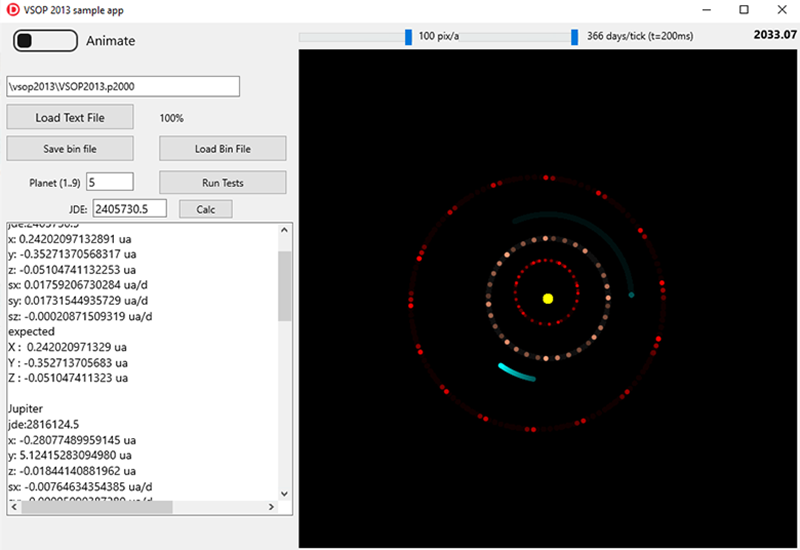
I did not test the original Fortran code, so I used the results on original file VSOP2013_ctl-1.txt.
Test of Delphi implementation of VSOP2013
==========================================
from VSOP2013_ctl.txt ( original results file)
  JUPITER     JD2405730.5  X: -5.392780445602 ua    Y: -0.805698954496 ua      Z :  0.124332318817 ua
                          X':  0.001019284060 ua/d  Y': -0.007116469431 ua/d   Z':  0.000005921462 ua/d

from TestVSOP2013   ( code in this repo )
  Jupiter     jde2405730.5 x: -5.39278044560243 ua   y: -0.80569895449564 ua    z: 0.12433231881710 ua
                          sx: 0.00101928405984 ua/d sy: -0.00711646943146 ua/d sz: 0.00000592146220 ua/d

from https://ssd.jpl.nasa.gov/horizons.cgi ( Nasa Horizons. used Jupiter Center and Sun  Center)
  Jupiter     jd2405730.5 (A.D. 1874-Jul-26 00:00:00.0000 TDB )
                           X =-5.392781657192185E+00 Y =-8.056977928944861E-01 Z = 1.243323711175276E-01
                           VX= 1.019554845438113E-03 VY=-7.116569436623840E-03 VZ= 5.921987272194194E-06

Planet Fun is a solar system simulation in 4D. The 9 Planets, Sun, Moon, stars are positioned using calculation methods described in "Astronomical Algorithms".
Implements an Almanac ( calculator of position for Sun, Moon, 9 planets and 150 stars )
Source code:
PlanetFun readme:
In order to compile and run this app, you will need to:
Install executables PlanetFun.exe, TestVSOP2013.exe, gravityIntegration.exe and assets.
get latest release: https://github.com/omarreis/vsop2013/releases
Also available on the Microsoft Store. Search for "planetfun".
Windows app. Integrates planet positions using Newton's universal gravity law and compares to VSOP2013. Shows charts of diferences (residues).
see https://github.com/omarreis/vsop2013/tree/master/gravityIntegration
Numbers related to the discovery of the planet Neptune, in 1846.
FB page: https://www.facebook.com/vrtoolsoftware