Stroika
v2.1.15)

Stroika is a modern, portable, C++ application framework. It makes writing C++ applications easier by providing safe, flexible, building blocks, as well as wrappers on other useful libraries that help them to all work together more seemlessly.
String a = u8" abc ";
String b = u32" abc ";
CallFunction (a+b);
// trim whitespace, and convert to u16string for some legacy API
std::u16string uuu = (a+b).Trim ().As<u16string>();
// tokenize
String t{ "ABC DEF G" };
Assert (t.Tokenize ()[1] == "DEF");// most Stroika types automatically support formattable<>
DbgTrace ("v = {}"_f, v); // to a tracelog file, or debugger
cerr << "v = {}"_f (v) << endl; // OR iostreams (unicode mapped automatically)// nb: String is an Iterable<Character>,
// despite internally representing the characters very differently
bool IsAllWhitespace (String s) const
{
return not s.Find ([] (Character c) -> bool { return not c.IsWhitespace (); });
}
Iterable<int> c { 1, 2, 2, 5, 9, 4, 5, 6 };
EXPECT_TRUE (c.Distinct ().SetEquals ({ 1, 2, 4, 5, 6, 9 }));
Iterable<int> c { 3, 4, 7 };
// Map iterates over 'c' and produces the template argument container
// automatically by appending the result of each lambda application
EXPECT_EQ ((c.Map<vector<String>> ([] (int i) { return "{}"_f (i); }), vector<String>{"3", "4", "7"}));COW (copy-on-write often signifcantly improves performance for most common cases)
APIs defined by access pattern, like Stack=Push/Pop, Sequence= array-like access, Map={from: to}, etc
Representational transparency
Stroika provides a rich set of container archtypes, and data structure implmentations.
extern void f(Set<int>);
// use the default Set<> representation - the best for type 'int'
Set<int> s{1, 2, 3};
f(s);  // data not actually copied - Stroika containers use 'copy-on-write (COW)'
s = Concrete::SortedSet_SkipList<int>{s}; // Use a skiplist to represent the set
f(s);  // call f the same way regardless of data structure used for implementation
// set equality not order dependent (regardless of data structure)
Assert (s == {2,3,1});
See Containers Sample for more details
MyClass someObject = ...;
VariantValue v = mapper.FromObject (someObject);   // Map object to a VariantValue

// Serialize using any serialization writer defined in
// Stroika::Foundation::DataExchange::Variant (we selected JSON)
Streams::MemoryStream::Ptr<byte> tmpStream = Streams::MemoryStream::New<byte> ();
Variant::JSON::Writer{}.Write (v, tmpStream);

// You can persist these to file if you wish
{
    using namespace IO::FileSystem;
    FileOutputStream::Ptr tmpFileStream =
        FileOutputStream::New (WellKnownLocations::GetTemporary () / "t.txt");
    Variant::JSON::Writer{}.Write (v, tmpFileStream);
}
See Serialization Sample for more details
Route{"variables/(.+)"_RegEx,
      // explicit message handler
      [this] (Message& m, const String& varName) {
          WriteResponse (m.rwResponse (), kVariables_, kMapper.FromObject (fWSImpl_->Variables_GET (varName)));
      }},
  Route{HTTP::MethodsRegEx::kPost, "plus"_RegEx,
      // automatically map high level functions via ObjectVariantMapper
      ObjectRequestHandler::Factory{kBinaryOpObjRequestOptions_,
                                    [this] (Number arg1, Number arg2) { return fWSImpl_->plus (arg1, arg2); }}},
See WebServices sample for more details.
Makes compression, encryption, IO, networking, data processing, all fit together seemlessly
// @todo INCOMPLETE - BAD EXAMPLE---
const OpenSSL::DerivedKey kDerivedKey =
     OpenSSL::EVP_BytesToKey{OpenSSL::CipherAlgorithms::kAES_256_CBC (), OpenSSL::DigestAlgorithms::kMD5, "password"};
const Memory::BLOB srcText =
  Memory::BLOB::FromHex ("2d ...");//...
// EncodeAES takes a stream, and produces a stream
// which can be chained with the gzip Transformer, which takes a stream, and produces a
Compression::GZip::Compress::New ().Transform (EncodeAES (kDerivedKey, srcText.As<Streams::InputStream::Ptr<byte>> (), AESOptions::e256_CBC))Stylistically, Stroika differs from the Standard C++ Library, boost, and many other C++ libraries, in that it (relatively) embraces object oriented abstractions over template-based genericity (see Stroika-Approach-To-Performance.md). The abstraction of type hierarchies is better suited to how people reason, and templates and concepts - while powerful - can be fiddly and obscure programmer intent. Also, Stroika emphasizes separation of interface from implementation: carefully documenting the interface in the headers, and separating the implementation to other files.
Stroika is comprised of 2 layers: the Foundation, which provides building-block classes applicable to most applications, and a series of domain specific Frameworks which provide a rich collection of code in different domains.
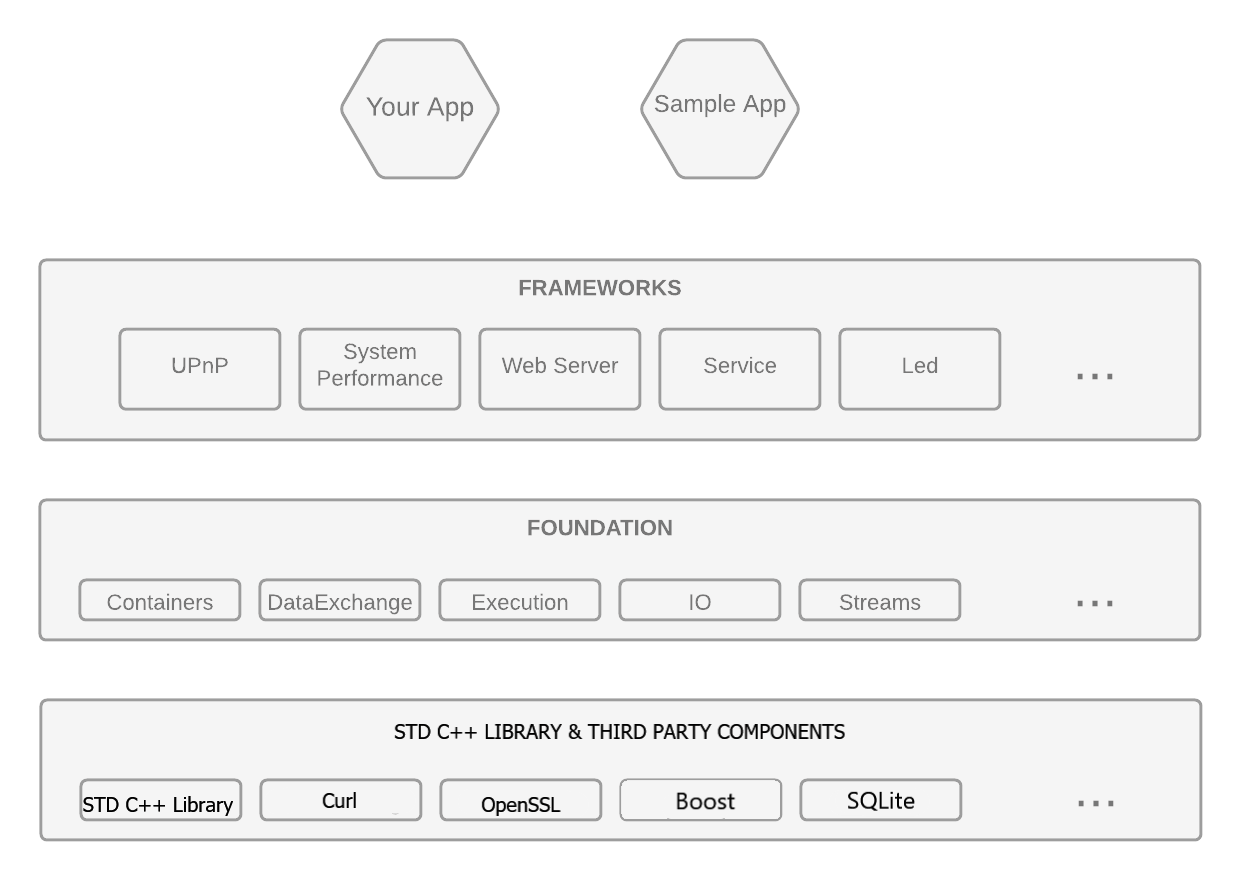
The Frameworks depend on the Foundation; Foundation modules frequently depend on each other; but Foundation layer code contains no dependencies outside of the Foundation (except on the Standard C++ Library, and various ThirdPartyComponent libraries optionally included or referenced, like openssl).
Don't want to read - just want to code. Step by step instructions to build your first stroika-based application on your machine, in minutes (less download/compile times - that varies).
Stroika's biggest strength is also its biggest weakness:
Stroika v3 in active development (not stable), and requires C++20 or later.
Stroika v2.1 is stable (in maintainance), and requires C++17 or later. Version 2.1 also conditionally supports many C++20 features (such as three-way-comparison etc, if available).
Stroika v2.0 is very stable, and requires C++14 or later. Stroika v2.0 is used to power a wide variety of open source and commercial applications.
Linux, MacOS, Windows
Stroika v3
TBD, but so far looks like vs2k22 (17.9) or later on windows, XCode 15(.2) or later on MacOS, and g++11 or later, and clang++15 or later.
Stroika v2.1
Tested on x86, arm (+m1), gcc 8 thru gcc 12, clang 6 thru clang 14, Visual Studio.Net 2017, Visual Studio.Net 2019 and Visual Studio.Net 2022, XCode 13, 14, 15.
Stroika v2.0
Tested on x86, arm, gcc 5 thru gcc 8, clang 3 thru clang 6, XCode 8 thru 9.
Github Actions
| Branches | Status | |
|---|---|---|
| v3-Release |  |
.github/workflows/build-N-test.yml |
| v3-Dev |  |
.github/workflows/build-N-test.yml |
For more details on individual release changes, see:
Release-Notes.md
"Getting Started", build instructions, design and other documentation:
Documentation/
Looking through the samples is also a good way to start:
Samples/
Please report bugs/issues at:
http://stroika-bugs.sophists.com