Internet of Things
1.0.0

In the world we live in today, almost every single thing is connected in some way to the internet. The Internet of Things is a pretty simple concept — taking all the things in the world and connecting them to the internet.
Internet of Things: The interconnection via the Internet of computing devices embedded in everyday objects, enabling them to send and receive data.
This sounds quite terrifying. Why would we need everything connected to the internet?
Let’s first think of a typical day in your life. How many internet-connected devices do you already use? Probably a lot more than you realize.
Your day starts with the ringing of your smart alarm, which is connected to your phone so it can show you the notifications you received during your beauty sleep. Then you check your smartwatch, which tracked your sleep during the night and lets you know how it was in comparison to other nights, and obviously is also connected to your smartphone so that you can see the meetings you have today at work. You brush your teeth with your smart toothbrush (yes, this actually exists), which somehow tracks your teeth-brushing. You get up and ready for work while yelling “Alexa! What’s the weather today?” so you know what kind of clothes to wear. You turn on the heater in your tesla from your phone because Alexa said it’s quite chilly.
(Of course, this “typical” day is a little extreme, but is absolutely possible in today's world).
As you can see, the rest of the day will continue similarly; most of the devices you use are connected to the internet.
The Internet of Things as a concept wasn’t officially named until 1999, however devices following this idea already existed.
One of the first examples is from the early ’80s: a Coca-Cola machine located in Carnegie Melon University. Programmers would connect via the Internet to the machine, and check if their preferred drink was available and cold, before heading to the machine.
The idea of adding sensors and a connection to the Internet was discussed already a few decades ago, but progress was slow; the technology just didn’t exist yet. As you can tell by the graph, the growth has been exponential for the past ~10 years and more internet-connected devices are being created, very fast.
All things connected to the internet can be divided into three categories:
To make this more clear, we could use some real-life examples.
These devices use sensors (usually) to collect information. For example, a thermostat in your smart home, can measure the temperature in your house and show you the degree on an app on your smartphone.
The sensors along with an internet connection allow us to automatically collect information and make smarter decisions based on complex computer algorithms, while not having to interact at all with anything but an internet-connected device.
Most of the devices we know operate like this — getting information and acting upon it. A printer receives a document to print and prints it. A car unlocks if it receives a signal to unlock.
These operations can be as simple as turning on a device from farther away. The real power of the Internet of Things is when these two behaviors can work simultaneously from the same device!
Let’s take the example with the thermostat from before; what if it could operate completely on its own? The thermostat measures the temperature, and once the house becomes too hot it automatically lowers the temperature.
This way the device is collecting information but also receiving its own information and acting upon it. This is the true power of IoT.
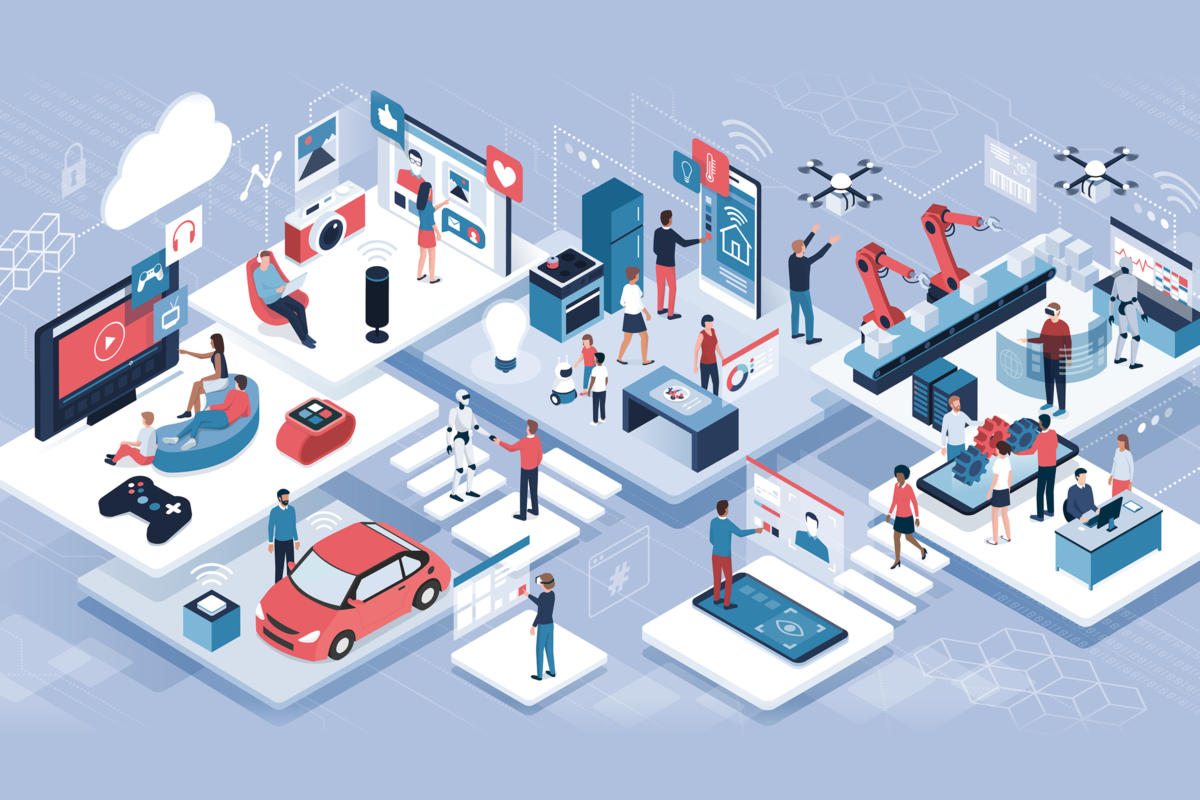
Automated Farming might seem less impactful in your personal world, so let’s think of how things can change in your day. Using our “typical day” story from before, we could think of different ways to improve the use of devices, especially by making them interact with each other (making them “smart’).
What if your morning alarm could automatically turn on the coffee machine for it to be ready once you need to leave? What if your smart fridge could take care of your groceries? It could track every food item, and use an app on your smartphone to automatically order more. If these sound a little useless (or lazy for some people).
What if your wearable devices can sense when you’re in danger, and automatically let someone know?
The possibilities are endless.
As I’m sure you’ve heard, everything connected to the internet can be hacked (yes, everything), and IoT products are no exception to this rule. With everything being connected to the internet, anything could be hacked and messed with. Following the previous example, one cyberattack could ruin an entire crop in a day. One other issue is the amount of data being stored. If every device is constantly storing all the data it’s collecting, there is a possibility of someone reaching all this data and using it for other purposes.
Also, what about your personal privacy? If everything in your house is connected to the internet, everything could be hacked and information about you and your habits come out. With a smart fridge, everything you eat and when you eat will come out. With your smartwatch, every heartbeat and step could be accessible. With almost all devices around you having some kind of sensor (some with cameras), hackers would have access to every aspect of your life.
These issues are very serious, and the truth is there isn’t any real solution yet. Different security methods have been released, and these issues are constantly being thought upon:
To sum things up, revolutionizing the planet with IoT is often thought of as “The 4th Industrial Revolution”, because of how impactful it can be. We should all be aware of the changes happening and the issues they bring, but also appreciate we live in a world where these kinds of changes are possible and are actually happening.
I’m sure lots of people will believe these changes are useless and are meant for “spoiled” people (mostly those with more old-fashioned ideologies), but we must think of all the positive impact it can bring, to the extent of saving lives (and even the planet).
The whole world is captivated by the potential of the Internet of Things (IoT), and rightly so. But most people are not aware of the fact that communication between devices in the form of machine-to-machine (M2M) systems is not a new phenomenon. This technology has existed for more than a century now and is an integral part of our workplace and personal lives.
Evolution of machine-to-machine solutions has been steady and staggering at the same time. Starting with telemetry solutions in mid 1800s, M2M technology has made a massive leap into the IoT solutions of today.
Machine-to-machine, or M2M, is a broad label that can be used to describe any technology that enables networked devices to exchange information and perform actions without the manual assistance of humans. Artificial intelligence (AI) and machine learning (ML) facilitate the communication between systems, allowing them to make their own autonomous choices.
M2M technology was first adopted in manufacturing and industrial settings, where other technologies, such as SCADA and remote monitoring, helped remotely manage and control data from equipment. M2M has since found applications in other sectors, such as healthcare, business and insurance. M2M is also the foundation for the internet of things
The main purpose of machine-to-machine technology is to tap into sensor data and transmit it to a network. Unlike SCADA or other remote monitoring tools, M2M systems often use public networks and access methods -- for example, cellular or Ethernet -- to make it more cost-effective.
The main components of an M2M system include sensors, RFID, a Wi-Fi or cellular communications link, and autonomic computing software programmed to help a network device interpret data and make decisions. These M2M applications translate the data, which can trigger preprogrammed, automated actions.
One of the most well-known types of machine-to-machine communication is telemetry, which has been used since the early part of the last century to transmit operational data. Pioneers in telemetrics first used telephone lines, and later, radio waves, to transmit performance measurements gathered from monitoring instruments in remote locations.
The Internet and improved standards for wireless technology have expanded the role of telemetry from pure science, engineering and manufacturing to everyday use in products such as heating units, electric meters and internet-connected devices, such as appliances.
Beyond being able to remotely monitor equipment and systems, the top benefits of M2M include:
Machine-to-machine communication is often used for remote monitoring. In product restocking, for example, a vending machine can message the distributor's network, or machine, when a particular item is running low to send a refill. An enabler of asset tracking and monitoring, M2M is vital in warehouse management systems (WMS) and supply chain management (SCM).
Utilities companies often rely on M2M devices and applications to not only harvest energy, such as oil and gas, but also to bill customers -- through the use of smart meters -- and to detect worksite factors, such as pressure, temperature and equipment status.
In telemedicine, M2M devices can enable the real time monitoring of patients' vital statistics, dispensing medicine when required or tracking healthcare assets.
The combination of the IoT, AI and ML is transforming and improving mobile payment processes and creating new opportunities for different purchasing behaviors. Digital wallets, such as Google Wallet and Apple Pay, will most likely contribute to the widespread adoption of M2M financial activities.
Smart home systems have also incorporated M2M technology. The use of M2M in this embedded system enables home appliances and other technologies to have real time control of operations as well as the ability to remotely communicate.
M2M is also an important aspect of remote-control software, robotics, traffic control, security, logistics and fleet management and automotive.
Key features of M2M technology include:
According to the European Telecommunications Standards Institute (ETSI), requirements of an M2M system include:
While many use the terms interchangeably, M2M and IoT are not the same. IoT needs M2M, but M2M does not need IoT.
Both terms relate to the communication of connected devices, but M2M systems are often isolated, stand-alone networked equipment. IoT systems take M2M to the next level, bringing together disparate systems into one large, connected ecosystem.
M2M systems use point-to-point communications between machines, sensors and hardware over cellular or wired networks, while IoT systems rely on IP-based networks to send data collected from IoT-connected devices to gateways, the cloud or middleware platforms.
Data collected from M2M devices is used by service management applications, whereas IoT data is often integrated with enterprise systems to improve business performance across multiple groups. Another way to look at it is that M2M affects how businesses operate, while IoT does this and affects end users.
For example, in the product restocking example above, M2M involves the vending machine communicating to the distributor's machines that a refill is needed. Incorporate IoT and an additional layer of analytics is performed; the vending machine can predict when particular products will need refilling based on purchase behaviors, offering users a more personalized experience.
The major concerns surrounding M2M are all related to security. M2M devices are expected to operate without human direction. This increases the potential of security threats, such as hacking, data breaches and unauthorized monitoring. In order to repair itself after malicious attacks or faults, an M2M system must allow remote management, like firmware updates.
The necessity of remote management also becomes a concern when considering the length of time M2M technology spends deployed. The ability to service mobile M2M equipment becomes unrealistic since it is impossible to send personnel to work on them.
The inability to properly service the M2M equipment creates various unique security vulnerabilities for the M2M systems and the wireless networks they use to communicate.





