webserv
1.0.0


Project developed at 1337 Khouribga coding school.
Authors: @JamiaFathiya & @achrafelkhnissi & @abellaismail7
HTTP stands for Hypertext Transfer Protocol, which is a protocol used to transfer hypertext. This raises two questions: what is a protocol, and what is hypertext? In this context, a protocol is a system of rules that enables the communication of information between different entities, such as computers. Hypertext is an outdated term for text displayed on a computer screen containing hyperlinks to other text, i.e., web documents. Therefore, the hypertext transfer protocol refers to the set of rules, servers, and browsers used to transfer web documents back and forth.
HTTP allows sessions, and stored states are shared between the browser and server. If a visitor is browsing a photo gallery, the browser and server can exchange information about the visitor's location in the sequence by passing information back and forth in the form of cookies. When the page is reloaded, the browser sends a cookie to the server indicating the last position visited, enabling the viewer to resume from that point. This means that while HTTP is stateless, it is not sessionless.
| Term | Definition |
|---|---|
| Browser | An application used to access and navigate between HTML documents. |
| User Agent | An application that acts on behalf of the user, typically a browser. |
| TCP | Short for Transmission Control Protocol, one of the main internet protocols used by the World Wide Web, email, FTP, and remote administration. |
| IP | Short for Internet Protocol. IP is used to transfer data between computers over a network. Every device connected to the internet has an IP address. |
| URL | Short for Uniform Resource Locator, an address pointing at a resource on the web. |
| DNS | Short for Domain Name Server. DNS catalogs all domain name URLs and points them to the IP addresses of servers. |
| Resource | The file or files available on a server when following a URL. |
| Server | A computer on the internet running some form of data storage and sharing application, most commonly a web server application. |
| Proxy | Software or hardware service acting as a middle person between clients and servers. |
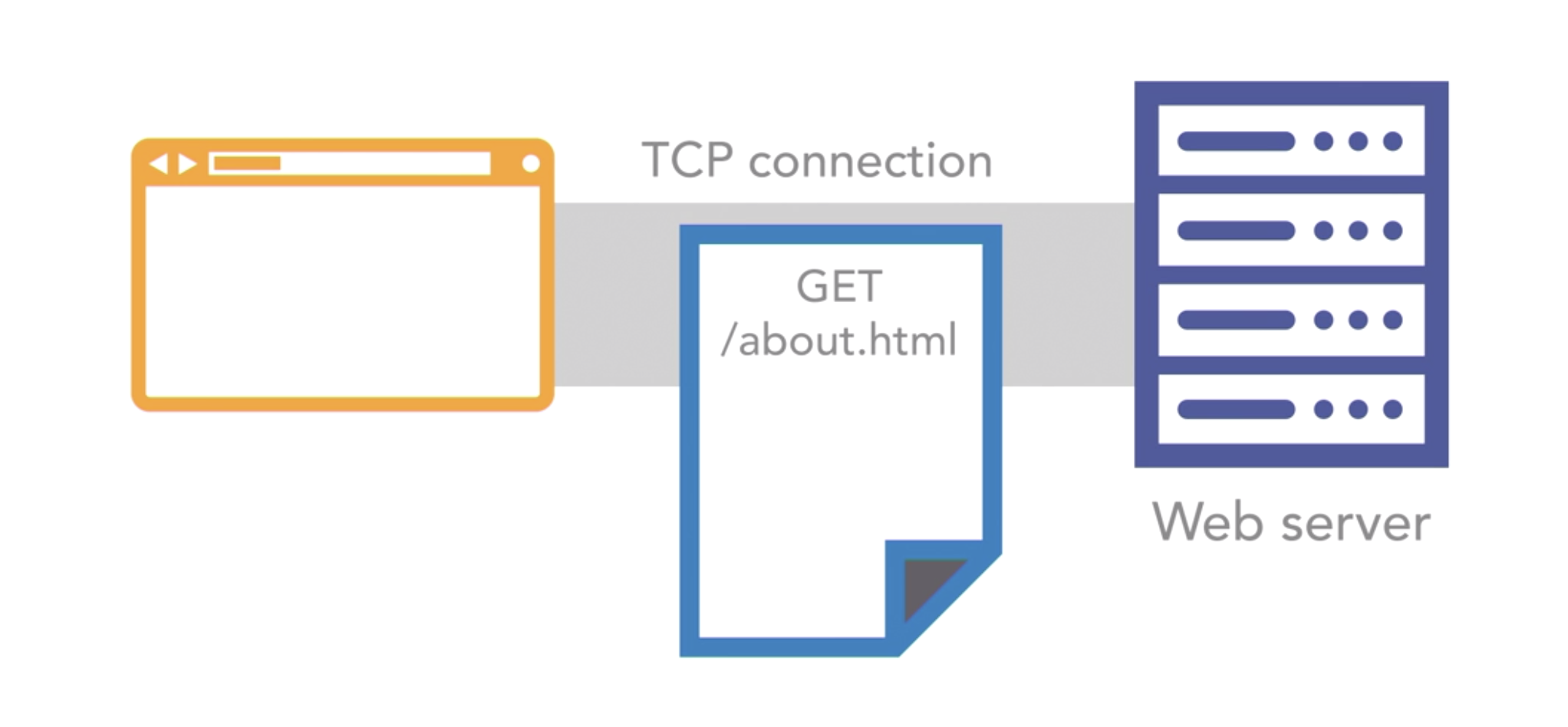
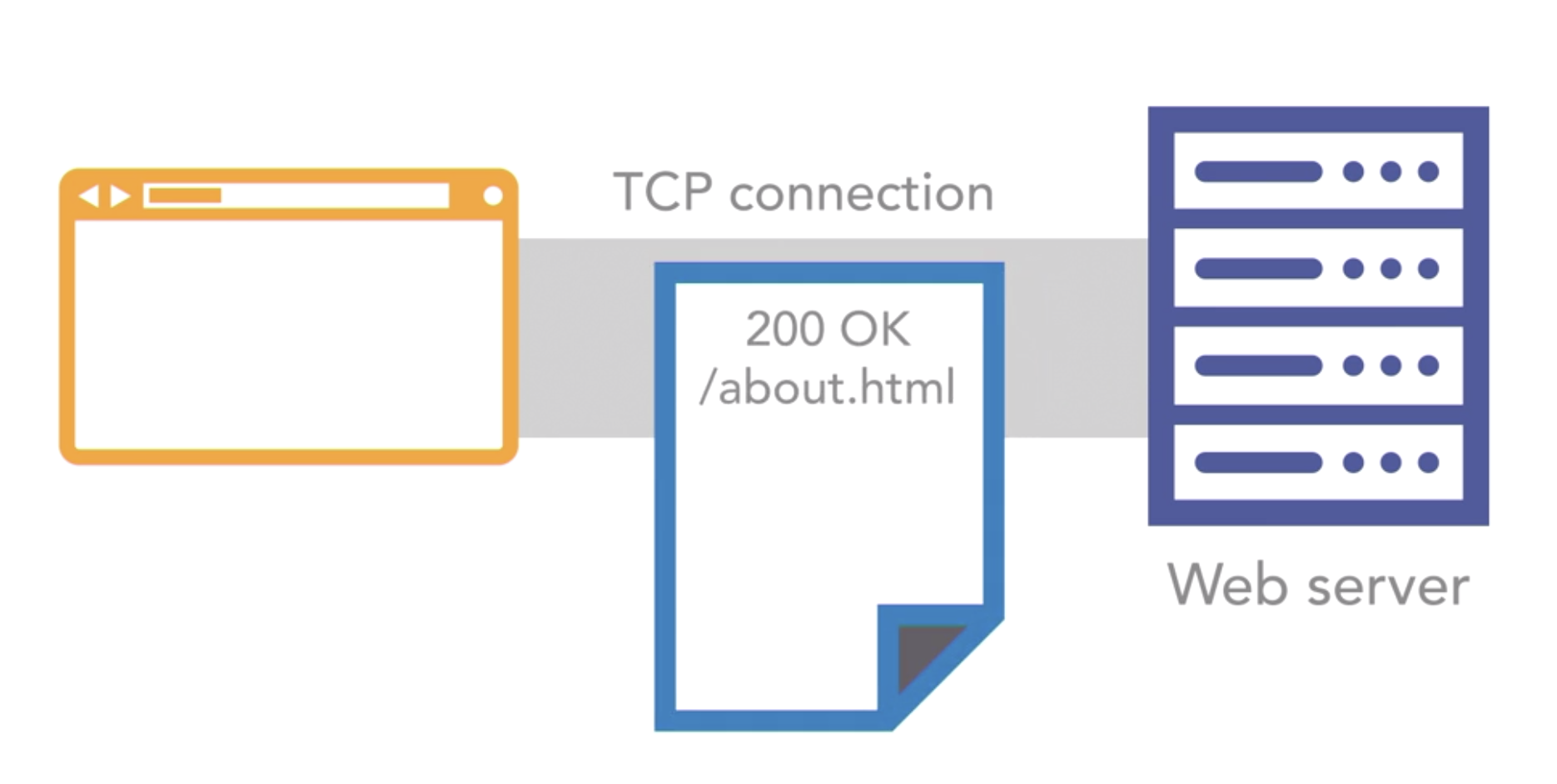
| Request-Response Pairs | Clients and servers communicate over HTTP using request-response pairs. A request is sent, and a response is returned. |
| Header | Requests and responses use HTTP headers to pass information back and forth. |
| HTTP Request Method/Verb | Every HTTP request contains a method, also known as a verb, that explains what action the sender wants to perform on the resource (e.g., GET, PUT, DELETE). |
| Status Response Code | A numerical code in the 100 to 500 range describing what type of response the server sent back to the client. |
| Cache | A method for storing data on the client or the server to speed up performance. |
| Stateless | HTTP is stateless, meaning every request and response is unique, and no state is stored. |
| Cookie | A string of data passed back and forth between the client and server to create a stateful session. |
| Session | Clients and servers can share information about states by passing information back and forth, creating a session. |
| Method | Description | Success | Failure |
|---|---|---|---|
| GET | Get the specified resource, if available | 200 OK | 404 Not Found |
| POST | Create a new resource and add it to a collection | 201 Created | 401 Unauthorized, 409 Conflict, 404 Not Found |
| PUT | Update an existing singleton resource-based or id | 200 OK | 401 Unauthorized, 404 Not Found, 405 Method not Allowed |
| PATCH | Modify an existing singleton resource-based or ID | 200 OK | 401 Unauthorized, 404 Not Found, 405 Method not Allowed |
| DELETE | Delete singleton resource-based or ID (you can’t delete a collection of resources) | 200 OK | 401 Unauthorized, 404 Not Found |
| OPTION | Get the options available from this resource | 200 OK | - |
| HEAD | Get just the response headers from the resource | 200 OK | 404 Not Found |
This section includes the description of the necessary functions to create a web server.
int getaddrinfo(const char *node, const char *service, const struct addrinfo *hints, struct addrinfo **res);node : The hostname or IP address of the server.
node is NULL, the IP address of the local host is used.service : The port number of the server.
service is NULL, the default port number for the service requested in hints is used.hints : A pointer to a struct addrinfo that specifies criteria for selecting the socket address structures returned in the list pointed to by res.
hints is NULL, then the returned list includes socket addresses for all socket types, for all protocol families supported by the address family of the specified node, and for the address of the local host.struct addrinfo are used:
ai_family : The address family. The following constants are defined for the ai_family field:
AF_INET : IPv4 Internet protocolsAF_INET6 : IPv6 Internet protocolsAF_UNIX : Local communicationAF_UNSPEC : Unspecifiedai_socktype : The socket type. The following constants are defined for the ai_socktype field:
SOCK_STREAM : Provides sequenced, reliable, two-way, connection-based byte streams. An out-of-band data transmission mechanism may be supported.SOCK_DGRAM : Supports datagrams (connectionless, unreliable messages of a fixed maximum length).SOCK_RAW : Provides raw network protocol access.SOCK_RDM : Provides a reliable datagram layer that does not guarantee ordering.SOCK_SEQPACKET : Provides a sequenced packet layer that does not guarantee ordering.ai_protocol : The protocol for the socket. The following constants are defined for the ai_protocol field:
IPPROTO_TCP : Transmission Control ProtocolIPPROTO_UDP : User Datagram ProtocolIPPROTO_RAW : Raw protocol interfaceIPPROTO_IP : Internet ProtocolIPPROTO_ICMP : Internet Control Message ProtocolIPPROTO_IGMP : Internet Group Management ProtocolIPPROTO_IPV4 : Internet Protocol version 4IPPROTO_IPV6 : Internet Protocol version 6res : A pointer to a linked list of one or more struct addrinfo structures that contains response information about the host.
Return value : On success, zero is returned. On error, -1 is returned, and errno is set appropriately.
struct addrinfo :
struct addrinfo {
	int ai_flags;               // input flags
	int ai_family;              // socket protocol family
	int ai_socktype;            // socket type
	int ai_protocol;            // protocol for socket
	socklen_t   ai_addrlen;     // socket address length
	struct sockaddr *ai_addr;   // socket address
	char*   ai_canonname;       // service name
	struct addrinfo *ai_next;   // next item in the list
}; int socket(int domain, int type, int protocol);domain : The communication domain, which specifies the communication semantics and the protocol family to be used. The following constants are defined for the domain argument:
AF_INET : IPv4 Internet protocolsAF_INET6 : IPv6 Internet protocolsAF_UNIX : Local communicationAF_UNSPEC : Unspecifiedtype : The communication semantics. The following constants are defined for the type argument:
SOCK_STREAM : Provides sequenced, reliable, two-way, connection-based byte streams. An out-of-band data transmission mechanism may be supported.SOCK_DGRAM : Supports datagrams (connectionless, unreliable messages of a fixed maximum length).SOCK_RAW : Provides raw network protocol access.SOCK_RDM : Provides a reliable datagram layer that does not guarantee ordering.SOCK_SEQPACKET : Provides a sequenced packet layer that does not guarantee ordering.protocol : The protocol to be used with the socket. Normally only a single protocol exists to support a particular socket type within a given protocol family, in which case protocol can be specified as 0. The following constants are defined for the protocol argument:
IPPROTO_TCP : Transmission Control ProtocolIPPROTO_UDP : User Datagram ProtocolIPPROTO_SCTP : Stream Control Transmission ProtocolIPPROTO_TIPC : Transparent Inter-Process CommunicationIPPROTO_RAW : Raw IP packetserrno is set appropriately.int bind(int sockfd, const struct sockaddr *addr, socklen_t addrlen);sockfd : The file descriptor of the socket to be bound.addr : A pointer to a sockaddr structure containing the address to be bound to the socket. The length and format of the address depend on the address family of the socket.addrlen : The size, in bytes, of the address structure pointed to by the addr argument.errno is set appropriately.int listen(int sockfd, int backlog);sockfd : The file descriptor of the socket to be listened.backlog : The maximum length to which the queue of pending connections for sockfd may grow.errno is set appropriately.int accept(int sockfd, struct sockaddr *addr, socklen_t *addrlen);sockfd : The file descriptor of the socket to be accepted.addr : A pointer to a sockaddr structure. This structure is filled in with the address of the peer socket, as known to the communications layer. The exact format of the address returned addr is determined by the socket's address family. When the returned address is too long to fit in the supplied sockaddr structure, the address is truncated.addrlen : A pointer to a socklen_t object which on input specifies the length of the supplied sockaddr structure, and on output specifies the length of the stored address.errno is set appropriately.ssize_t recv(int sockfd, void *buf, size_t len, int flags);sockfd : The file descriptor of the socket to be received.buf : A pointer to a buffer where the message should be stored.len : The length in bytes of the buffer pointed to by the buf argument.flags : Specifies the type of message reception. The value is formed by logically OR'ing zero or more of the following values:
MSG_OOB : Process out-of-band data.MSG_PEEK : Peek at incoming messages.MSG_WAITALL : Wait for a full request, unless the socket is nonblocking.MSG_DONTWAIT : Enables nonblocking operation; if the operation would block, the call fails with the error EAGAIN or EWOULDBLOCK.MSG_NOSIGNAL : Do not generate SIGPIPE when writing to a pipe with no one to read it.recv() returns 0. On error, -1 is returned, and errno is set appropriately.ssize_t send(int sockfd, const void *buf, size_t len, int flags);sockfd : The file descriptor of the socket to be sent.buf : A pointer to a buffer containing the message to be sent.len : The length in bytes of the message pointed to by the buf argument.MSG_OOB : Process out-of-band data.MSG_DONTROUTE : Bypass routing, use direct interface.MSG_DONTWAIT : Enables nonblocking operation; if the operation would block, the call fails with the error EAGAIN or EWOULDBLOCK.MSG_NOSIGNAL : Do not generate SIGPIPE when writing to a pipe with no one to read it.errno is set appropriately.General
HTTP Request
HTTP Response
CGI
Stress testing





