PLOOC
v4.6.4 Minor Improvement

Protected Low-overhead Object-Oriented Programming with ANSI-C, known as PLOOC ['plu:k], is a set of well-polished C macro templates that:
NOTE: This protection can be disabled by defining the macro
__OOC_DEBUG__to facilitate debugging.
_Generic.NOTE: The overhead is nearly ZERO. The template fully utilizes ANSI-C's enforced compilation rules to deliver object-oriented features with minimal necessary cost.
    - Suitable for both bare-metal and RTOS environments.
    - Suitable for both 8-bit and 32-bit MCUs.
The concept of Object-Oriented C (OOC) is not new. There are numerous libraries, SDKs, and templates that extend ANSI-C with object-oriented programming features. Although PLOOC emphasizes its low overhead in both code size and performance, many macro-based OOC solutions also offer low overhead. PLOOC does not force you to use heap or pool memory management, nor does it provide garbage collection (GC) features, leaving these options to the user. This makes it suitable even for 8-bit systems. While some might see this as a drawback, it is a deliberate design choice. I won't argue about this.
So, what really sets PLOOC apart from the others? Is it simply another reinvented wheel?
The answer is NO.
PLOOC introduces a unique feature that most other solutions lack: it ensures that a class's private members are truly private and protected. This means that users outside of the class source code are prevented from accessing these private members. Instead, they see only a solid block of memory, masked as a byte array. Since classes in C are mimicked by structures, PLOOC implements classes using a masked structure. As expected, only the class source code can access the private members, and only the class source code of a derived class can access the protected members of the base class. Public members, however, are accessible to everyone.
How does this work? You might have guessed it from the term "masked structure." Essentially, it's a type-cheating trick in the header files.
This trick works well until it encounters a strict type-checking compiler. The most famous (or notorious) example is IAR, especially when multi-file compilation mode is enabled. No type-cheating trick can survive the rigorous checks of IAR's multi-file compilation mode.
//! The original structure in the class source code
struct byte_queue_t {
    uint8_t   *pchBuffer;
    uint16_t  hwBufferSize;
    uint16_t  hwHead;
    uint16_t  hwTail;
    uint16_t  hwCount;
};

//! The masked structure: the class byte_queue_t in the header file
typedef struct byte_queue_t {
    uint8_t chMask [sizeof(struct {
        uint8_t   *pchBuffer;
        uint16_t  hwBufferSize;
        uint16_t  hwHead;
        uint16_t  hwTail;
        uint16_t  hwCount;
    })];
} byte_queue_t;
To make this work, you must ensure that the class source code does not include its own interface header file. You can even go further if you're serious about the content:
//! The masked structure: the class byte_queue_t in the header file
typedef struct byte_queue_t {
    uint8_t chMask [sizeof(struct {
        uint32_t        : 32;
        uint16_t        : 16;
        uint16_t        : 16;
        uint16_t        : 16;
        uint16_t        : 16;
    })];
} byte_queue_t;
NOTE: The above code snippets are provided to illustrate the underlying scheme but are not practical, as the original structure's alignment is missing when creating the mask array. To solve this, you need to extract the alignment information using the
__alignof__()operator and set the mask array's alignment attribute accordingly using__attribute__((aligned())).
PLOOC provides the "private-protection" feature with a different scheme, rather than relying on type-cheating. This allows it to support almost all C compilers with C99 features enabled. As the author, I must confess that it took considerable time to figure out how to deal with strict type-checking, and the initial scheme was both ugly and counterintuitive. Thanks to the inspiring contributions of Simon Qian, it took another three months to refine PLOOC into something elegant and simple. Henry Long's support was also crucial.
I hope you enjoy this unique approach to the challenges of object-oriented programming in C.
If you have any questions or suggestions, please feel free to let us know.
[08/25/2024] Fix class template, version 4.6.4
Updated Readme
Add __plooc_malloc_align() and __plooc_free
Add private_method(), protected_method() and public_method()
Remove the dependency on the GNU extensions
Other minor changes.
[11/02/2022] Fix class template, version 4.6.3
[12/05/2022] Improve compatibility with the latest C++ language, version 4.6.2
[02/01/2022] Add helper macros for heap, version 4.6.1
__new_class() and __free_class() for using malloc and free together with constructors and destructors, i.e. xxxx_init() and xxxx_depose().[30/12/2021] Improved CMSIS-Pac, version 4.6.0
[29/12/2021] Add CMSIS-Pack, version 4.5.9
[28/11/2020] Minor update, version 4.5.7
[05/08/2020] Add __PLOOC_CLASS_IMPLEMENT__ and __PLOOC_CLASS_INHERIT__ version 4.5.6
[18/05/2020] Introduce both short- and long- style of macro, version 4.5.5
[16/05/2020] Minor Update, version 4.5.4a
[11/05/2020] Minor Update, version 4.5.4
[15/04/2020] Update __PLOOC_EVAL, version 4.5.3
[19/02/2020] Minor update to enable RAM footprint optimisation, version 4.52
[21/01/2020] Misc update for C90, version 4.51
[09/06/2019] Added support for C89/90, version 4.50
[09/05/2019] Added support for C89/90, version 4.40
[08/15/2019] Updated plooc_class_strict.h to use more soften syntax, version 4.31
[08/14/2019] Introduced support for limited support for overload, version 4.30
[07/26/2019] Syntax update, version 4.21
[07/24/2019] Added new ooc class template, version 4.20
[07/12/2019] Minor Update, version 4.13
[05/30/2019] Minor Update, version 4.12
[05/02/2019] Efficiency improve, version 4.11
[05/01/2019] Compatibility Improving, version 4.04
[04/20/2019] Upload PLOOC to github, version 4.03
[04/17/2019] Uploaded PLOOC to github, version 4.01
The PLOOC library was written by GorgonMeducer(王卓然)[email protected] and Simon Qian(钱晓晨)https://github.com/versaloon with support from Henry Long [email protected].
The PLOOC library is released under an open source license Apache 2.0 that allows both commercial and non-commercial use without restrictions. The only requirement is that credits is given in the source code and in the documentation for your product.
The full license text follows:
/*****************************************************************************
 *   Copyright(C)2009-2019 by GorgonMeducer<[email protected]>    *
 *                       and  SimonQian<[email protected]>             *
 *         with support from  HenryLong<[email protected]>                  *
 *                                                                           *
 *  Licensed under the Apache License, Version 2.0 (the "License");          *
 *  you may not use this file except in compliance with the License.         *
 *  You may obtain a copy of the License at                                  *
 *                                                                           *
 *     http://www.apache.org/licenses/LICENSE-2.0                            *
 *                                                                           *
 *  Unless required by applicable law or agreed to in writing, software      *
 *  distributed under the License is distributed on an "AS IS" BASIS,        *
 *  WITHOUT WARRANTIES OR CONDITIONS OF ANY KIND, either express or implied. *
 *  See the License for the specific language governing permissions and      *
 *  limitations under the License.                                           *
 *                                                                           *
 ****************************************************************************/
| module | Contrinutor |
|---|---|
| plooc.h | GorgonMeducer |
| plooc_class.h | GorgonMeducer, Simon Qian |
| plooc_class_strict.h | GorgonMeducer |
| plooc_class_back_box.h | GorgonMeducer |
| plooc_class_simple.h | Simon Qian |
| plooc_class_simple_c90.h | GorgonMeducer |
| module | Contrinutor |
|---|---|
| How to define a class | GorgonMeducer |
| How to access protected members | GorgonMeducer |
| How to implement Polymorphism | GorgonMeducer |
In order to show how PLOOC is easy and simple to use, examples are provided to demonstrate different aspects of the new OOPC method. Currently, the available examples are:
More examples will be added later...
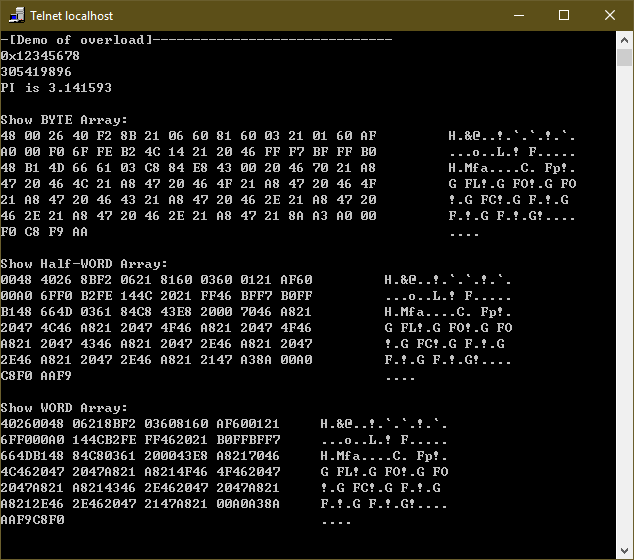
This example shows
How to implement overload using PLOOC
Require C11 support
LOG_OUT("rn-[Demo of overload]------------------------------rn");
LOG_OUT((uint32_t) 0x12345678);
LOG_OUT("rn");
LOG_OUT(0x12345678);
LOG_OUT("rn");
LOG_OUT("PI is ");
LOG_OUT(3.1415926f);
LOG_OUT("rn");

LOG_OUT("rnShow BYTE Array:rn");
LOG_OUT((uint8_t *)main, 100);

LOG_OUT("rnShow Half-WORD Array:rn");
LOG_OUT((uint16_t *)main, 100/sizeof(uint16_t));

LOG_OUT("rnShow WORD Array:rn");
LOG_OUT((uint32_t *)main, 100/sizeof(uint32_t));