FlaxDiff
1.0.0


This project is partially supported by Google TPU Research Cloud. I would like to thank the Google Cloud TPU team for providing me with the resources to train the bigger text-conditional models in multi-host distributed settings.
In recent years, diffusion and score-based multi-step models have revolutionized the generative AI domain. However, the latest research in this field has become highly math-intensive, making it challenging to understand how state-of-the-art diffusion models work and generate such impressive images. Replicating this research in code can be daunting.
FlaxDiff is a library of tools (schedulers, samplers, models, etc.) designed and implemented in an easy-to-understand way. The focus is on understandability and readability over performance. I started this project as a hobby to familiarize myself with Flax and Jax and to learn about diffusion and the latest research in generative AI.
I initially started this project in Keras, being familiar with TensorFlow 2.0, but transitioned to Flax, powered by Jax, for its performance and ease of use. The old notebooks and models, including my first Flax models, are also provided.
The Diffusion_flax_linen.ipynb notebook is my main workspace for experiments. Several checkpoints are uploaded to the pretrained folder along with a copy of the working notebook associated with each checkpoint. You may need to copy the notebook to the working root for it to function properly.
In the example notebooks folder, you will find comprehensive notebooks for various diffusion techniques, written entirely from scratch and are independent of the FlaxDiff library. Each notebook includes detailed explanations of the underlying mathematics and concepts, making them invaluable resources for learning and understanding diffusion models.
Diffusion explained (nbviewer link) (local link)
EDM (Elucidating the Design Space of Diffusion-based Generative Models)
These notebooks aim to provide a very easy to understand and step-by-step guide to the various diffusion models and techniques. They are designed to be beginner-friendly, and thus although they may not adhere to the exact formulations and implementations of the original papers to make them more understandable and generalizable, I have tried my best to keep them as accurate as possible. If you find any mistakes or have any suggestions, please feel free to open an issue or a pull request.
Multi-host Data parallel training script in JAX
TPU utilities for making life easier
I worked as a Machine Learning Researcher at Hyperverge from 2019-2021, focusing on computer vision, specifically facial anti-spoofing and facial detection & recognition. Since switching to my current job in 2021, I haven't engaged in as much R&D work, leading me to start this pet project to revisit and relearn the fundamentals and get familiar with the state-of-the-art. My current role involves primarily Golang system engineering with some applied ML work just sprinkled in. Therefore, the code may reflect my learning journey. Please forgive any mistakes and do open an issue to let me know.
Also, few of the text may be generated with help of github copilot, so please excuse any mistakes in the text.
Implemented in flaxdiff.schedulers:
flaxdiff.schedulers.LinearNoiseSchedule): A beta-parameterized discrete scheduler.flaxdiff.schedulers.CosineNoiseSchedule): A beta-parameterized discrete scheduler.flaxdiff.schedulers.ExpNoiseSchedule): A beta-parameterized discrete scheduler.flaxdiff.schedulers.CosineContinuousNoiseScheduler): A continuous scheduler.flaxdiff.schedulers.CosineGeneralNoiseScheduler): A continuous sigma parameterized cosine scheduler.flaxdiff.schedulers.KarrasVENoiseScheduler): A sigma-parameterized continuous scheduler proposed by Karras et al. 2022, best suited for inference.flaxdiff.schedulers.EDMNoiseScheduler): A sigma-parameterized continuous scheduler based on the Exponential Diffusion Model (EDM), best suited for training with the KarrasKarrasVENoiseScheduler.Implemented in flaxdiff.predictors:
flaxdiff.predictors.EpsilonPredictor): Predicts the noise in the data.flaxdiff.predictors.X0Predictor): Predicts the original data from the noisy data.flaxdiff.predictors.VPredictor): Predicts a linear combination of the data and noise, commonly used in the EDM.flaxdiff.predictors.KarrasEDMPredictor): A generalized predictor for the EDM, integrating various parameterizations.Implemented in flaxdiff.samplers:
flaxdiff.samplers.DDPMSampler): Implements the Denoising Diffusion Probabilistic Model (DDPM) sampling process.flaxdiff.samplers.DDIMSampler): Implements the Denoising Diffusion Implicit Model (DDIM) sampling process.flaxdiff.samplers.EulerSampler): An ODE solver sampler using Euler's method.flaxdiff.samplers.HeunSampler): An ODE solver sampler using Heun's method.flaxdiff.samplers.RK4Sampler): An ODE solver sampler using the Runge-Kutta method.flaxdiff.samplers.MultiStepDPM): Implements a multi-step sampling method inspired by the Multistep DPM solver as presented here: tonyduan/diffusion)Implemented in flaxdiff.trainer:
flaxdiff.trainer.DiffusionTrainer): A class designed to facilitate the training of diffusion models. It manages the training loop, loss calculation, and model updates.Implemented in flaxdiff.models:
flaxdiff.models.simple_unet.SimpleUNet): A sample UNET architecture for diffusion models.flaxdiff.models.simple_unet.Upsample), downsampling (flaxdiff.models.simple_unet.Downsample), Time embeddings (flaxdiff.models.simple_unet.FouriedEmbedding), attention (flaxdiff.models.simple_unet.AttentionBlock), and residual blocks (flaxdiff.models.simple_unet.ResidualBlock).To install FlaxDiff, you need to have Python 3.10 or higher. Install the required dependencies using:
pip install -r requirements.txtThe models were trained and tested with jax==0.4.28 and flax==0.8.4. However, when I updated to the latest jax==0.4.30 and flax==0.8.5, the models stopped training. There seems to have been some major change breaking the training dynamics and therefore I would recommend sticking to the versions mentioned in the requirements.txt
Here is a simplified example to get you started with training a diffusion model using FlaxDiff:
from flaxdiff.schedulers import EDMNoiseScheduler
from flaxdiff.predictors import KarrasPredictionTransform
from flaxdiff.models.simple_unet import SimpleUNet as UNet
from flaxdiff.trainer import DiffusionTrainer
import jax
import optax
from datetime import datetime

BATCH_SIZE = 16
IMAGE_SIZE = 64

# Define noise scheduler
edm_schedule = EDMNoiseScheduler(1, sigma_max=80, rho=7, sigma_data=0.5)

# Define model
unet = UNet(emb_features=256,
            feature_depths=[64, 128, 256, 512],
            attention_configs=[{"heads":4}, {"heads":4}, {"heads":4}, {"heads":4}, {"heads":4}],
            num_res_blocks=2,
            num_middle_res_blocks=1)

# Load dataset
data, datalen = get_dataset("oxford_flowers102", batch_size=BATCH_SIZE, image_scale=IMAGE_SIZE)
batches = datalen // BATCH_SIZE

# Define optimizer
solver = optax.adam(2e-4)

# Create trainer
trainer = DiffusionTrainer(unet, optimizer=solver,
                           noise_schedule=edm_schedule,
                           rngs=jax.random.PRNGKey(4),
                           name="Diffusion_SDE_VE_" + datetime.now().strftime("%Y-%m-%d_%H:%M:%S"),
                           model_output_transform=KarrasPredictionTransform(sigma_data=edm_schedule.sigma_data))

# Train the model
final_state = trainer.fit(data, batches, epochs=2000)Here is a simplified example for generating images using a trained model:
from flaxdiff.samplers import DiffusionSampler

class EulerSampler(DiffusionSampler):
    def take_next_step(self, current_samples, reconstructed_samples, pred_noise, current_step, state, next_step=None):
        current_alpha, current_sigma = self.noise_schedule.get_rates(current_step)
        next_alpha, next_sigma = self.noise_schedule.get_rates(next_step)
        dt = next_sigma - current_sigma
        x_0_coeff = (current_alpha * next_sigma - next_alpha * current_sigma) / dt
        dx = (current_samples - x_0_coeff * reconstructed_samples) / current_sigma
        next_samples = current_samples + dx * dt
        return next_samples, state

# Create sampler
sampler = EulerSampler(trainer.model, trainer.state.ema_params, edm_schedule, model_output_transform=trainer.model_output_transform)

# Generate images
samples = sampler.generate_images(num_images=64, diffusion_steps=100, start_step=1000, end_step=0)
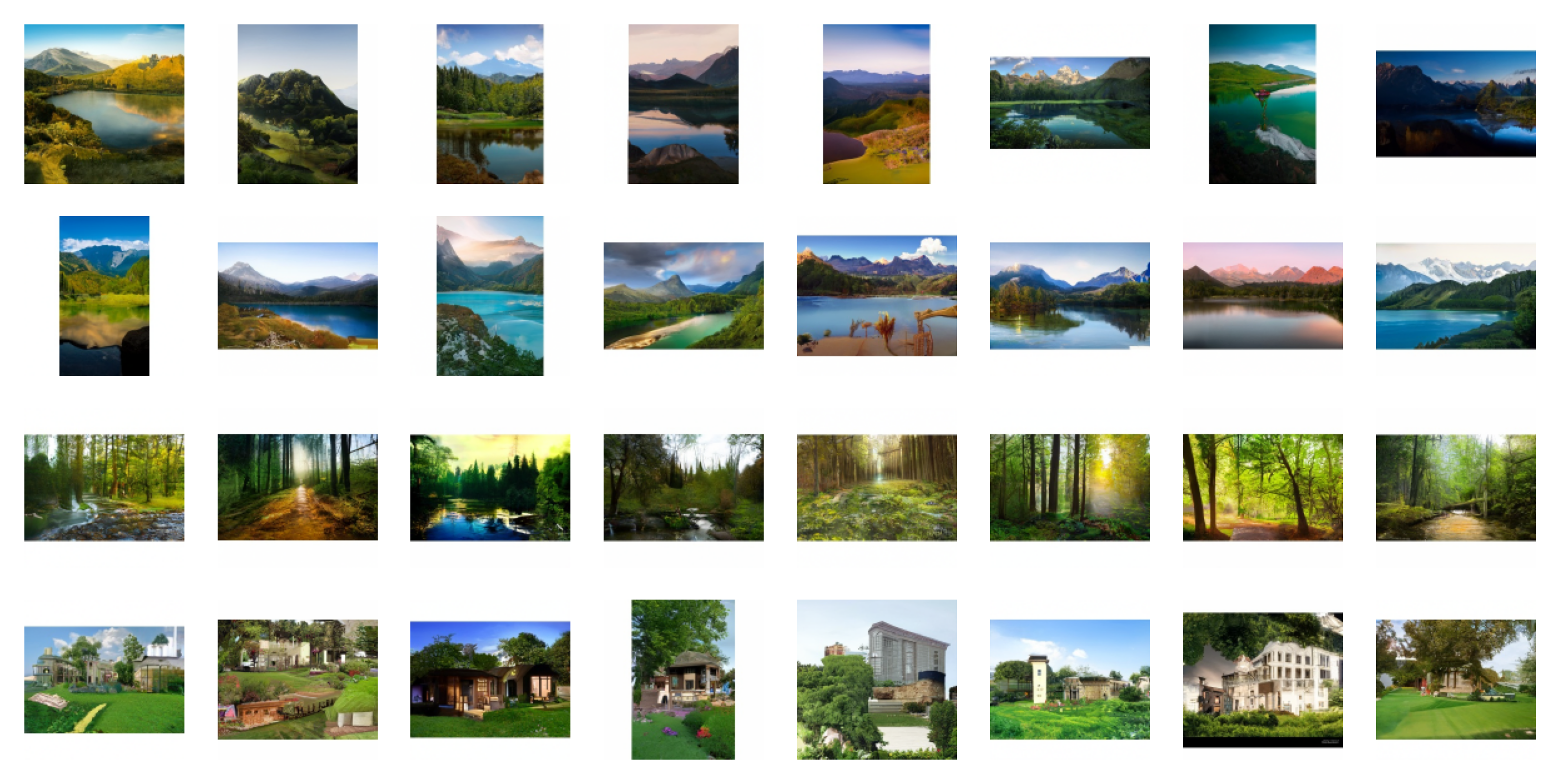
plotImages(samples, dpi=300)Model trained on Laion-Aesthetics 12M + CC12M + MS COCO + 1M aesthetic 6+ subset of COYO-700M on TPU-v4-32:
a beautiful landscape with a river with mountains, a beautiful landscape with a river with mountains, a beautiful landscape with a river with mountains, a beautiful landscape with a river with mountains, a beautiful landscape with a river with mountains, a beautiful landscape with a river with mountains, a beautiful landscape with a river with mountains, a beautiful landscape with a river with mountains, a beautiful landscape with a river with mountains, a beautiful landscape with a river with mountains, a beautiful landscape with a river with mountains, a beautiful landscape with a river with mountains, a beautiful landscape with a river with mountains, a beautiful landscape with a river with mountains, a beautiful landscape with a river with mountains, a beautiful landscape with a river with mountains, a beautiful forest with a river and sunlight, a beautiful forest with a river and sunlight, a beautiful forest with a river and sunlight, a beautiful forest with a river and sunlight, a beautiful forest with a river and sunlight, a beautiful forest with a river and sunlight, a beautiful forest with a river and sunlight, a beautiful forest with a river and sunlight, a big mansion with a garden, a big mansion with a garden, a big mansion with a garden, a big mansion with a garden, a big mansion with a garden, a big mansion with a garden, a big mansion with a garden, a big mansion with a garden
Params:
Dataset: Laion-Aesthetics 12M + CC12M + MS COCO + 1M aesthetic 6+ subset of COYO-700M
Batch size: 256
Image Size: 128
Training Epochs: 5
Steps per epoch: 74573
Model Configurations: feature_depths=[128, 256, 512, 1024]
Training Noise Schedule: EDMNoiseScheduler
Inference Noise Schedule: KarrasEDMPredictor
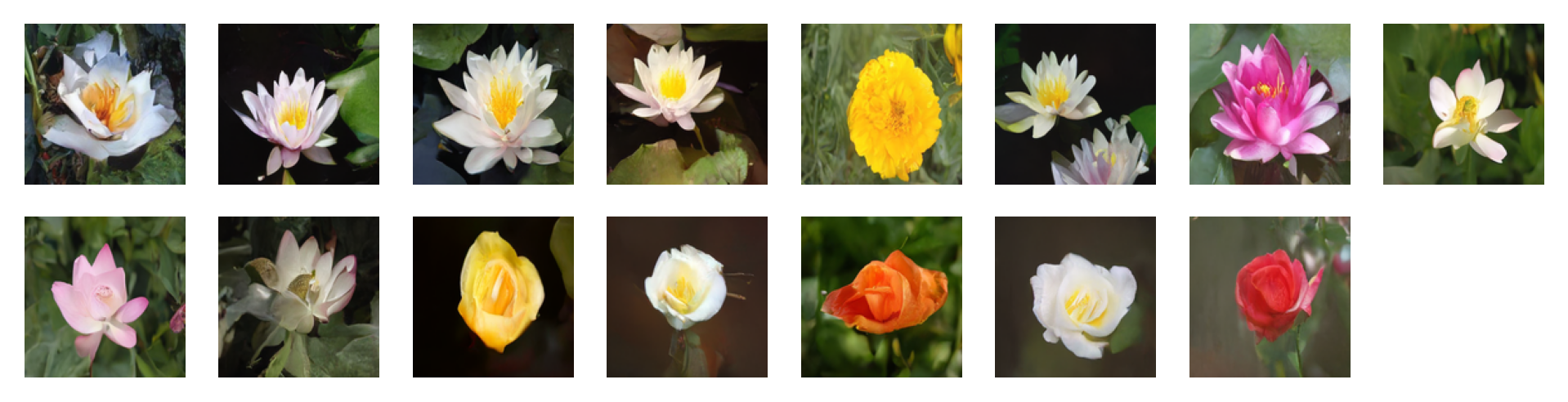
Images generated by the following prompts using classifier free guidance with guidance factor = 2:
'water tulip, a water lily, a water lily, a water lily, a photo of a marigold, a water lily, a water lily, a photo of a lotus, a photo of a lotus, a photo of a lotus, a photo of a rose, a photo of a rose, a photo of a rose, a photo of a rose, a photo of a rose'
Params:
Dataset: oxford_flowers102
Batch size: 16
Image Size: 128
Training Epochs: 1000
Steps per epoch: 511
Training Noise Schedule: EDMNoiseScheduler
Inference Noise Schedule: KarrasEDMPredictor
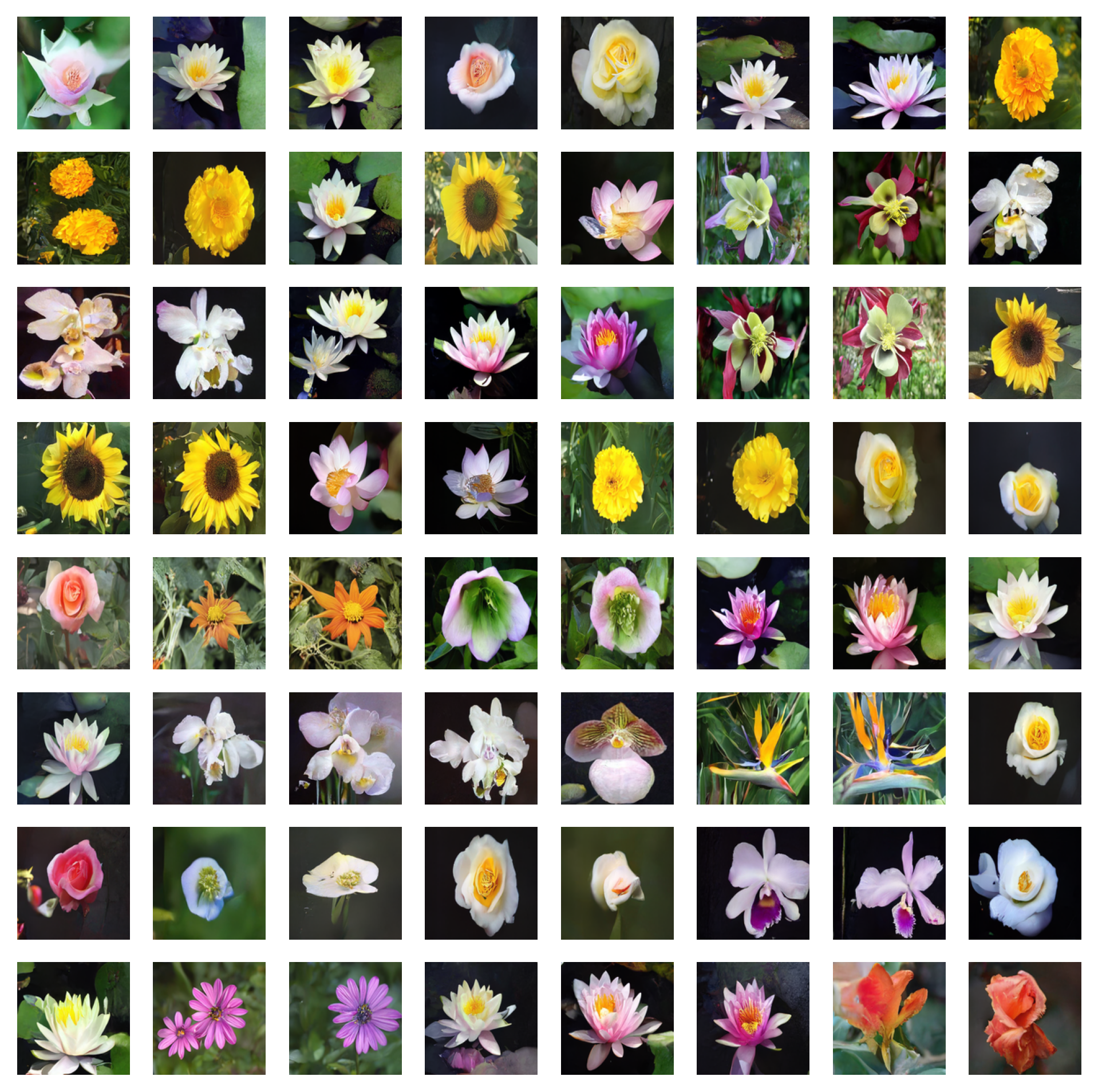
Images generated by the following prompts using classifier free guidance with guidance factor = 4:
'water tulip, a water lily, a water lily, a photo of a rose, a photo of a rose, a water lily, a water lily, a photo of a marigold, a photo of a marigold, a photo of a marigold, a water lily, a photo of a sunflower, a photo of a lotus, columbine, columbine, an orchid, an orchid, an orchid, a water lily, a water lily, a water lily, columbine, columbine, a photo of a sunflower, a photo of a sunflower, a photo of a sunflower, a photo of a lotus, a photo of a lotus, a photo of a marigold, a photo of a marigold, a photo of a rose, a photo of a rose, a photo of a rose, orange dahlia, orange dahlia, a lenten rose, a lenten rose, a water lily, a water lily, a water lily, a water lily, an orchid, an orchid, an orchid, hard-leaved pocket orchid, bird of paradise, bird of paradise, a photo of a lovely rose, a photo of a lovely rose, a photo of a globe-flower, a photo of a globe-flower, a photo of a lovely rose, a photo of a lovely rose, a photo of a ruby-lipped cattleya, a photo of a ruby-lipped cattleya, a photo of a lovely rose, a water lily, a osteospermum, a osteospermum, a water lily, a water lily, a water lily, a red rose, a red rose'
Params:
Dataset: oxford_flowers102
Batch size: 16
Image Size: 128
Training Epochs: 1000
Steps per epoch: 511
Training Noise Schedule: EDMNoiseScheduler
Inference Noise Schedule: KarrasEDMPredictor
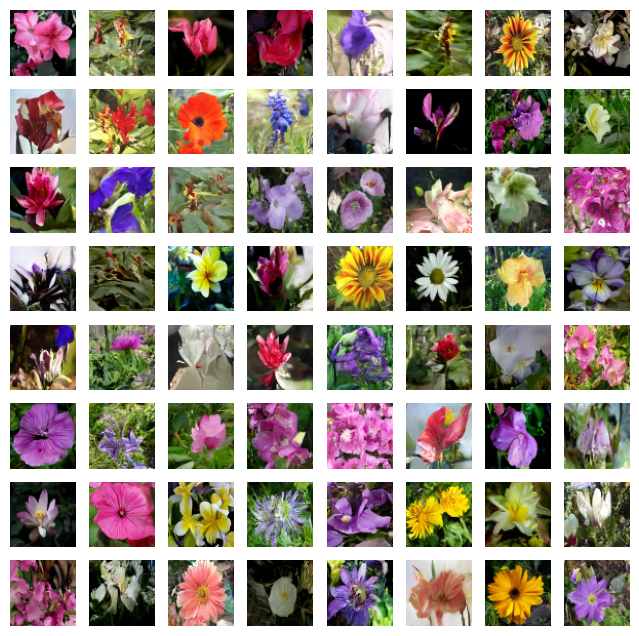
Params:
Dataset: oxford_flowers102
Batch size: 16
Image Size: 64
Training Epochs: 1000
Steps per epoch: 511
Training Noise Schedule: CosineNoiseSchedule
Inference Noise Schedule: CosineNoiseSchedule
Model: UNet(emb_features=256, feature_depths=[64, 128, 256, 512], attention_configs=[{"heads":4}, {"heads":4}, {"heads":4}, {"heads":4}, {"heads":4}], num_res_blocks=2, num_middle_res_blocks=1)
Params:
Dataset: oxford_flowers102
Batch size: 16
Image Size: 64
Training Epochs: 1000
Steps per epoch: 511
Training Noise Schedule: CosineNoiseSchedule
Inference Noise Schedule: CosineNoiseSchedule
Model: UNet(emb_features=256, feature_depths=[64, 128, 256, 512], attention_configs=[{"heads":4}, {"heads":4}, {"heads":4}, {"heads":4}, {"heads":4}], num_res_blocks=2, num_middle_res_blocks=1)
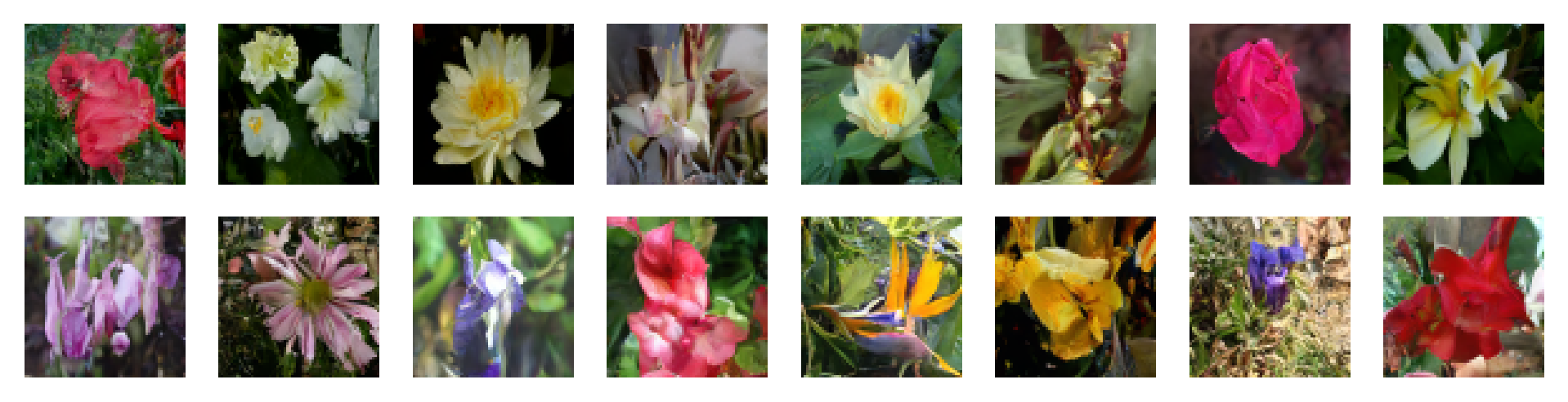
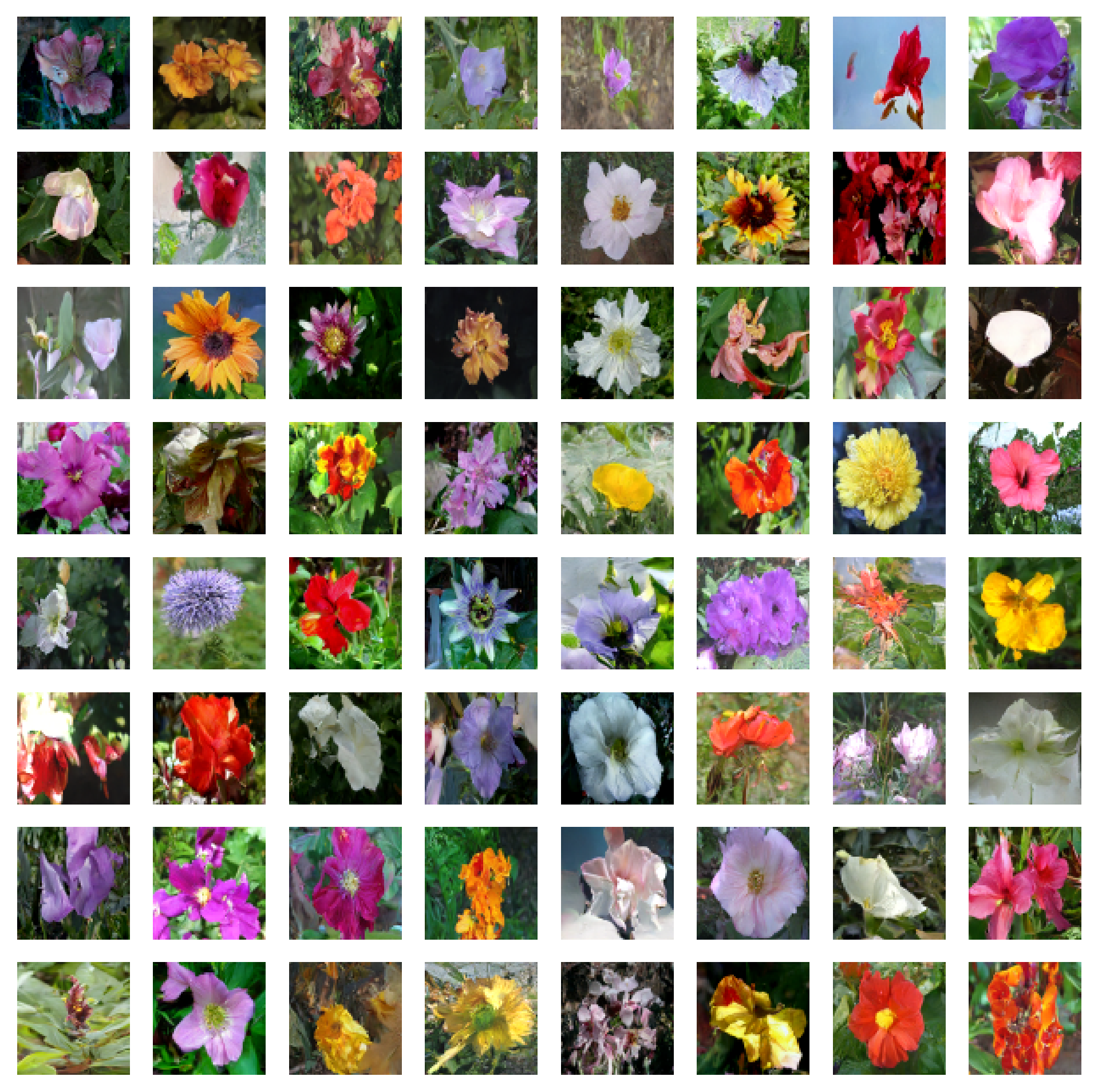
Params:
Dataset: oxford_flowers102
Batch size: 16
Image Size: 64
Training Epochs: 1000
Steps per epoch: 511
Training Noise Schedule: EDMNoiseScheduler
Inference Noise Schedule: KarrasEDMPredictor
Model: UNet(emb_features=256, feature_depths=[64, 128, 256, 512], attention_configs=[{"heads":4}, {"heads":4}, {"heads":4}, {"heads":4}, {"heads":4}], num_res_blocks=2, num_middle_res_blocks=1)
Feel free to contribute by opening issues or submitting pull requests. Let's make FlaxDiff better together!
This project is licensed under the MIT License.





