LightBot
1.0.0

Telegram Bot on the ESP to know if you have light at home. Actual for Ukraine.
So for the last 2 months I didn't have light for 12h almost every day. There supposed to be some schedule, that sometimes worked.
Imagine you don't have light at home and you go out to spend some time until light is goes on. And you don't know when light will go on. You can call your family or neighbor if they are at home, but that is not my case.
Previously a made a Plant Life Project that notificates me with the message "ONLINE" if light at home goes on. But that was not enough for me.
In addition of knowing when light is going on, I want to know:
I came up with idea of making telegram bot or how I called it "Lightbot". The principle of work of this bot is simple.
I made the UPS for router, it will work only if your WI-FI don't turn off immidiately with grid ( it needs a few seconds to send the message to telegram when light goes off)! Let's have a look at the picture below.
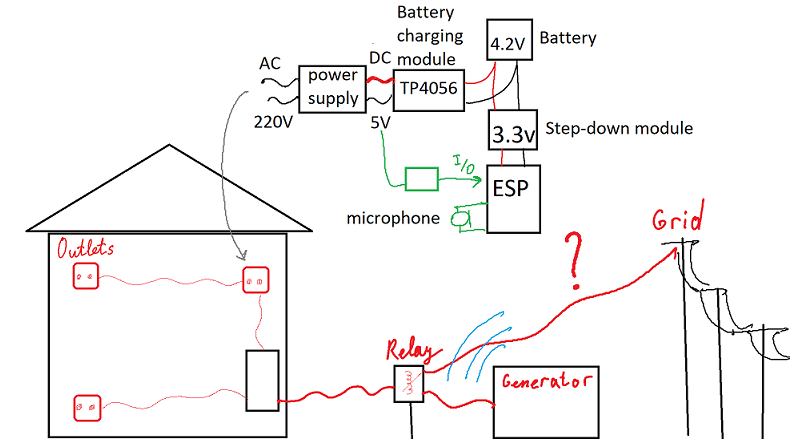
Power supply will charge battety, to power ESP if light goes off. With help of optocoupler I could detect if there is power on power supply.
Also I have the generator, that we manualy are turning on. And I wanted to detect if light is on from the generator or the grid. The idea was to meassure the level of noise with help of microphone. There is no othe way to detect it, because the device will be installed inside the house, and there is no obvious voltage difference beetwen grid power and the generator power.
But lately I abandoned this idea with the detection of the generator. Since we turn it on manually, I just will have to unplug the lightbot.
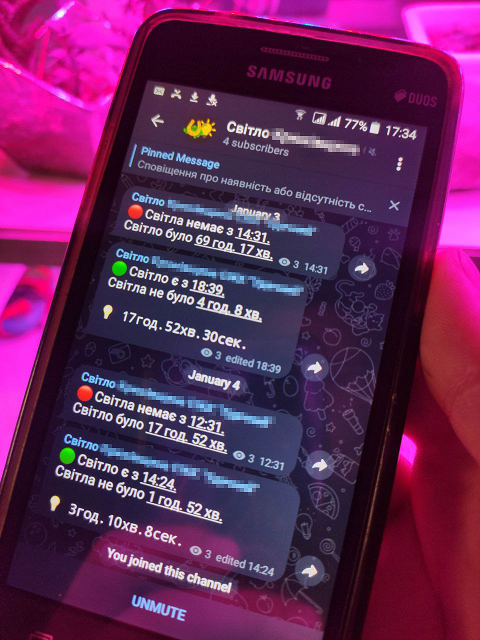
There is a channel that post next messages. If light is ON, it shows:
? There is light from 18:27.
There was no light for 2 h. 12 min.

 17h.57min.49sec.
Third row "" updates every 10 seconds to know for how long do I have light. If light is OFF, it sends message and goes into light sleep mode.
? There is no light from 12:26.
There was light for 17 h. 57 m.
How it looks in the telegram
Yep, there is no sense of using optocoupler, because they have common ground, but I decided to do this universal. You can use instead any npn-transistor, I didn't check how it works, but it should ;D. With light sleep mode it can work for months without charging (which will never happen).
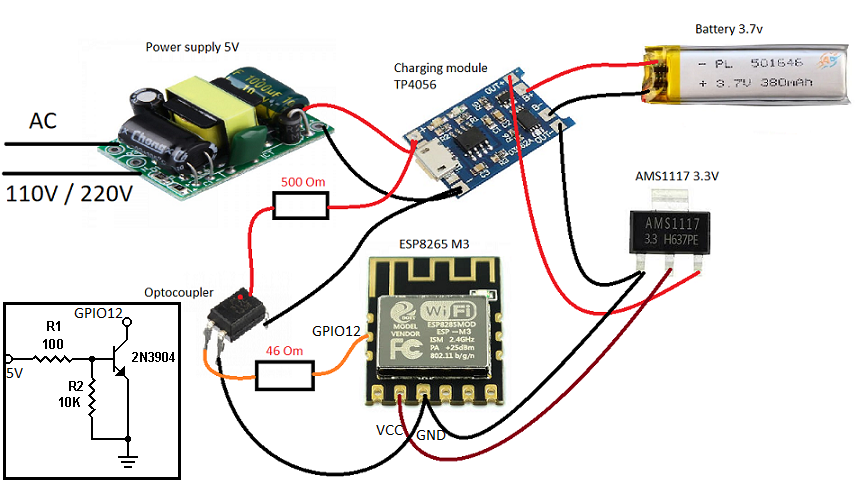
I recommend you to add flash and reset buttons. This will make your life easier.
List of components
| Amount | Name | Description |
|---|---|---|
| 1 | Power Supply 5V | from old phone charger |
| 1 | Battery Charger Module TP4056 | with battery protection circuit if battery without low charge protection |
| 1 | Li-ion Battery 3.7V >200mA | can be used old phone battery |
| 1 | AMS1117-3.3V Voltage Regulator | depends on MC voltage requirements |
| 1 | ESP-8265 M3 | any microcontroller with Wi-Fi module |
| 2 | Tactile Button switch | if needed for easer flash and reset |
| 1 | Optocoupler PC-817 | any optocoupler or bipolar NPN-transistor |
| 1 | Resistor 500 Om | if optocoupler used |
| 1 | Resistor 46 Om | if optocoupler used, to limit current |
| 1 | NPN- transistor | BC337, 2N2222, 2N3904.... if instead of optocoupler |
| 1 | Resistor 10k Om | if instead of optocoupler, from 4k to 10k |
| 1 | Resistor 200 Om | if instead of optocoupler, to limit current |
// Wifi network station credentials
#define WIFI_SSID "SSID"
#define WIFI_PASSWORD "PASS"
// Telegram BOT Token (Get from Botfather)
#define BOT_TOKEN "1234567:Bot_TokeN"
String chat_id="CHANNEL_ID";
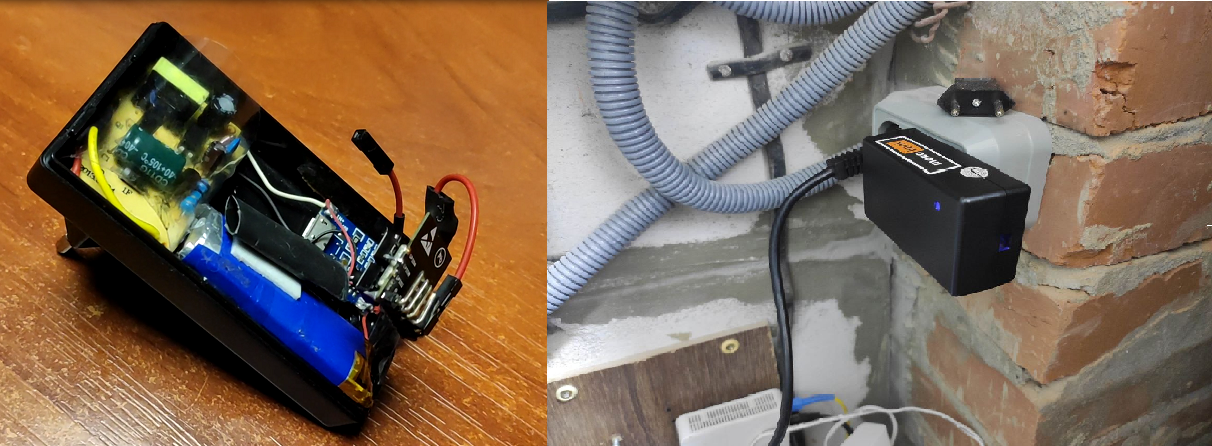
int timezone = 2 ;https://arduino.esp8266.com/stable/package_esp8266com_index.json;I have found an old case from charger, that fitted evrything perfectly inside.